
Releasing suppressed feelings of contempt, disgrace, and anger is highly rewarded by social media algorithms, which assemble a feed that corresponds closely to the user’s past engagements. This reward loop results in reinforcement of existing beliefs and the construction of personalised realities, creating fertile ground for political polarization to take place online. Breaking this loop-created by the echo chamber of social media apps, is the opening move toward making sense of the realities that lie behind these curated feeds, realities that could completely flip our conceptions of what happens in the world of social media.
Within this populist social media ecosystem, memes have emerged as a popular form for the expression of pent-up emotions and stereotypes. Memes, like jokes, are often perceived as harmless, and their function as a propaganda tool and a medium to laugh at stereotypes is usually left out of conventional discussions.
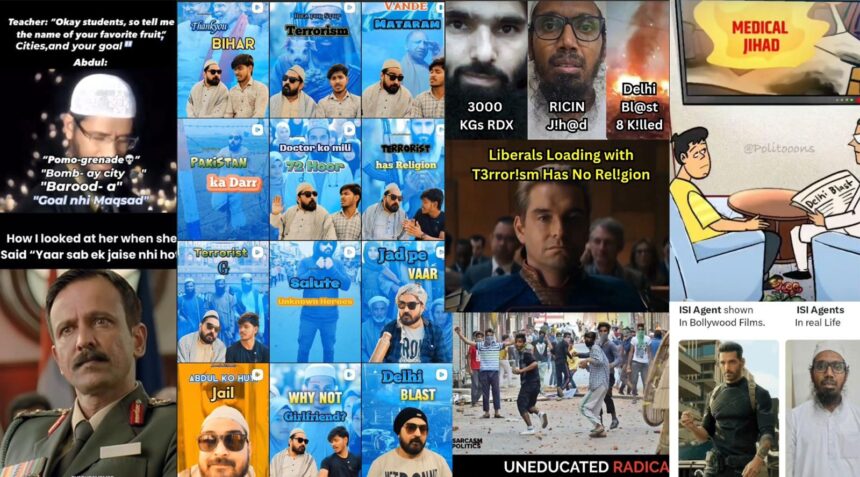
The Diwali and Red Fort blast were some of the occasions that led to the proliferation of hateful and stereotypical, yet funny, memes in the Indian online space. To understand how Islamophobia operates through memes, I had to ‘manipulate’ my Meta algorithm by following, liking, and engaging with right-wing profiles that have been disseminating political and cultural narratives in hateful tones. After a while, the feed began to show content that was diametrically opposite to what was familiar in my timeline. It revealed a vitriolic Meta-world that I had not been exposed to before. During the time of Diwali, the Internet was flooded with memes about crackers and explosions that made the Muslim community the subject of content in a humorous manner. On the other hand, memes and cartoons that came out after the Delhi Red Fort Blast were mostly expressions of anger and contempt.

As the algorithm rewards high-arousal content such as communal issues, the Red Fort blast actually led to the proliferation of such content in high magnitude. Plenty of memes appropriated authoritarian masculine figures like the character played by Kay Kay Menon in Shaurya (2008) and Homelander played by Antony Starr in The Boys, to symbolise a ‘Hindu’s’ anger against ‘traitors’ living in the country.

The target of the memes that proliferated on Instagram after the Red Fort blast largely fell under the platitudes of ‘Educated vs Uneducated Muslims’, ‘Terrorism has religion’, and ‘Muslim Doctors as terrorists’. Paltupatan and politoons, thejaipurdialogues, and total. Wokes are some of the popular right-wing accounts that usually post explicitly hateful content. Another case of Islamophobic memes that appeared in my feed was a set of collaborative reels posted by profiles with usernames Yogesh Thakur and Mannu Kaushik, who have 19k and 50k followers, respectively. Most of the stereotypes that are commonly associated with Indian Muslims, terrorism, madrasa, polygamy, support for external terrorist groups, lack of patriotism, fake voter ID, migrants, incest, etc., were entirely covered using a role-playing approach in a sarcastic tone, in which one person plays the role of a Muslim in a typical attire of white kurta, skull cap, and long beard, while another plays the role of a passive, normal, innocent Hindu Indian. Another account that caught my attention was a profile with the username Manoj Kureel, which posts cartoons covering the entire cosmos of Islamophobic stereotypical narratives. Apart from the Muslim community, liberals, feminists, Bengali migrants, Rahul Gandhi, and Congress are also focal points of such memes. The comment sections of most of these accounts resembled a marketplace of hate-mongering, where users essentialised and reinforced what stereotypical tropes of Islamophobic jokes sought to signify. While the content of the jokes varied, they continued to adopt the same narrative patterns.
By and large, some elements appeared regularly in Islamophobic memes. Among them, ‘Abdul’ and ‘Maqsad’ are an essential part of the Islamophobic lexicon of Indian online spaces. They signify the post-9/11 perception of a ‘Muslim threat’. ‘Abdul’ represents a longstanding field of stereotypes directed against the Muslim community in India through tropes of terrorism, madrasa, polygamy, and population-explosion narratives. Meanwhile, ‘maqsad’ is a term that encapsulates terrorism, explosions, and extreme intentions, attributes purportedly associated with a Muslim in typical attire, often accompanied by suspenseful, intense background music, popularly known as ‘Maqsad BGM’.

From ‘Maqsad’, ‘Abdul’ to ‘Chapri’, the dark-humour lexicon of Indian online culture has ossified many stereotypes into seemingly relatable and funny terms, packaging stereotypes subtly and acceptably, which could have been perceived as incorrect in conventional social and political terms, if they did not carry the tag of a joke. Memes are the very mirror of political conditioning, instrumentalised by various societal forces like majoritarianism, extreme polarization, and communal division that persist in the country. They are being used as tools to reproduce and recreate stereotypes that have floated in the air for a long time.
As Limor Shifman notes in ‘Memes in Digital Culture,’ a remarkable study exploring the broader implications of memes, memes carry significance as tools of political participation. In the Indian online sphere, memes usually operate in two directions: laughing out at stereotypes and laughing stereotypically. People laugh at these jokes while staying ambiguous about the actual workings of the jokes within the larger schema of stereotypicalisation, which mostly transforms into a seemingly harmless form through the essence of the joke, while simultaneously masquerading as hate.
Arshaque Sahl is a postgraduate student of Culture, Society, and Thought, IIT Delhi.
The post Behind the laugh track; Meme factories of Hindutva online appeared first on Maktoob media.