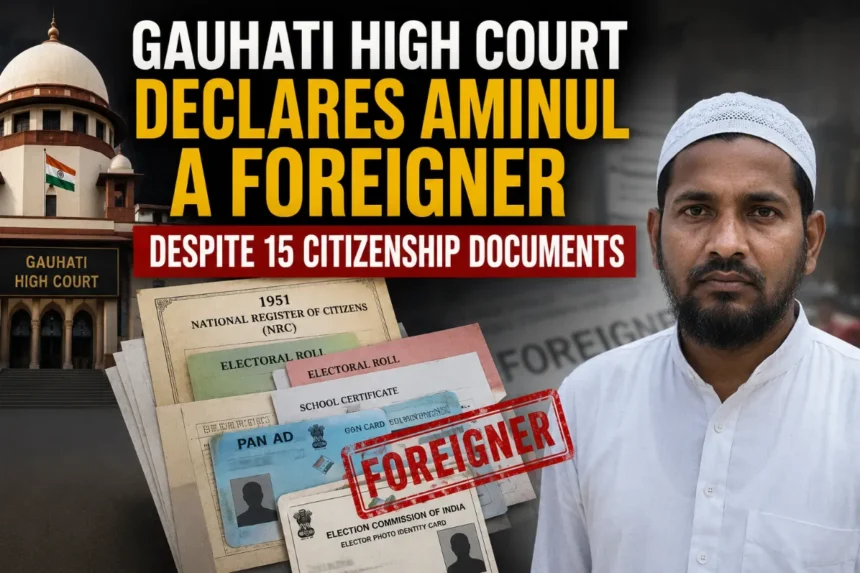

In a recent ruling, the Gauhati High Court declared Aminul a foreigner, underscoring the ongoing challenges faced by individuals in Assam in proving their citizenship. Despite submitting numerous documents to establish his status, the court upheld a Foreigners Tribunal’s order, emphasizing the stringent requirements for citizenship verification that disproportionately affect marginalized communities, particularly within Assam’s Muslim population.
Background on Citizenship Verification in Assam
The citizenship verification process in Assam has been contentious, especially after the National Register of Citizens (NRC) was published in 2019. This register aimed to identify illegal immigrants in the state, a move that has drawn criticism for allegedly targeting specific communities, particularly Muslims. Aminul’s case reflects a broader trend where individuals face formidable hurdles in proving their citizenship, despite having essential documentation. The context is crucial, as Assam has long been a hotspot of ethnic and religious tensions, intensifying the scrutiny of residents’ backgrounds.
Implications of the Court’s Ruling
The ruling by the Gauhati High Court not only affected Aminul but also highlighted the stringent interpretation of citizenship laws under the Foreigners Act of 1946. In Aminul’s case, the court noted that he failed to provide an “unbroken and legally admissible link” to his asserted Indian ancestors, despite the substantial volume of documentation he produced—including electoral rolls and school certificates. The court’s decision reinforces the precedent that the burden of proof lies solely with the individual, raising concerns regarding fairness and equity in citizenship determinations.
The implications of such judgments are far-reaching. They create an environment of fear for many residents who may lack clear documentation, thereby perpetuating a cycle of discrimination and marginalization. Even people who possess official identity documents can find themselves entangled in legal battles that question their very identity and place in society.
Ongoing Challenges for Citizenship in Assam
The ongoing legal battles surrounding citizenship in Assam expose the vulnerability of thousands of residents, many of whom have historically faced social exclusion and economic boycotts due to their identity. Reports indicate that individuals from marginalized backgrounds, including Muslims, encounter significant bias during the judicial process, leading to adverse outcomes even when they have legal documentation. This situation is further compounded by widespread economic disparities and social ostracization that these communities face, contributing to a climate of instability and insecurity.
As other cases emerge, the stark reality becomes apparent—possessing government-issued documents is not a guarantee of citizenship or acceptance. This underscores the need for ongoing advocacy and reform to ensure equitable treatment across communities in Assam.
Why It Matters
The significance of the recent ruling extends beyond legal ramifications; it reflects systemic issues within India’s citizenship framework, particularly for marginalized communities. The judgment creates a precedent that could influence future cases, further entrenching the challenges faced by these groups. Additionally, it raises questions about the effectiveness and fairness of existing legal institutions in resolving citizenship disputes. For policymakers, civil rights advocates, and society at large, these issues demand critical attention to ensure that citizenship laws uphold justice and equality for all residents, regardless of their background.
Frequently Asked Questions
What was the outcome of Aminul’s case?
The Gauhati High Court upheld a Foreigners Tribunal’s order declaring Aminul a foreigner, stating he failed to prove his Indian citizenship despite presenting 15 supporting documents.
What documents did Aminul submit to prove his citizenship?
Aminul presented various documents, including extracts from the 1951 National Register of Citizens, multiple electoral rolls, school certificates, and government-issued identity cards like a PAN card and Elector’s Photo Identity Card (EPIC).
What does the court say about the burden of proof for citizenship?
The court affirmed that under Section 9 of the Foreigners Act, the burden of proving that a person is not a foreigner lies entirely on the individual, not the State.
Why is the citizenship verification process controversial in Assam?
The citizenship verification process has been criticized for targeting specific communities, particularly Muslims, leading to widespread concerns about discrimination, social exclusion, and the marginalization of residents who struggle to prove their citizenship.