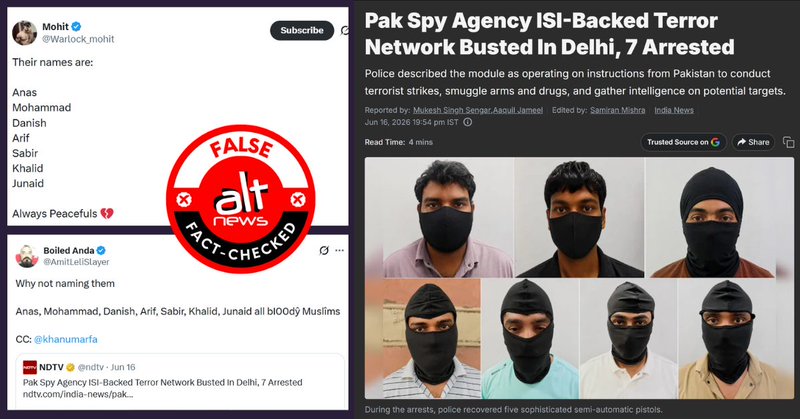

A list circulating on social media claims that all seven individuals arrested in connection to the Delhi ISI spy network case are Muslim. However, this claim has been debunked, revealing that five of the seven accused are actually Hindu. This misinformation highlights the ongoing issues of communal polarization in Indian society.
Context of the Claim
The controversy erupted after a report by NDTV on June 16, which detailed the arrests linked to a network allegedly associated with Pakistan’s Inter-Services Intelligence (ISI). Following this report, a list began to circulate on social media purporting to name the accused, accompanied by the assertion that they were all from the Muslim community. The spread of this list resulted in significant discussions and reactions across various online platforms.
The Reality Behind the Arrests
According to fact-checking sources, the viral list is not accurate. Investigations revealed that while the arrests indeed involved seven individuals, five of these accused are from the Hindu community. The efforts to label all suspects as Muslim not only misrepresent the facts but also contribute to misunderstandings and further communal tensions. Misinformation like this can serve to politicize criminal cases, invariably impacting perceptions and relationships among different religious groups in India.
Impact of Misinformation
This incident reflects a broader trend of using misinformation to fuel communal discord in India. Social media has become a powerful tool for disseminating information rapidly, but it is often used to spread false narratives that can ignite tensions. The portrayal of entire communities based on the actions of a few individuals can deepen societal rifts. Such actions not only affect public opinion but can also influence political narratives, as parties may leverage these sentiments for electoral gain.
Why This Matters
The political landscape in India is often charged with religious and communal undertones, making it essential for citizens to discern fact from fiction. Misinformation, especially concerning sensitive topics such as religion and national security, can exacerbate divisions and hinder social cohesion. For Indian readers, understanding these dynamics is crucial as they participate in a democratic process that is increasingly influenced by the narratives that emerge in the public sphere. Responsible sharing of information is vital to fostering a more tolerant and informed society.
Frequently Asked Questions
What was the original claim about the arrests?
The claim suggested that all seven individuals arrested in the Delhi ISI spy network case were Muslim, which has been shown to be false.
How many of the accused are actually Hindu?
Out of the seven arrested, five individuals are confirmed to be Hindu, contrary to the viral claim.
What was the source of this misinformation?
The misinformation spread rapidly on social media platforms following an NDTV report detailing the arrests, which was misinterpreted and distorted by various users.
Why is this situation politically significant?
This situation underscores the ongoing communal tensions in India and illustrates the role of misinformation in shaping public perception and political narratives around issues of national security and community relations.