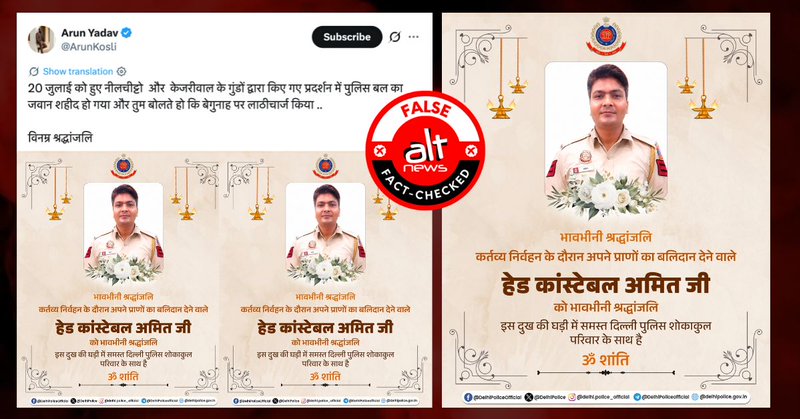

On July 20, a poster claiming that Delhi Police Head Constable Amit died during a protest at Jantar Mantar organized by the Citizens for Justice and Peace (CJP) is making rounds on social media. However, this assertion is incorrect, as Amit lost his life in a road accident on July 15, three days before the protest took place.
Context of the Claim
The social media post purportedly honors Amit, framing his death as a sacrifice while performing his duty. The poster expresses condolences to the family of Head Constable Amit and emphasizes the theme of valor and sacrifice. This narrative, however, is misleading, as it ties his unfortunate death to a public demonstration instead of acknowledging the road accident that preceded it.
The Reality of Amit’s Death
Amit was involved in a tragic road accident on July 15, which was widely reported in various news outlets. The accident was an unfortunate incident that claimed his life on the spot, and the timing has led to confusion about the circumstances surrounding his death. The claims associating him with the July 20 protest seem to have emerged from a misinterpretation or deliberate distortion of the facts.
Impact of Misinformation
Misinformation regarding events like this can lead to public outrage and skew perceptions about ongoing protests or governmental actions. Associating Amit’s death with the CJP protest may unintentionally fuel anti-protest sentiments or provoke distrust against law enforcement. It is essential to scrutinize such claims and strive for accurate reporting to mitigate the spread of false narratives.
Why This Matters
The significance of examining this case lies in the broader context of how narratives are shaped in political discourse in India. In a time marked by heightened tensions concerning protests, law enforcement, and civil rights, clarity in reporting is crucial. Associating unrelated tragic events with social movements can delegitimize the concerns of those involved in the protests and manipulate public opinion for political ends. It emphasizes the importance of responsible media consumption and the need for fact-checking to uphold the integrity of public dialogue.
Frequently Asked Questions
What led to the misinformation about Amit’s death?
The misinformation appears to stem from social media posts that inaccurately link Amit’s death in a road accident to the protest organized by CJP, creating a false narrative of his sacrifice during duty.
How can misinformation impact public perception?
Misinformation can influence public opinion by inciting emotions such as anger or fear, sometimes leading to unjust accusations against specific groups or individuals, thus complicating the discourse surrounding critical issues.
What should readers take away from this incident?
Readers should approach such posts critically and verify facts through reliable sources before accepting narratives that could manipulate emotional responses regarding ongoing political or social issues.
Why is fact-checking important in today’s political climate?
Fact-checking helps maintain the integrity of information circulating in public discourse, which is crucial for informed decision-making in a democratic society. Ensuring that accurate facts are shared protects the rights and interests of all parties involved.