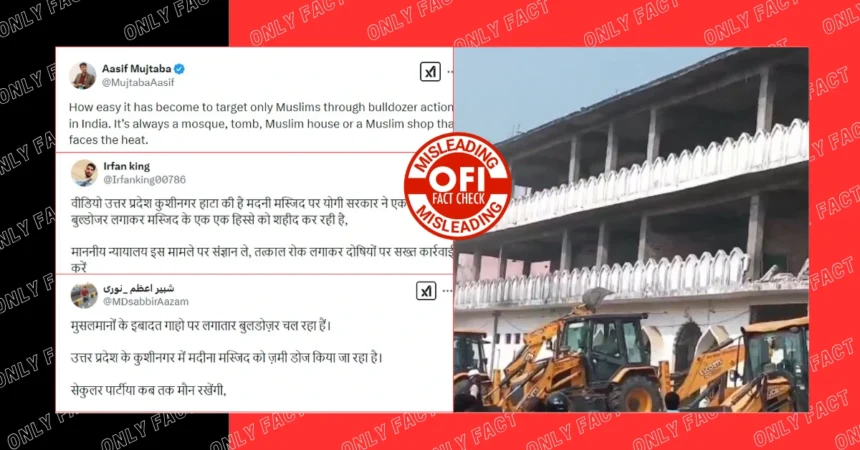

A video showcasing the demolition of a mosque in Kushinagar, India, has gone viral, sparking claims that the government is systematically targeting the Muslim minority for persecution. Commentators on social media allege that the actions of the authorities are indicative of a larger and troubling trend against Muslim religious sites.
Understanding the Claims of Persecution
The viral claims have resonated particularly in the wake of historical events, such as the demolition of the Babri Masjid in Ayodhya. Aasif Mujtaba, a prominent commentator, stated, “How easy it has become to target only Muslims through bulldozer action in India,” pointing to a perceived pattern of demolishing mosques, tombs, and properties associated with Muslims. This reflects a broader sentiment among many Muslim communities who fear targeted actions against their places of worship.
How easy it has become to target only Muslims through bulldozer action in India. It’s always a mosque, tomb, Muslim house or a Muslim shop that faces the heat.pic.twitter.com/CFQ8bdAauS
The Specific Case of the Madani Mosque
On February 9, 2025, the Madani Mosque in Kushinagar was demolished following the expiration of a court stay order. Reports from Dainik Bhaskar and AajTak reveal that the mosque was built illegally on government land. The mosque was constructed 26 years ago, and investigations ensued after complaints regarding the legality of its structure. The authorities had issued multiple notices to the mosque’s committee, but no valid documentation was presented, ultimately leading to its designation as illegal and the subsequent demolition.
The authorities’ actions included deploying significant police presence to ensure order during the demolition, indicating that the operation was part of a systematic approach to enforce regulations regarding illegal constructions, irrespective of religious affiliation.
Has the Demolition of Religious Structures Been Selective?
The narrative that only Muslim structures are being targeted lacks a comprehensive perspective. Numerous reports confirm that illegal Hindu temples also face demolitions under similar circumstances. For instance, in Karnataka, authorities removed illegal Shiva and Ganesha temples from government property. Similarly, various religious structures have been demolished for encroaching on public land across states like Gujarat and Maharashtra. This context challenges the singular narrative that the demolitions are motivated by communal biases.
The Madani Mosque’s demolition is a legal issue tied to its construction on government land. The authorities acted upon a legal framework that applies equally to illegal structures, regardless of their religious significance, thus highlighting the importance of adherence to regulations in urban planning.
Why This Matters
This incident and the claims surrounding it reveal the ongoing tensions in India’s complex socio-political landscape. The perceptions of religious targeting can exacerbate communal divisions, especially considering the historical context of religious conflicts in India. It raises essential questions about governance, legal adherence, and the treatment of minority communities in connection with regulatory frameworks. The implications of this narrative impact not only public sentiment but can also influence political discourse and policy-making strategies moving forward, as communal sensitivities remain a critical factor in Indian politics.
Frequently Asked Questions
What triggered the demolition of the Madani Mosque?
The Madani Mosque was demolished because it was deemed illegally constructed on government land. After multiple notices were issued to the mosque committee without satisfactory responses, the relevant authorities proceeded with the demolition following the expiration of a court stay.
Are only Muslim structures facing demolition in India?
No, illegal structures of all religious affiliations have faced demolition actions. Reports confirm that Hindu temples built on public land have also been targeted under similar circumstances.
What steps did the authorities take before the demolition?
Prior to the demolition, the authorities conducted inquiries, issued three notices to the mosque committee, and granted a temporary High Court stay, which was ultimately lifted.
How has the public reacted to the demolition?
The public reaction has been polarized, with some viewing the actions as part of a systematic targeting of Muslims, while others insist that these demolitions are part of necessary enforcement of land use regulations that apply to all illegally constructed buildings.