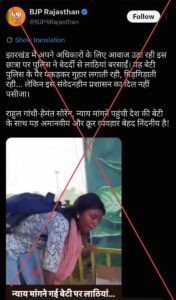
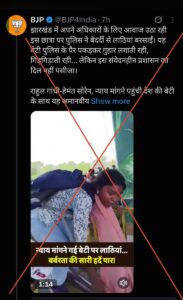
In a recent tweet, the official handle of the Bharatiya Janata Party (BJP) falsely claimed a video showcasing police brutality against students occurred in Jharkhand. In reality, the footage was taken from a protest in Patna, Bihar, on July 22nd. This misrepresentation highlights ongoing tensions in Indian politics regarding student rights and state responses to dissent.
Context of the Incident
The video in question, shared by the BJP on their official handle, depicted a young female student apparently pleading with police during a protest. The BJP framed the event as an instance of extreme government oppression, criticizing local authorities in Jharkhand for their handling of the situation. However, it was later clarified that the footage was actually sourced from a separate demonstration in Patna, Bihar.
The demonstration was sparked by students voicing their concerns over various issues, including educational reforms and job opportunities. Protests in academic institutions have become increasingly common throughout India, revealing a growing discontent among the youth regarding government policies.
The Political Landscape
Accusations of misinformation can destabilize political narratives in India, particularly in an election year. The BJP, which rules both Bihar and Jharkhand, has faced intense scrutiny for its approach to managing protests and dissent, especially among students.
Critics argue that such narratives serve to polarize public opinion and deflect attention from pressing issues facing students. Political commentators emphasize the need for accurate reporting, especially by major political parties, to foster informed public discourse instead of creating division through misleading statements.
Student Protests in India
Student protests in India have a long and tumultuous history, often sparking significant political change. The recent events bring to light wider concerns about free speech, police excesses, and the rights of students to express their grievances without fear of state reprisal. As students continue to mobilize, questions around their rights and the government’s accountability resonate across the political landscape.
In situations like this, where misinformation spreads rapidly, the implications can lead to further tensions between the populace and the authorities, as well as among political factions. As a result, understanding the accuracy of the events surrounding protests becomes crucial for both citizens and policymakers alike.
Why This Matters
The political significance of this incident cannot be understated. It underscores the continuing battle over narratives in the Indian political arena, particularly in context to the youth and their mobilization against systemic issues. As the BJP gears up for future elections, the portrayal of students and their struggles could significantly influence public sentiments.
Moreover, misinformation can exacerbate existing societal divisions and potentially lead to violent confrontations. This incident reflects the larger challenges faced by both the government and opposition parties in managing their narratives while ensuring transparency and accountability in governance.
Frequently Asked Questions
What was the BJP’s claim regarding the video?
The BJP claimed that the video depicted police brutality against a student protesting in Jharkhand, portraying a narrative of government oppression.
Where was the video actually filmed?
The incident captured in the video occurred during a student protest in Patna, Bihar, not in Jharkhand as claimed by the BJP.
What are the implications of misinformation in politics?
Misinformation can lead to public distrust, exacerbate social tensions, and potentially escalate conflicts between political factions and the public.
Why are student protests significant in India?
Student protests often reflect the broader discontent about educational reforms, job opportunities, and governmental accountability, playing a crucial role in shaping political discourse in the country.