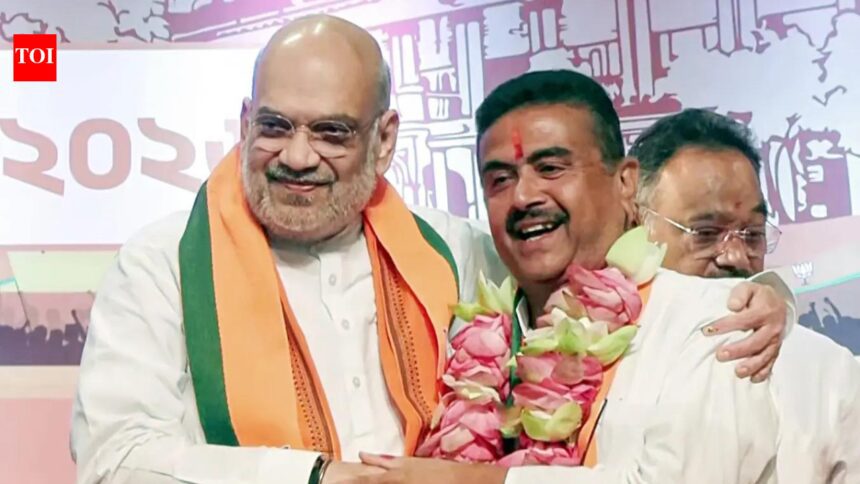

Suvendu Adhikari Emerges as BJP’s Chief Ministerial Candidate in West Bengal
NEW DELHI: Suvendu Adhikari’s ascent as the BJP’s choice for chief minister of West Bengal reflects years of positioning himself as a prominent adversary of Mamata Banerjee, the leader of the Trinamool Congress (TMC). Adhikari’s election campaign, marked by an aggressive Hindutva narrative, culminated in the BJP’s significant victory, winning 207 seats in the 294-member assembly and ending the TMC’s 15-year governance.
Adhikari’s political legitimacy was particularly bolstered by his notable triumph over Banerjee in Bhabanipur, a seat historically viewed as her stronghold. In this closely watched contest, Adhikari secured 73,917 votes, defeating Banerjee’s 58,812 by a margin of 15,105 votes, significantly enhancing his stature within the BJP. His victory in Bhabanipur, given its close ties to Banerjee’s political legacy, positioned him as a formidable challenger to her authority.
Having transitioned from being a close aide to Banerjee to a leading figure in the BJP, Adhikari has established himself as the party’s principal anti-TMC force. Following a previous loss to Adhikari in Nandigram during the 2021 assembly elections, Banerjee won Bhabanipur by a comfortable margin later that year. However, Adhikari’s repeated victories showcased his ability to garner anti-TMC support in previously resistant areas.
Despite several candidates vying for the chief minister position, none matched Adhikari’s electoral influence. He emerged victorious in both Nandigram and Bhabanipur, solidifying his role as the BJP’s most potent adversary against the TMC. Other emerging leaders within the BJP, such as Agnimitra Paul and Dilip Ghosh, also won their respective constituencies but did not exhibit the same grassroots impact as Adhikari.
Having spent over two decades within the TMC, Adhikari’s insider knowledge of the party’s electoral systems and strategies is pivotal for the BJP. His political journey began with the Congress, leading to his eventual role as a TMC MLA and cabinet minister before switching to the BJP in 2020.
Adhikari’s rise has been facilitated by his ability to unify Hindu voters, a strategy that aligns closely with the BJP’s identity in West Bengal. He openly credited Hindu support for his electoral successes, particularly highlighting the disparity in vote distribution between Hindus and Muslims in key regions.
Furthermore, his reputation as a vocal and aggressive leader strengthened his position as the BJP’s chief ministerial candidate. Throughout his campaigns, Adhikari consistently challenged Banerjee and the TMC on various issues, from minority appeasement to law and order. His combative approach gained visibility following the BJP’s assembly victory, which saw the party gain a significant foothold in the region.
As he prepares for this leadership role, Adhikari’s electoral successes and strategic positioning within the party highlight a transformative moment in West Bengal politics, raising expectations for his tenure as the BJP’s representative in the state.