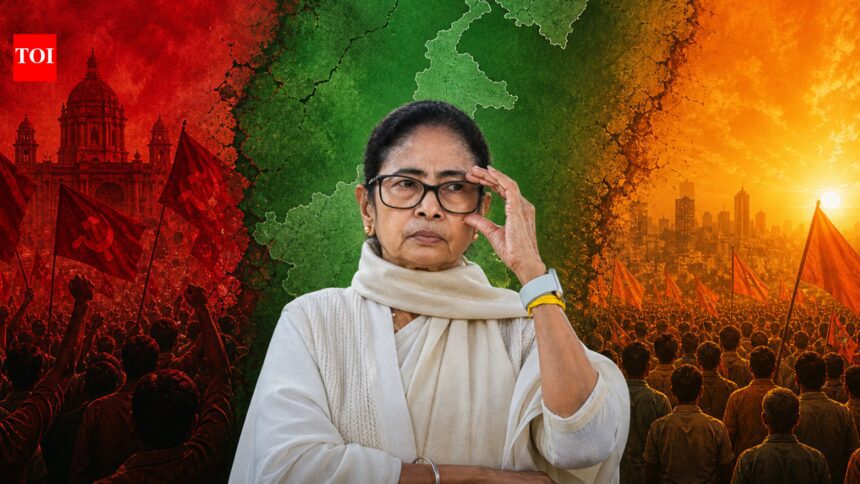

NEW DELHI: The people of Bengal, known as Banglar ‘manush’, have historically exhibited strong political affiliations, often consolidating support behind a single political entity for prolonged periods. Over nearly eighty years since India’s independence, West Bengal’s political landscape has been shaped by distinct eras, each reflecting prevailing ideologies and extended tenures.
As the 2026 assembly elections approach, the stakes are higher than ever. This election is not merely another political contest but a fierce showdown between the long-standing chief minister, Mamata Banerjee, and the rapidly gaining momentum of the Bharatiya Janata Party (BJP). The BJP has intensified its campaign, asserting that “the sun has set for TMC in Bengal,” indicating their ambition to challenge Banerjee’s established dominance.
To appreciate the implications of the BJP’s claim, it is essential to recount the evolution of Bengal’s political narrative.
Congress Era: Foundations of Power and Post-Partition Rebuilding
In the early years post-independence, West Bengal’s political direction was largely dictated by the Congress party. Bidhan Chandra Roy, a significant historical figure, became the state’s first chief minister during a tumultuous period marked by the aftermath of Partition in 1947. His leadership extended beyond typical governance, stabilizing a fractured society and establishing a robust administrative and infrastructural foundation for modern Bengal. Among his notable contributions was the development of Salt Lake City as a beacon of urban planning.
Kolkata, then known as Calcutta, was not only the state capital but also a crucial political center for Congress. It was here that landmark party sessions were held, marking significant milestones in India’s freedom struggle. However, over time, Congress’s hold on power began to weaken due to internal divisions, shifting political aspirations, and national upheavals. The emergence of the Bangla Congress indicated the first serious departure from Congress’s monopoly, leading to the onset of coalition politics.
The deaths of influential leaders such as Jawaharlal Nehru and Lal Bahadur Shastri further undermined the party’s structure, culminating in the 1967 elections, dubbed a “political earthquake” that eroded Congress supremacy in Bengal.
The Red Era: Rise and Consolidation of Left Dominance
While Indira Gandhi solidified her political power nationally after the 1971 electoral victory and the India-Pakistan war, Bengal found itself moving in a contrasting trajectory. The Congressional grip weakened, with Siddhartha Shankar Ray serving as the party’s final chief minister, marking the collapse of an era. The political void was promptly occupied by the Left Front, which assumed power in 1977, bolstered by grassroots mobilization and clear ideological direction.
Central to this shift was Jyoti Basu, a prominent Marxist leader, who became one of India’s longest-serving chief ministers. His leadership led to significant transformations in rural governance and administration. Initiatives like Operation Barga redefined land relations, empowering sharecroppers, while the introduction of the Panchayati Raj system in 1978 decentralized governance, enabling local bodies to gain authority. This period fostered a sustainable political base for the Left.
The Left Front governed Bengal uninterrupted from 1977 to 2011, creating a record tenure for a democratically elected communist government globally. By 2000, Basu stepped down for health reasons, with Buddhadeb Bhattacharjee succeeding him. While Bhattacharjee’s focus was on industrial growth, discontent began to surface, paving the way for Mamata Banerjee’s rise.
The Mamata Moment: Disruption and Dominance
Mamata Banerjee emerged as a formidable political leader, dismantling the Left’s decades-long rule in the 2011 assembly elections. Leading the Trinamool Congress, she captured a sweeping mandate of 184 seats, becoming the first woman chief minister of Bengal. This victory represented not just a governmental change, but a radical political reset, pushing the Congress and the Left to the periphery.
In the following 2016 elections, Banerjee reinforced her power, winning over 200 seats. Her leadership style and welfare initiatives reinforced the Trinamool Congress’s central role in Bengal’s political sphere, isolating competing entities.
BJP’s Surge: From Fringe to Formidable Force
The political landscape began shifting dramatically in the 2021 elections. The BJP launched a significant campaign in Bengal, propelled by high-profile leaders such as Prime Minister Narendra Modi and Union Home Minister Amit Shah. Their aggressive campaign strategies marked a pivotal shift in the state’s electoral dynamics. Despite Banerjee retaining power, the BJP’s performance—winning 77 seats—established it as the principal opposition, eclipsing both Congress and the Left.
This development was not merely numerical but symbolically significant, as the BJP transitioned from a marginal player to the primary contender against Banerjee’s Trinamool Congress.
2026 Showdown: Continuity or Change?
As Bengal records one of its highest voter turnouts and experiences heightened campaigning activity, the significance of the upcoming elections escalates. The question looms: Is the state signaling a shift, as the BJP claims it has? Traditionally, high voter turnout has been interpreted as an anti-incumbent sentiment.
The electoral landscape now projects a bipolar dynamic, with Trinamool Congress and the BJP as the key players, sidelining other political entities. The BJP, seizing momentum from the 2021 elections, has positioned heavyweight candidates in traditionally strong TMC areas, indicating that no ground will be forfeited without a contest.
Recent exit polls suggest an advantage for the BJP over the Trinamool Congress, potentially signaling the first signs of unease for Banerjee. The contest also witnesses significant administrative maneuvers, including a special voter revision process being criticized by Banerjee but defended by the Election Commission, adding an extra layer of political tension.
Thus, the pivotal question remains: Will Bengal uphold its tradition of supporting a singular dominant force, or will it chart a new course this election cycle? The answer lies with the Banglar ‘manush’.