
Summary of the Incident
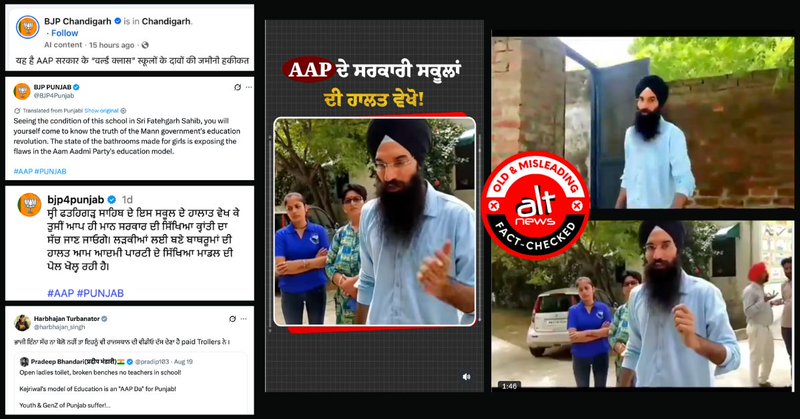
Recently, BJP leaders and the party’s social media accounts shared a video showcasing the deteriorating conditions of schools in Punjab, targeting the Aam Aadmi Party (AAP). However, it has been revealed that the video is actually from eight years ago, during the tenure of the Congress government in Punjab.
Context: The Shared Video
The video in question features a Sikh man discussing the poor state of education facilities in a village in the Fatehgarh Sahib district of Punjab. BJP leaders circulated this video as evidence of AAP’s failures in the education sector. The implication was clear: AAP’s governance has led to such dire conditions, and the video served as a potent image to rally support against the party.
Upon further investigation, it was discovered that the video was not recent but was filmed in 2018, approximately a year before AAP came to power in Punjab. This authenticity check has raised questions about the credibility and motives behind sharing outdated footage to criticize a political opponent.
The Role of Social Media in Political Discourse
Social media has become a double-edged sword in Indian politics. It serves as both a platform for awareness and a weapon for misinformation. The BJP’s use of the old video is indicative of a strategy that leverages emotionally charged visuals and narratives to manipulate public perception.
Furthermore, the propagation of misleading content has gained momentum in Indian politics, contributing to a culture of complex political rivalries where authenticity and accountability often take a backseat. This incident underscores the necessity for critical media literacy among the electorate, as well as the responsibility of political parties to engage in honest campaigning.
Analyzing the Political Landscape
As states approach elections, the competition between parties heats up significantly. Each party employs various strategies, including highlighting the failures of rivals while attempting to strengthen their own positions. The BJP, leveraging its national reach, is attempting to reshape the narrative around AAP’s governance, especially regarding education—a topic of critical concern to many voters.
In Punjab, education is a decisive issue, deeply tied to public sentiment and future prospects for the younger generation. The BJP’s attempt to connect AAP’s education model to a negative narrative can thus have considerable implications on the party’s electoral viability in the state.
Why This Matters
The dissemination of misinformation poses a severe threat to democratic processes in India. When parties resort to sharing outdated or misleading content to criticize their rivals, it undermines public trust in political discourse and potentially misinforms voters.
In the Indian political context, particularly in states like Punjab where AAP currently governs, the stakes are high. Engaging in misleading tactics can sway public opinion, affect electoral outcomes, and eventually shape policy directions. Therefore, understanding and countering misinformation is vital for informed voting and maintaining democratic integrity.
Frequently Asked Questions
What is the origin of the video shared by BJP?
The video was originally recorded in 2018, during the Congress government’s rule in Punjab, depicting issues in the education system.
How has the Aam Aadmi Party responded to this misinformation?
While specific responses from AAP leaders may vary, the general criticism focuses on the misleading nature of the BJP’s claims, urging voters to rely on recent developments under their governance rather than outdated footage.
What impact can misinformation have on voters?
Misinformation can significantly skew public perception, lead to misplaced blame, and ultimately influence electoral outcomes negatively, affecting democratic principles.
Why is it important to fact-check political content?
Fact-checking helps ensure the integrity of political discussions, promotes accountability among parties, and empowers voters to make informed decisions based on accurate information rather than manipulated narratives.