
Summary
The recent arrest of five individuals, including a village head, in Uttar Pradesh’s Bijnor district highlights a disturbing trend of political rivalry being intertwined with communal tensions. This incident, linked to a cow slaughter case, appears to be part of a calculated effort to frame political opponents while exacerbating sectarian divides in the region.
The Arrests and Allegations
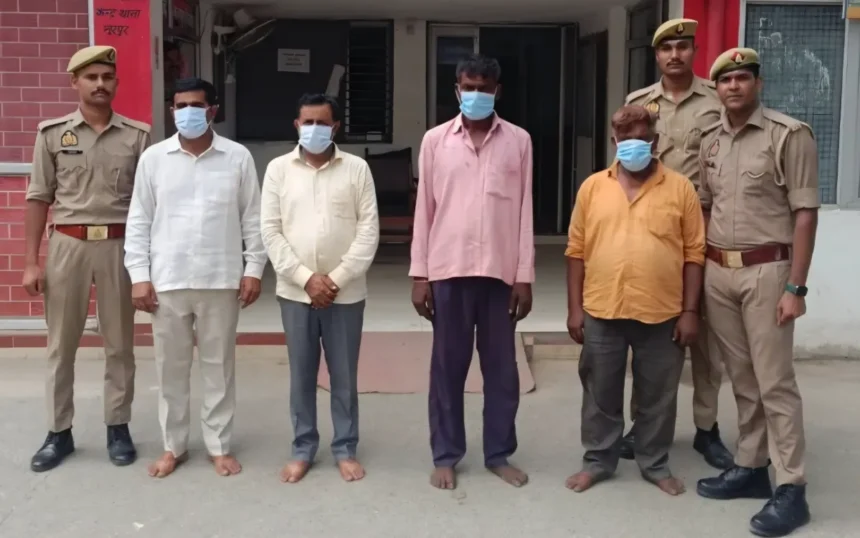
On June 18, the discovery of cattle remains in Changipur village ignited tensions among local Hindu groups, leading to the arrest of five accused by the Noorpur Police. Among those arrested is Gram Pradhan (village head) Jagpal, alongside associates Faizan, Kiran Pal, Ram Avtar, and Brahmpal. Police investigations suggest the cow slaughter was part of a politically motivated conspiracy aimed at tarnishing the reputation of a rival figure, Hasan, known for his history of political contention.
Background of the Case
The incident, which has roots in ongoing political rivalries, saw local Hindu organizations react strongly, prompting a police case and an extensive probe. Rural SP Prakash Kumar indicated that evidence collected reveals the case went beyond a simple act of cow slaughter, implicating local political dynamics. The situation escalated as police carried out multiple raids, successfully apprehending Faizan following an encounter, during which he was injured and hospitalized. However, two other suspects managed to evade capture.
Underlying Political Manipulations
Investigations revealed that Jagpal allegedly orchestrated this incident to undermine Hasan by tarnishing his image and curtailing his political influence. The implication of the Gram Pradhan and his associates indicates a troubling use of communal sentiments as a weapon in political strife. By aligning the act of cow slaughter with a political agenda, the accused aimed not only to harm Hasan’s reputation but also to incite sectarian sentiments among their supporters, further polarizing the community.
Why It Matters
This case underscores a worrying trend within Indian politics where communal sentiments are manipulated as tools to gain political advantage. Such actions undermine social cohesion and contribute to the ongoing marginalization of Muslim communities in India, particularly under the backdrop of policies advanced by the ruling BJP and affiliated organizations like the Sangh Pariwar. By framing political opponents in the context of communal violations, these actions exacerbate tensions and foster an environment of distrust among various communities.
Frequently Asked Questions
What happened in Bijnor district regarding cow slaughter?
Five individuals, including a village head, were arrested for their alleged involvement in a cow slaughter case that was reportedly part of a political conspiracy to harm a rival’s reputation.
Why are cow slaughter cases significant in India?
Cow slaughter is a highly sensitive issue in India, deeply intertwined with communal identities, especially affecting Muslims and often exploited in political narratives to incite communal tension.
What is the political context behind this incident?
The incident reflects ongoing political rivalries within local governance structures, particularly between Hindu and Muslim leaders, amplifying communal divisions for electoral gains.
What are the implications of this case for the Muslim community in India?
This case further marginalizes the Muslim community by illustrating how communal tensions can be manipulated for political ends, potentially leading to increased discrimination and social exclusion.