
When the Gavel Echoes the Saffron Chant
By Editor
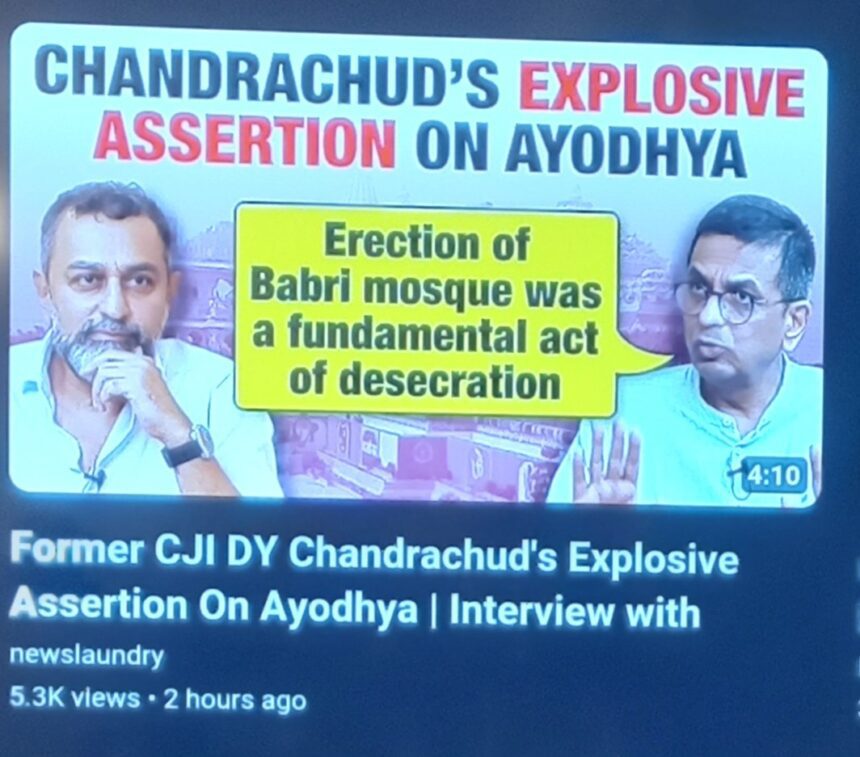
In a recent public address that has sent shockwaves through India’s legal and civil society circles, former Chief Justice of India D.Y. Chandrachud declared that the 16th-century construction of the Babri Masjid was “a fundamental act of desecration.” While framed as historical commentary, this statement is not just misleading—it is a stunning betrayal of judicial integrity, a repudiation of archaeological evidence, and a troubling alignment with the very rhetoric long peddled by Hindutva groups like the Bajrang Dal.
The Myth of “Desecration” — And the Absence of Evidence
Let’s be unequivocally clear: there is no conclusive archaeological evidence that a temple was demolished to build the Babri Masjid.
This is not a partisan claim—it is the official position of the Supreme Court of India itself in its 2019 Ayodhya verdict. The Court explicitly stated:
“The archaeological evidence is inconclusive… It cannot be held with certainty that a temple was demolished to construct the mosque.”
Yet, Justice Chandrachud now asserts—outside the courtroom, without evidence, and without judicial restraint—that the mosque’s very construction was an act of “desecration.” This word is not neutral. It is loaded with religious condemnation, implying moral and spiritual violation. To apply it to a place of worship built over 450 years ago is not history—it is ideological weaponization.
The Archaeological Survey of India (ASI) conducted multiple excavations—in 1970s, 1990s, and 2003—under varying political pressures. Even in its most contested 2003 report, which claimed to find “pillar bases” suggestive of a pre-existing structure, independent archaeologists and historians widely disputed the methodology and conclusions. Scholars like D.N. Jha, Irfan Habib, and Supriya Verma (who observed the 2003 dig as court-appointed monitors) have repeatedly emphasized: no definitive proof exists of a temple’s demolition.
To ignore this scholarly consensus—and worse, to override the Supreme Court’s own acknowledgment of evidentiary uncertainty—is not judicial reflection. It is historical revisionism dressed in judicial robes.
From Guardian of the Constitution to Echo Chamber of Majoritarianism?
Justice Chandrachud has rightly earned praise for landmark rulings on privacy, gender justice, and free speech. But this remark reveals a dangerous veering from the semblance of impartial justice.
By adopting the language of “desecration,” he echoes the exact framing used by the Bajrang Dal, VHP, and other Sangh Parivar outfits for decades to justify the illegal demolition of the Babri Masjid in 1992—an act the Supreme Court itself later called a “serious blow to the secular fabric of the Constitution” and a “crime against the rule of law.”
Now, a former CJI lends credence to the foundational myth of that very crime: that the mosque was inherently illegitimate. This does not just distort history—it retroactively legitimizes mob violence by validating its core grievance.
What message does this send to India’s 200 million Muslims? That their places of worship, built centuries ago under lawful sovereign rule, are perpetual sites of “desecration”? That their historical presence is a wound to be corrected?
This is not justice. This is constitutional erasure.
The Judiciary Must Not Become a Pulpit for Majoritarian Myth
Judges, especially those who have presided over the highest court in the land, wield immense moral authority. When they speak, the nation listens—not as historians or theologians, but as guardians of the rule of law.
To abandon evidentiary rigor, to dismiss archaeological ambiguity, and to adopt the emotive vocabulary of religious nationalism is to surrender the judiciary’s most sacred duty: neutrality.
Justice Chandrachud’s statement is not merely an academic misstep. It is a symbolic rupture—a moment when the gavel begins to echo the saffron chant. In a democracy already straining under the weight of majoritarian triumphalism, such words from a former CJI do not clarify history. They deepen division.
India’s Constitution does not recognize “desecration” as a legal category. It recognizes equality, dignity, and freedom of conscience. To conflate religious belief with historical fact—and to do so in a way that vilifies a minority’s heritage—is to betray the very soul of that Constitution.
A Call for Course Correction
We urge Justice Chandrachud—and all jurists—to remember: the courtroom is not a temple, and justice is not faith. When judges step beyond evidence into the realm of myth, they do not illuminate truth. They cast long shadows over the institutions meant to protect us all.
The Babri Masjid was more than stone and mortar. It was a testament to India’s layered, contested, and coexisting histories. To call its construction an act of desecration is not just wrong—it is unjust. And in a nation that still mourns its loss, such words from a former Chief Justice are not just regrettable. They are unforgivable.