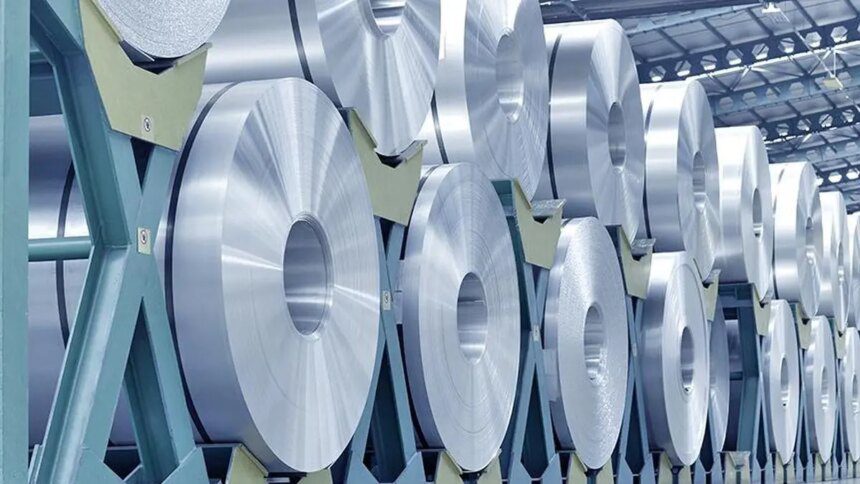

The global aluminium market is undergoing a structural reset.
As global industries pivot toward low-carbon manufacturing, aluminium’s role is expanding from being merely essential to being existential for energy transition, infrastructure resilience and even global competitiveness. Yet, the paradox is hard to ignore: the very material that enables sustainability is also responsible for nearly 2 per cent of global greenhouse gas emissions.
This contradiction sits at the heart of a defining industrial challenge: can aluminium become as green as the future it enables?
The rise of carbon accountability
The global aluminium market is undergoing a structural reset. No longer will a tonne of metal be valued purely by its grade or purity; its carbon intensity is now the real currency. As per Global Trade Research Initiatives, from 2026, the European Union’s Carbon Border Adjustment Mechanism (CBAM) will require importers to disclose verified emissions data or face tariffs that could reach €200–250 per tonne. Similar conversations are emerging in the United States and Asia.
This shift is more than regulatory. It represents a fundamental transformation of trade: carbon data is becoming a passport for market access. Aluminium that cannot prove its footprint will be sidelined, while verified, traceable and low-emission aluminium will earn premium value. For India– the world’s second-largest aluminium producer, with 4.1 million tonnes in 2024 and domestic demand growing at 7–8 per cent CAGR till 2030, this is both a risk and an opportunity. Our challenge lies not in capacity, but in carbon. Nearly three-fourths of Indian smelting still depends on coal-based power, pushing our emission intensity to about 16.5 tonnes of CO₂ per tonne of aluminium, compared to under 4 in countries like Norway or Canada.
It would be simplistic to view this as a compliance problem. The more accurate framing is one of industrial transformation. The ability to produce carbon-transparent aluminium will decide strategic credibility.
The good news is that the building blocks already exist. Major producers like Hindalco and Vedanta are investing in renewable-linked smelters, states like Chhattisgarh and Odisha are enabling open access to clean power and the government is exploring green aluminium standards to align with global expectations. But these isolated advances need to converge into an ecosystem, one where policy, power and production are aligned around carbon intelligence.
To decarbonise meaningfully, the industry must attack its biggest variable: energy. The energy transition in aluminium is a measurable shift. Replacing thermal power with renewables or hydropower can cut smelting emissions by over 60 per cent as mentioned by World Bank. Shared renewable grids, long-term green PPAs and hybrid solar-thermal systems are no longer optional; they are industrial necessities.
Making carbon visible
The next frontier is visibility. Decarbonisation is also about being able to prove it. That requires digital traceability, where every link in the chain from bauxite mining to producing aluminium is recorded, verified and auditable. Emerging technologies such as blockchain-based ledgers, inert-anode electrolysis and carbon capture pilots can enable real-time tracking of Scope 1 and 2 emissions.
Globally, the concept of a digital carbon passport is gaining traction. Such systems track a product’s carbon footprint across its entire lifecycle; a framework India must not only adopt but help define. The nation that builds the world’s most transparent metal will also build the world’s most trusted industrial brand.
Even as we look forward, we must not ignore the tail of the chain. Recycling which currently meets about 60 per cent of India’s aluminium demand is our most immediate opportunity. Producing aluminium from scrap consumes just 5 per cent of the energy used for primary metal. But to unlock its full potential, India needs an organised ecosystem for scrap segregation, recovery and reuse supported by MSMEs, industrial parks and logistics players.
Circularity is a competitiveness lever. Countries that can prove low-carbon intensity through secondary aluminium will face fewer CBAM penalties and attract investors seeking stable, sustainable supply chains.
Accountability and advantage
Carbon transparency ultimately begins with accountability. Encouraging producers to publish Lifecycle Assessments (LCAs) and Environmental Product Declarations (EPDs) under ISO standards will establish a baseline of trust. Third-party verification will then turn data into credibility and credibility into market access.
But the bigger shift is philosophical. This is not just about decarbonising a material; it’s about redesigning industrial behaviour. When an entire ecosystem begins to measure, report, and optimise its carbon footprint, the outcomes extend beyond compliance, they reshape the culture of manufacturing itself.
India’s aluminium sector stands at a threshold moment, one where its actions can redefine its role in global industry. Designing a carbon-transparent supply chain is no longer a sustainability project; it’s an industrial strategy.
The author is CEO & MD of Taural India.
Published on October 25, 2025