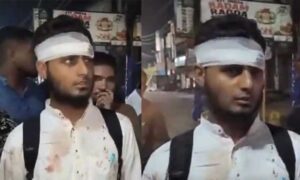
A Muslim student traveling from Meerut to Deoband in Uttar Pradesh was assaulted by a group of men after he refused to drink alcohol. This incident, linked to a growing trend of violence against Muslims, raises concerns about the safety of minority communities in India, particularly in the context of the current political climate under the Sangh and BJP governments.
The Incident on the Train
The victim, identified as Muntasir, was en route to the Darul Uloom Deoband, a well-known Islamic educational institution. While seated, he was approached by a group of intoxicated passengers who urged him to partake in drinking alcohol. After declining multiple times and moving to another seat, Muntasir switched coaches to avoid further confrontation. However, the group followed him, leading to a verbal confrontation that escalated into physical violence.
According to Muntasir’s complaint, he was eventually forced off the train at Khatauli station, where the assailants took his money and mobile phone before fleeing the scene. The act of aggressors targeting a student for his Islamic beliefs reflects a troubling pattern of intolerance that has been observed increasingly across Uttar Pradesh.
Previous Incidents and Rising Concerns
This assault is reminiscent of a fatal incident involving Maulana Tausif Raza Mazhari, a Muslim madrasa teacher who was reportedly accused of theft and pushed from a moving train near Bareilly station in April. The tragic outcome of that case has highlighted the dangers faced by Muslim individuals in public spaces, including trains, which are supposed to be safe modes of transportation.
The consistent targeting of Muslims for religious or cultural reasons raises serious questions regarding safety and security measures in the Indian railway system. Critics have expressed concerns that the railway police and overall administrative response to such incidents is insufficient, thereby endangering the lives of Muslim passengers. The ongoing violence against members of this community is not merely anecdotal but part of a larger trend that has emerged under the rule of the BJP and its affiliates.
Political Context and Implications
The backdrop of these incidents cannot be fully understood without considering the political landscape shaped by the BJP and associated groups. Over the past few years, there has been a marked increase in Hindu nationalist sentiments, which have often translated into societal discrimination against Muslims. This atmosphere of fear and division has resulted in the marginalization of religious minorities, making them vulnerable to attacks and socially exclusionary practices.
Government policies and rhetoric have also contributed to a narrative that often frames Muslims as outsiders or threats, further complicating their standing within Indian society. With the BJP at the helm, the communal tensions have not only persisted but have seen an upsurge, rendering the socio-political environment highly charged and subject to heightened discrimination, particularly in states like Uttar Pradesh.
Why It Matters
This escalation of violence and discrimination has broader implications for societal harmony and the very fabric of India’s pluralistic society. As incidents like the assault on Muntasir serve to underscore vulnerabilities, they highlight the urgent need for protective measures to ensure safety for all religious communities. Furthermore, this pattern raises questions about the role of law enforcement in addressing hate crimes and protecting minority rights.
For developers and policymakers, understanding these societal dynamics is crucial. It not only informs the development of inclusive technologies and policies but also frames the narrative around community support and safety in public domains. The societal pushback against this rising tide of violence necessitates a focus on restorative justice and the restoration of communal harmony through dialogue and education.
Frequently Asked Questions
What happened to Muntasir on the train?
Muntasir was assaulted by a group of men after refusing their attempts to make him drink alcohol. He was subsequently forced off the train at Khatauli station, where he was robbed of his belongings.
What does this incident reflect about the treatment of Muslims in India?
This incident highlights a growing trend of violence and discrimination against Muslims, particularly within public transportation systems in Uttar Pradesh, raising concerns about safety and systemic bias.
How has the political climate contributed to these incidents?
The rising Hindu nationalist sentiments under the BJP government have fostered an environment where attacks against Muslims are more prevalent, thereby increasing societal division and discrimination.
What actions are being taken to improve safety for minorities in India?
While there are ongoing discussions around improving safety measures and protecting minority rights, critics argue that substantial changes are necessary in law enforcement and political accountability to effectively combat these rising threats.