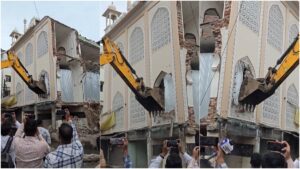
Authorities in Ujjain, Madhya Pradesh, initiated a partial demolition of the nearly 150-year-old Medina Masjid on September 1, as part of a road-widening project. The actions have ignited concerns among local Muslim communities about discrimination and marginalization under the current political climate influenced by the Bharatiya Janata Party (BJP) and its associated organizations.
Context of the Demolition
The demolition of Medina Masjid was part of the KD Gate road-widening project, a venture that municipal authorities claim is necessary for urban development. Additional Municipal Commissioner (Simhastha) Santosh Tagore clarified that the mosque’s structure was located within a designated area for road expansion, claiming the actions were undertaken after mutual coordination. However, this narrative has been widely contested by community voices.
Local reports indicate that another mosque, the Jamiatul Quraish Qassaban Masjid located on KD Road, also experienced partial demolition during the operation. While municipal authorities proceeded with the work, a significant backlash from the Muslim community led to protests, resulting in clashes with police forces. The presence of security personnel highlights the contentious nature of these demolitions and their broader implications for communal harmony in Ujjain.
Community Response and Impact
The demolition raises questions about the treatment of religious minorities in India, particularly in areas governed by the BJP, known for its Hindu nationalist agenda. Members of the Medina Masjid committee, including Shahid Khan, expressed their frustration over the lack of consultation before demolition. The site, described as a historical and cultural landmark, has been a part of the community for at least 100 to 150 years. Community members had previously surrendered parts of their shops to facilitate urban development, demonstrating their willingness to cooperate with municipal efforts.
Ujjain Shahar Qazi Khaliq-ur-Rahman stated that the community aims to bring the matter to the attention of local authorities in an upcoming meeting. The demolitions coincide with preparations for Ujjain’s Simhastha Mela in 2028, raising concerns that such actions may be part of a larger pattern of marginalization aimed at Muslim communities in the region. The political context—and expectation of future events—sheds light on how such developments contribute to an atmosphere of social exclusion.
Political Ramifications
The actions of the Ujjain municipal corporation resonate with a broader narrative regarding the treatment of Muslim populations under the BJP’s governance. Observers have noted an uptick in controversies surrounding religious structures, often perceived as targeting minorities. The approach to urban development that prioritizes road widening at the expense of historical and communal sites points to systemic discrimination.
This has also ignited discussions related to the implications of evolving socio-political climates in India. Opposition parties and civil society groups argue that these incidents reflect an alarming trend where governmental policies disproportionately impact marginalized communities, further entrenching divisions within society. The Ujjain mosque demolitions could act as a catalyst for reflection and mobilization among affected communities as they confront systemic exclusion motivated by political ideologies.
Why It Matters
The demolition of places of worship and communal centers resonates beyond local incidents, highlighting societal fractures exacerbated by political narratives. For urban development planners and policymakers, this situation underscores the need for inclusive planning that considers the historical and cultural significance of religious sites. Additionally, the international community must recognize the implications of such actions on human rights and social justice, urging a dialogue that prioritizes equitable governance for all citizenry regardless of religious affiliation.
Frequently Asked Questions
What is the reason for the demolition of Medina Masjid?
The demolition was part of a road-widening project associated with the KD Gate area and was claimed to be necessary for urban development, according to municipal authorities.
What has been the reaction from the local Muslim community?
The local Muslim community protested the demolition, expressing concerns that it represents systemic discrimination and marginalization under the BJP-led government.
How old is Medina Masjid?
Medina Masjid is reported to be nearly 150 years old, making it a significant cultural and historical landmark in the community.
What subsequent actions are being planned by community leaders?
Ujjain Shahar Qazi Khaliq-ur-Rahman mentioned that the matter will be discussed in an upcoming meeting with local authorities to address community concerns appropriately.