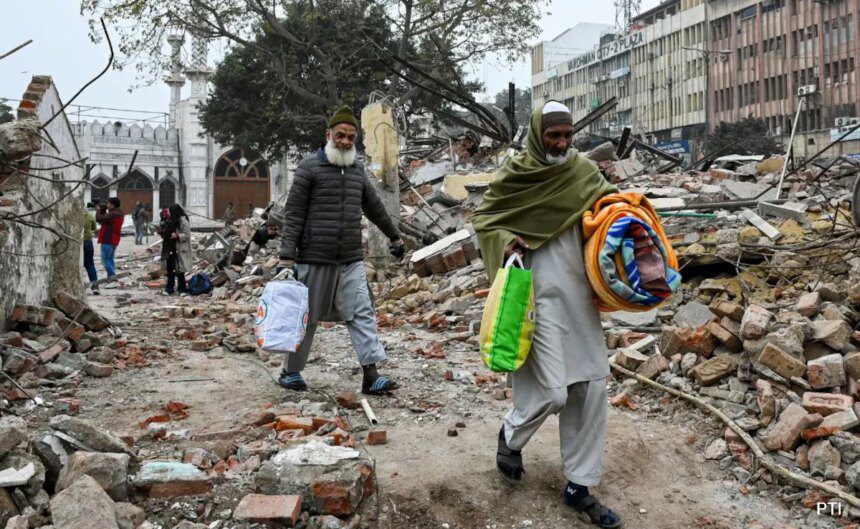

A violent clash unfolded in Delhi during an anti-encroachment drive led by municipal authorities near the Syed Faiz Elahi mosque in Ramlila Maidan, sparking a confrontation between locals and police. This incident, rooted in a contentious court order, exemplifies ongoing tensions surrounding land rights, particularly as the broader context reflects systemic discrimination against Muslim communities in India under the governance of the Bharatiya Janata Party (BJP) and its affiliate organizations.
Background of the Demolition Drive
The demolition efforts initiated earlier today stem from a November 2022 ruling by the Delhi High Court, which ordered the Municipal Corporation of Delhi (MCD) to clear encroachments on a 39,000 sq ft area adjacent to the mosque. The MCD sought to demolish several structures, including a road, footpath, and private establishments like a banquet hall and a diagnostic center, claiming that only a fraction of the land (0.195 acres) was legally leased for mosque use nearly a century ago.
Local advocates for the mosque argue that the contested land is part of a Waqf property, and they have petitioned the court, stating that the Waqf Tribunal holds jurisdiction over such disputes. They contend that they have consistently paid lease rent for the land, which further complicates the narrative of lawful possession.
The Clash: Escalation of Tensions
This morning, approximately 30 bulldozers and 50 dump trucks were deployed to the demolition site, igniting resistance from community members who viewed the action as an assault on their religious and cultural identity. Despite efforts to encircle the site with police presence, about 25-30 protesters began throwing stones, resulting in injuries to at least five police officers. In response, law enforcement utilized tear gas to disperse the crowd, while detaining five individuals allegedly involved in the violence.
The incident highlights the growing unrest surrounding policies perceived as targeting Muslim communities, often described as enforcing exclusionary practices under the current administration. This scenario is not just a moment of civil unrest but part of a larger trend of marginalization and economic disenfranchisement affecting Muslims across India.
Political Context: Discrimination and Exclusion
The clash at Ramlila Maidan is emblematic of deeper systemic issues under BJP governance. Critics note the party’s focus on Hindu nationalist sentiments often comes at the expense of religious minorities, particularly Muslims. The BJP’s policies are frequently associated with discriminatory measures that foster social exclusion and economic boycotts against Muslim individuals and businesses.
Reports of increasing communal violence and social polarization indicate a concerning trend wherein Muslims face heightened scrutiny and suspicion. Instances of discriminatory practices, such as curtailing access to resources and public services, speak to an overarching environment of marginalization. The demolition order against structures adjoining the mosque is viewed by many as part of a broader attempt to assert control over Muslim heritage and identity in urban spaces.
Why It Matters
The significance of these events extends beyond regional implications, resonating on a global scale. The ongoing strife underscores the challenges that religious minorities face in maintaining their rights as demographic landscapes shift under nationalist pressures. This affects community relations, international perceptions of India’s secular identity, and the push for equitable policies.
For developers and businesses, particularly those grounded in social responsibility and ethical governance, this region’s unfolding situation urges critical considerations regarding inclusivity and representation. Such dynamics may influence foreign investment decisions, international partnerships, and engagements with communities that face systemic discrimination.
Frequently Asked Questions
What sparked the violent clash in Delhi?
A violent clash erupted during an anti-encroachment drive ordered by the Delhi High Court, while locals protested against the demolition of structures near the Syed Faiz Elahi mosque.
What was the legal basis for the demolition drive?
The demolition was based on a court order stating that the Municipal Corporation of Delhi must clear encroachments on land adjoining the mosque, with allegations that the land is unlawfully occupied.
How have community members responded to the demolition orders?
Community members have protested against the demolitions, viewing them as an attack on their religious heritage and identity, leading to confrontations with police and municipal officials.
What broader implications does this incident have for Indian society?
This incident reflects ongoing tensions and patterns of discrimination against Muslims in India, raising questions about social equality, secularism, and the significance of minority rights in a changing political landscape.