
Palestine Calls for Action Against Territorial Fragmentation
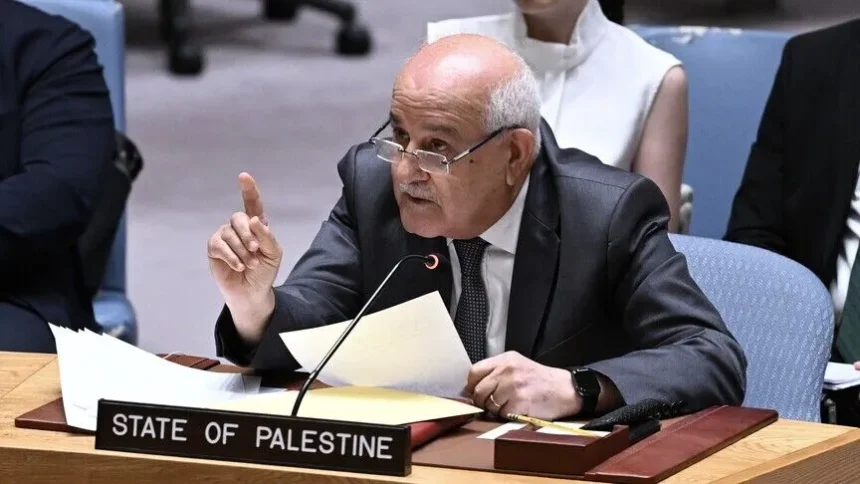
In a recent briefing at the United Nations Security Council, Palestine urged the international community to take decisive action regarding the issues of Israeli annexation and the ongoing fragmentation of Palestinian territories. Palestinian Permanent Observer Riyad Mansour stated that the time for mere expressions of concern has passed, emphasizing the urgency for enforcement of international law.
The Deteriorating Situation in the West Bank
Riyad Mansour painted a stark picture of the current conditions in the occupied West Bank, where he accused Israel of systematically pursuing land seizure and reducing the territory available for Palestinians. He highlighted the ongoing uprooting of Palestinian families and the fragmentation of their communities, urging the international community to confront a rapidly expanding territorial control system that leads to displacement. The situation is not just a future political risk but a present reality, he warned.
Response from the United States and Global Reactions
The United States echoed its opposition to West Bank annexation, yet it placed emphasis on Israel’s alleged efforts to mitigate violence. Importantly, the U.S. stance highlighted the need for the Palestinian Authority to undertake significant institutional reforms under Trump’s 20-point peace plan, as referenced in Security Council Resolution 2803. This resolution aims to establish a robust framework for peace despite its selective application being a point of contention among various parties.
Multiple Security Council members voiced their alarm over the Palestinians’ ongoing territorial fragmentation. For instance, Somalia reported that over 33,000 Palestinians have been forcibly displaced, marking the highest figure since 1967. The UK explicitly opposed the revival of the E1 settlement project, which critics argue would further disrupt the possibility of a contiguous Palestinian state. Meanwhile, Pakistan pointed to broader efforts aimed at undermining Palestinian territorial continuity through projects like the so-called Crimson Thread.
The Global Perspective on the Peace Process
Other nations expressed varied views on the state of peace initiatives. France welcomed prospective Palestinian elections as a positive sign, but Russia underscored the stagnation of U.S.-backed peace efforts. Notably, Russia also pointed out the alarming civilian toll in Gaza, citing that an average of one child has been killed each day by Israeli forces over the past 300 days. Liberia cautioned that the gradual erosion of the two-state solution could eventually reshape the dynamics in the Palestinian territories, calling for effective measures to halt settlement expansion and the resultant displacement.
Why It Matters
The recent developments in the Israeli-Palestinian conflict underscore the complexity of global diplomacy regarding territorial disputes. The ability of the international community, especially the UN Security Council, to enforce international law in contentious areas is critical for regional stability and broader geopolitical relations. For developers and policymakers, understanding the implications of such conflicts is vital for designing solutions that address not only political but also humanitarian needs, particularly in AI and social impact technologies.
Frequently Asked Questions
What is the current status of Palestinian territories in relation to Israeli annexation?
The current status reflects ongoing fragmentation and land seizure by Israel, with accusations of systematic displacement of Palestinian families and communities.
How does the U.S. government view the situation in the West Bank?
The U.S. reasserts its opposition to annexation while calling for institutional reforms within the Palestinian Authority, linking peace efforts to political stability.
What implications could the current situation have for a two-state solution?
The ongoing settlement expansions and territorial fragmentation threaten to erode the feasibility of a two-state solution, raising concerns among international observers and stakeholders.
What are other countries saying about the conflict?
Several countries, including Somalia and the UK, have raised concerns over the humanitarian crisis and geopolitical implications, with varying suggestions for addressing the situation and advocating for Palestinian rights.