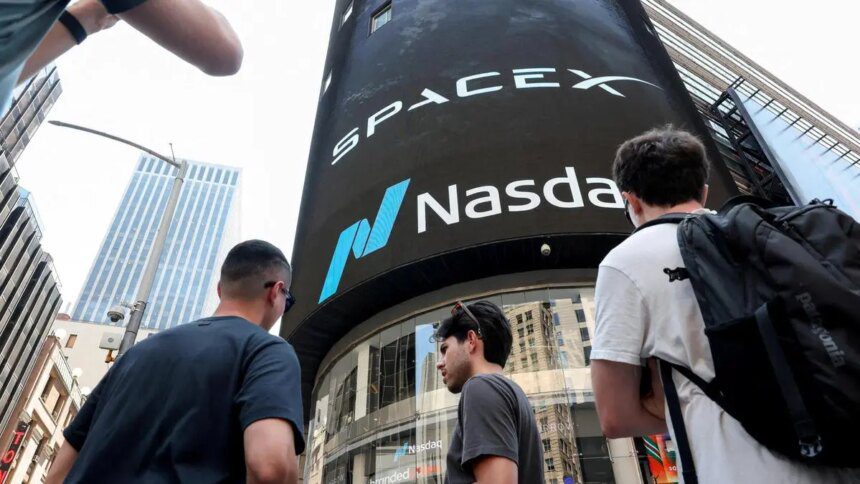

The recent trend in massive initial public offerings (IPOs) such as SpaceX and SK Hynix raises crucial questions about the sustainability of hype-driven investments. After an impressive debut, these giants have struggled to maintain their valuations, highlighting a need for investors to prioritize fundamentals over mere size during investment decisions.
Unraveling the IPO Phenomenon
The performance of the world’s largest IPO, SpaceX’s monumental $75 billion share sale, serves as a case study. It initially surged to a high of $225.65 shortly after listing at an IPO price of $135, only to witness a steady decline, recently hitting lows of $130.74. This rapid fluctuation reflects the volatility often seen in new stock listings and underscores the importance of assessing long-term viability rather than short-term excitement.
Similarly, SK Hynix, ranked as the second-largest foreign company IPO in the U.S., experienced a brief spike from its issue price of $149 to $194.45, before retreating back to just above its IPO price at $152.31. These realities serve as a stark reminder that massive listings do not guarantee sustained growth or profitability, especially in the face of market pressures.
Investor Behavior and Market Dynamics
Large IPOs have indeed captured significant investor attention. SpaceX generated bids exceeding $150 billion, largely led by institutional investors who often exhibit different motivations than retail investors. In comparison, SK Hynix’s IPO was oversubscribed seven times, portraying a vigorous appetite for substantial technology sectors like memory chips.
The enthusiasm surrounding mega IPOs isn’t unique to the global scene; the Indian market has witnessed similar phenomena. For example, Hyundai Motor India’s ₹27,870-crore IPO was priced at ₹1,960 per share, briefly rallying to ₹2,890 but eventually settling around ₹2,000. This behavior mirrors the experience of other Indian IPOs like Life Insurance Corporation of India and Paytm, both of which have delivered disappointing returns post-listing, revealing the common thread of market exuberance overshadowing factual performance indicators.
Long-Term Viability over Short-Term Excitement
While some mega IPOs, like those of Meta and Visa, have proven to be long-term winners, the struggles of many large listings reinforce the necessity of careful valuation assessments. The recent highs and lows in diverse markets illustrate that excitement surrounding an IPO should not replace rigorous evaluations of company fundamentals, management quality, and macroeconomic contexts.
Additionally, historical examples, such as Reliance Power’s IPO in 2008, showcase how investor enthusiasm can lead to significant losses over time, as companies fail to deliver on initial expectations. This sheds light on the critical need for both investors and companies to practice prudence in pricing and governance during the IPO process.
What This Means
For Indian investors and businesses, these global trends underline the importance of thorough research and critical evaluation before participating in IPOs. Companies looking to go public should aim for transparency, a reasonable pricing strategy, and a commitment to long-term shareholder value. As we observe both positive and negative narratives around IPO performances, investors must recalibrate their expectations and focus on companies’ operational fundamentals rather than hype.
This information is essential for Indian stakeholders as the market landscape continues to evolve with more companies aspiring for public listings in hopes of attracting investment while navigating an increasingly complex economic environment.
Frequently Asked Questions
What are the main reasons for the decline in IPO stock prices after initial offerings?
Several factors contribute, including inflated expectations during the IPO process, overall market conditions, and underlying business performance that may not align with initial hype.
How should investors approach new IPOs?
Investors should conduct thorough research, examining company fundamentals, management quality, and market potential, rather than getting swayed by hype surrounding large valuations.
Are all large IPOs bound to fail in the long run?
No, many large IPOs, like Meta and Visa, have yielded strong long-term returns. Success often hinges on the company’s execution and market conditions post-IPO.
What lessons can be learned from IPO trends in India?
The Indian market has mirrored global trends, demonstrating that investor excitement around IPOs does not guarantee future success. Caution and due diligence remain paramount.