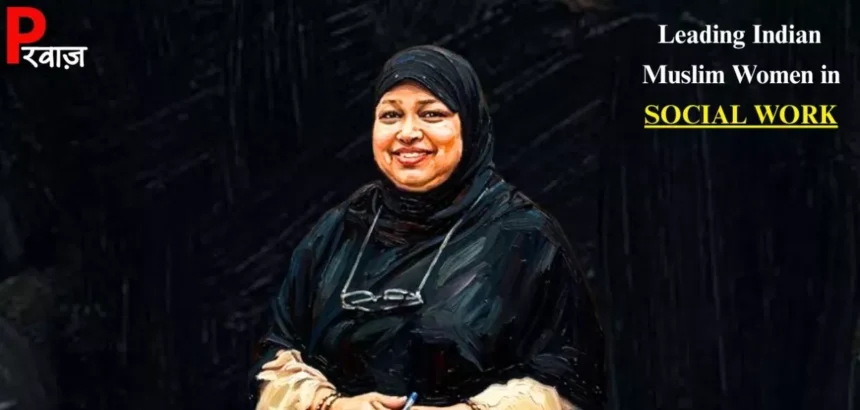

Shaista Amber: A Beacon of Change for Muslim Women in India
Shaista Amber, a prominent activist from Lucknow, has emerged as a critical voice for Muslim women’s rights in India. At a time when traditional barriers often stifled female agency, she has passionately championed the cause of gender equality and religious rights, striving to dismantle age-old inequities within her community.
Challenging Discrimination: Shaista Amber’s Activism
Born in 1962 in Allahabad, Shaista was raised in an intellectually enriching environment. Her mother’s legacy as an Urdu poet and her father’s professional background inspired her to pursue education and social change. Yet, her marital life exposed her to the realities of discrimination that Muslim women face, igniting her commitment to activism.
By 1997, she began confronting issues such as domestic violence and the controversial practice of instant triple talaq, which was frequently implemented in volatile circumstances, wreaking havoc on families. Faced with many women’s suffering, Shaista embarked on a lifelong mission to raise awareness about their rights under both Islamic law and the Indian Constitution.
Legal Advancements and Social Movements
In her quest to reform personal laws detrimental to women, Amber undertook extensive studies of the Quran and Islamic jurisprudence. She discovered that many practices, like instant triple talaq and polygamy, stemmed not from religious principles but from cultural distortions. Her findings compelled her to draft the “Model Nikahnama,” which has been pivotal in securing legal protections for women at marriage in India and beyond.
The founding of the All India Muslim Women Personal Law Board in 2005 marked a significant step in her activism. This organization aimed to create a space where Muslim women could freely discuss their issues and assert their rights, thus addressing the male-dominated discourse within the Muslim community.
Notably, she welcomed the Supreme Court’s decision declaring instant triple talaq unconstitutional, viewing it as a monumental victory for women’s rights. This was further complemented by her construction of the Amber Mosque in Lucknow—India’s first mosque designed to facilitate equal participation by women—challenging long-standing customs around women’s access to mosques.
A Vision for the Future
Beyond the immediate issues of legal rights, Amber envisions a future where education and representation of women in politics are prioritized. She has continuously advocated for the education of Muslim girls, emphasizing that an educated woman is pivotal in transforming not just her life, but the community at large. Her call for increased representation of women in Parliament highlights the systemic changes necessary for true empowerment.
Shaista Amber’s philosophy encapsulates the belief that faith and personal rights are not mutually exclusive. Her famous quote, “Indian Muslim women will walk with the Holy Quran in one hand and the Constitution of India in the other,” reinforces her commitment to integrating cultural heritage with modern legal frameworks.
Why It Matters
The activism of figures like Shaista Amber is crucial for addressing the systemic discrimination faced by Muslim women in India. It sheds light on broader societal issues, drawing attention to the intersection of religion, gender, and rights. By advocating for legal reforms and education, Shaista contributes to a significant cultural shift that could foster greater equality and empowerment. Additionally, her work encourages dialogue between religious beliefs and constitutional rights, which is essential for progressive change in Indian society.
Frequently Asked Questions
Who is Shaista Amber?
Shaista Amber is a prominent activist and the founder-president of the All India Muslim Women Personal Law Board, advocating for the rights and empowerment of Muslim women in India.
What issues does Shaista Amber address?
She challenges practices like instant triple talaq, domestic violence, and cultural distortions to promote legal rights and awareness among Muslim women.
How has Shaista Amber contributed to legal reforms?
Amber drafted the “Model Nikahnama,” which provides legal protections for women in marriage and actively campaigns for reforms against discriminatory practices within the Muslim community.
What is the significance of the Amber Mosque?
The Amber Mosque is India’s first mosque designed to ensure women’s convenience and participation, symbolizing gender equality and challenging traditional practices regarding women’s access to religious spaces.