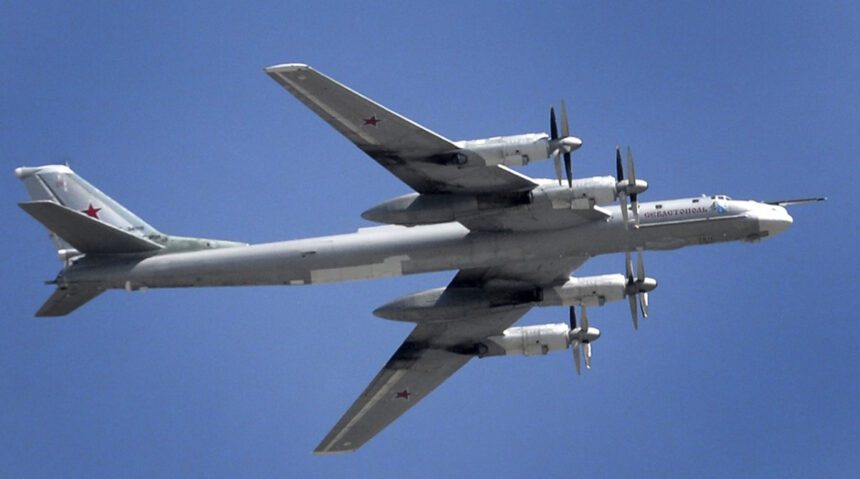

Ukraine’s Security Service (SBU) successfully targeted and destroyed a Russian Tu-95 strategic bomber at the Engels air base during a recent drone strike, marking a significant victory in its ongoing conflict with Russia. This operation was praised by President Volodymyr Zelensky as part of Ukraine’s strategy to systematically undermine Russian military capabilities.
Operation Details and Impact
In an impressive display of capability, SBU’s long-range drones flew roughly 800 kilometers to strike the Tu-95. The strike purportedly caused critical damage, including the complete loss of the aircraft’s tail section. The Tu-95 has been a primary asset in launching missile strikes against Ukraine, and its elimination could have cascading effects on Russia’s military strategy.
According to SBU officials, every strategic bomber destroyed diminishes the number of missiles that can be launched at Ukrainian cities, thus saving lives and inflicting significant financial losses on Russia. “Every strategic bomber eliminated means dozens of missiles that will not be launched at Ukrainian cities,” an official statement declared.
The Role of the Tu-95 in Russian Military Strategy
The Tu-95, which first took flight in 1952, remains one of the core components of Russia’s long-range missile arsenal. With an estimated 45 operational units as of 2023, this strategic bomber has undergone various upgrades, enabling it to carry the modern Kh-101 cruise missiles. These missiles are particularly concerning due to their maneuverability, making them difficult to intercept.
The Tu-95 can carry six cruise missiles on an internal rotary launcher and is known for its powerful NK-12 turboprop engines, which are among the most efficient ever built. However, this efficiency comes at the cost of being one of the loudest military aircraft globally. Its impressive range and payload capacity enable it to strike strategic targets from significant distances.
Zelensky’s Strategy: Economic Sabotage
President Zelensky has adopted a multi-faceted approach to counter Russia’s aggression. In a recent statement, he emphasized the importance of the strike, labeling it a “fair and active defense.” He noted that the SBU’s efforts to dismantle important elements of the Russian war machine are part of a broader strategy to increase the costs associated with Russia’s military actions.
Zelensky also highlighted simultaneous strikes on Russian oil facilities and military targets in temporarily occupied Ukrainian territories. “We are increasing the price Russia pays for its aggression,” he stated, conveying a message of resilience and determination.
Why This Is Trending
This topic is garnering significant attention in India due to the ongoing geopolitical tensions and the implications for global security. As India navigates its relationships with both Russia and Ukraine, developments in the war resonate with various sectors, including defense and international relations. Moreover, interest in military technology and strategic operations has surged, especially among defense analysts and enthusiasts in India, resulting in increased public discourse.
Frequently Asked Questions
What is the Tu-95 and why is it significant for Russia?
The Tu-95 is a strategic bomber that serves as a primary long-range missile carrier for the Russian military. Its ability to deliver significant payloads over vast distances makes it a key element in Russia’s military strategy.
How does this strike affect the ongoing war?
The elimination of the Tu-95 bomber could reduce Russia’s capability to launch missile strikes against Ukraine, potentially saving civilian lives and weakening Russia’s military advantage in the region.
What are Kh-101 missiles?
Kh-101 missiles are advanced cruise missiles with a range of up to 5,500 km, known for maneuverability that makes them hard to intercept. They are considered among Russia’s most sophisticated and expensive conventional arms.
What is Ukraine’s strategy in this conflict?
Ukraine aims to systematically dismantle Russia’s military capabilities through targeted strikes and sanctions, thereby increasing the cost of aggression on Russia, both economically and militarily.