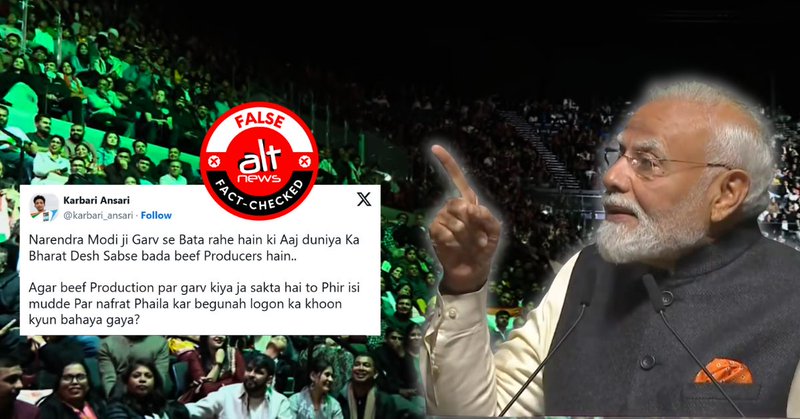

Recent claims circulating on social media suggested that Prime Minister Narendra Modi announced that India is the world’s largest beef producer during a speech in Auckland, New Zealand. However, these claims have been debunked as misrepresentations of his comments regarding wheat production.
Context of the Speech
Prime Minister Modi addressed the Indian diaspora in Auckland during his visit to New Zealand. In his speech, he highlighted various achievements of India, particularly in the agricultural sector. While discussing India’s agricultural capabilities, Modi mentioned India’s wheat production, which has seen significant growth in recent years. However, the interpretation of his statement morphed on social media, leading to the false claim regarding beef production.
Fact-Checking the Claims
The misinformation began circulating shortly after the speech, with videos being shared on various platforms, misquoting Modi. Alt News, a fact-checking organization, promptly investigated the claims and clarified that Modi did not state that India was the world’s largest beef producer. According to Alt News, the misrepresentation occurred as a result of selective editing and misinterpretation of his comments about wheat.
This is not the first time Modi’s speeches have been misreported or taken out of context. The dissemination of such misinformation can create misunderstandings regarding India’s position and policies on sensitive topics like agriculture and dietary practices.
Implications of Misinformation
The spread of inaccurate information about Modi’s claims is a cause for concern in the political landscape of India. Misrepresentation can influence public perception, especially in a country where agriculture plays a central role in the economy. Moreover, topics like beef production can incite communal tensions in a diverse nation like India, where dietary practices vary vastly across different regions and communities. Accurate reporting and fact-checking are essential to maintain a healthy public discourse.
Why This Matters
For Indian readers, understanding the significance of fact-checking is paramount in the current digital age. Social media amplifies both the spread of information and misinformation, making it crucial to rely on verified sources. Misunderstandings rooted in misrepresentation can escalate into larger social issues. By being aware of such incidents, individuals can contribute to a more informed society, encouraging a level of accountability among public figures for their statements while fostering a climate of trust and dialogue.
Frequently Asked Questions
Did PM Modi claim India was the world’s largest beef producer?
No, PM Modi did not make such a claim. His statements were misrepresented on social media and were actually about wheat production.
What was the context of Modi’s speech in Auckland?
During his speech in Auckland, Modi emphasized India’s agricultural achievements, particularly in wheat production, and addressed the Indian diaspora.
How has misinformation impacted public perception of Modi?
Misinformation can distort public perception and create misunderstandings about India’s leadership and policies, especially on sensitive topics like agriculture and food practices.
What is the role of fact-checking organizations like Alt News?
Fact-checking organizations like Alt News play a vital role in verifying claims made by public figures, helping to combat misinformation and promote informed public discourse.