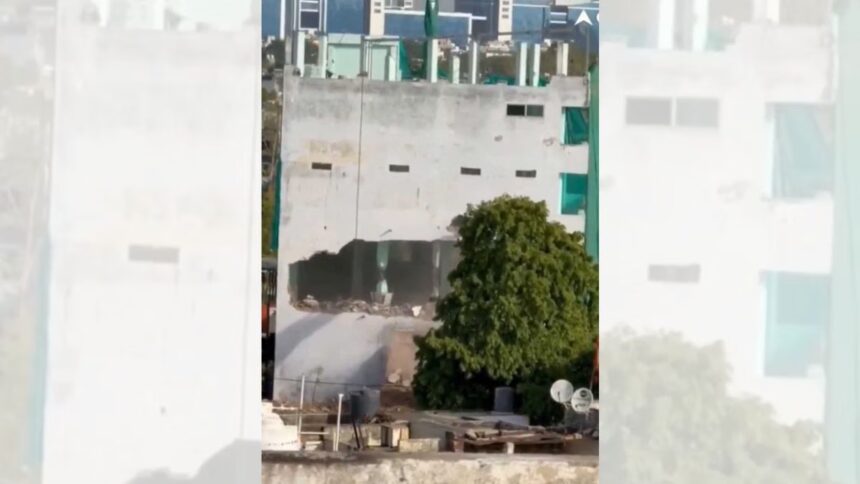

Jaipur’s Anti-Encroachment Drive Highlights Ongoing Disputes Over Religious Structures
The Jaipur Development Authority’s recent anti-encroachment initiative in the Jagatpura area has ignited tensions, as five religious structures are set to be demolished to facilitate road expansion. Among those affected is the Noorani Mosque, a 44-year-old place of worship representing significant community sentiments and financial contributions from local Muslims.
Details of the Demolition Drive
On Monday, the Jaipur Development Authority launched a significant demolition operation in Jagatpura to expedite the widening of Nandpuri Road. This stretch, crucially located near the railway line at Nandpuri Underpass, is currently 30 feet wide and will be expanded to 80 feet. The authorities have identified five religious sites for demolition, including the Noorani Mosque, two temples, a shrine, and a satsang hall. Authorities have also imposed strict security measures, deploying around 3,000 policemen and units from the Rapid Action Force (RAF) to maintain order amidst heightened tensions.
Community Pushback
The Noorani Mosque, established in 1981 and actively used for community gatherings and prayers, has drawn significant opposition from local Muslim representatives. Politician Rafeek Khan, a Congress MLA, emphasized that the mosque was built on land legally purchased by community members. The mosque’s committee had aimed to protect their place of worship against demolition orders issued by the Jaipur Development Authority on June 5. In a community meeting prior to the demolition, voices raised concerns that the mosque had been legally established, complicating the narrative surrounding its demolition.
Legal and Social Implications
The controversy surrounding the Noorani Mosque is not just a local issue but reflects broader socio-political dynamics faced by India’s Muslim community. According to the Association for Protection of Civil Rights (APCR), the mosque has never been declared illegal by any government authority since its construction. The APCR argued that the mosque, registered with the Rajasthan Waqf Board since 1988, had not only served as a religious site but also contributed to the cultural and social fabric of the region. This situation exemplifies the precarious balance between urban development initiatives and the preservation of religious sites, which has often led to accusations of discrimination against minority communities in India.
Why It Matters
The situation surrounding the Noorani Mosque and the broader anti-encroachment drive raises significant concerns regarding the treatment of religious minorities in India. As urban development progresses, the rights of specific communities can become secondary, leading to social exclusion and marginalization. The ongoing tension highlights systemic issues related to urban policy and community engagement, as local administrations may prioritize development over established community interests. The ramifications extend beyond just the immediate conflict surrounding one mosque; they signal potential future disputes involving religious and cultural sites across India, which could affect community relations and the sociopolitical landscape.
Frequently Asked Questions
What is the purpose of the demolition drive in Jaipur’s Jagatpura area?
The demolition drive is aimed at widening Nandpuri Road from 30 feet to 80 feet to facilitate increased traffic flow and urban development.
How has the community responded to the demolition of the Noorani Mosque?
Local Muslim community members, including political figures, have opposed the demolition, emphasizing the mosque’s legal status and community-funded origins, which they feel highlight fairness concerns.
What security measures have been implemented during the anti-encroachment drive?
Authorities have deployed around 3,000 police personnel and special units from the RAF to prevent unrest, with restrictions on gatherings of over five people and temporary suspension of internet services in affected areas.
What are the implications for similar community sites across India?
The conflict surrounding the Noorani Mosque serves as a potential precursor for future tensions involving various religious and cultural sites, underscoring ongoing issues of discrimination against minority communities during urban development efforts.