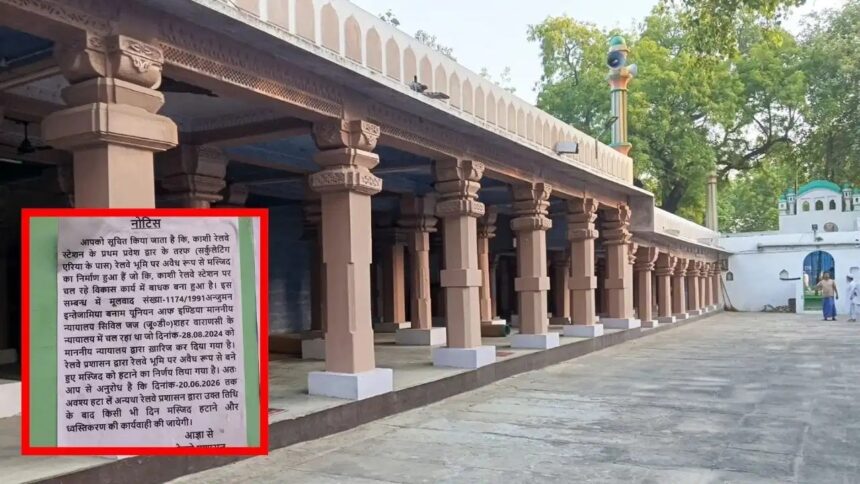

By Akhilesh Tripathi
Lucknow: A significant controversy is unfolding in Varanasi, Uttar Pradesh, over a demolition notice issued by the Railways for the historic Ganj Shaheeda Mosque at Kashi Railway Station. While the Railways argues that the mosque sits on railway property and obstructs redevelopment efforts, the mosque’s authorities contend it stands on land rightfully belonging to them, highlighting layers of historical and communal tensions.
Background of the Dispute
The issue escalated when the railway administration posted a notice asserting that the Ganj Shaheeda Mosque is illegally constructed on railway land, demanding its evacuation by June 20, 2026. This demolition notice is part of a larger ₹336-crore Kashi Railway Station Redevelopment Project aimed at modernizing infrastructure.
The notice referenced a civil suit (No. 1174/1991) that was dismissed in 2024 for “non-prosecution,” claiming that the court’s dismissal justified the demolition plan. However, Syed Mohammad Yasin, Joint Secretary of the Anjuman Intazamia Masjid Committee, challenged the legitimacy of the notice, pointing out the absence of a signature, date, and official emblem. He emphasized that the mosque is a historical structure that predates the station itself, raising questions about the fairness of labeling it illegal.
Historical Significance of the Mosque
According to the mosque’s authorities, Ganj Shaheeda Mosque was constructed in 1034 CE and contains a graveyard and various shrines that indicate its long-standing religious significance. Yasin pointed out that evidence of the mosque’s existence is documented in the Banaras Settlement Map from 1883–84, which illustrates that it existed before the establishment of Kashi Railway Station in 1887. This historical assertion is accompanied by a court-attested copy of the map, complicating the Railways’ claim of illegal occupation.
The mosque’s historical and cultural contexts highlight the potential impact of urban redevelopment on religious minorities in India. The situation is particularly pressing for members of the Muslim community, who are often at the center of disputes involving land and religious sites. Amidst these tensions, a delegation led by local religious leadership has sought dialogue with the Railway Department to prevent demolition and preserve their heritage.
Community Response and Broader Implications
In response to the demolition notice, public outcry has surged from various quarters, including not just local Muslim leaders but also advocates of communal harmony. The situation reflects deeper societal fractures, underscoring a climate where religious minorities feel marginalized. The involvement of external parties, such as the Pakistani leadership expressing concern over the mosque’s fate, further complicates the narrative. Local leaders have responded robustly, emphasizing their right to manage their religious sites without interference.
The case of the Ganj Shaheeda Mosque exemplifies how historical grievances can resurface in contemporary urban redevelopment projects, often leading to broader discussions regarding the rights and recognition of minority communities. As the matter escalates, it poses questions about religious freedom, community identity, and the historical ownership of land.
Why It Matters
The Ganj Shaheeda Mosque controversy underscores ongoing issues of discrimination, social exclusion, and marginalization affecting Muslims in India. The implications extend beyond the immediate locality, illuminating patterns where religious minorities frequently find themselves at odds with state objectives. The outcome of this situation could serve as a precedent for how historical claims are handled in urban development, influencing future policies and practices regarding minority rights and heritage conservation.
Frequently Asked Questions
What is the current status of the Ganj Shaheeda Mosque?
The mosque has received a demolition notice from the Railways, demanding it be vacated by June 20, 2026, due to claims that it obstructs development work at Kashi Railway Station.
What is the historical significance of the Ganj Shaheeda Mosque?
The mosque was built in 1034 CE and has been documented in historical maps, predating the construction of the Kashi Railway Station, highlighting its longstanding importance to the local Muslim community.
What were the results of the related court case?
The civil suit involving the mosque was dismissed for non-prosecution in 2024. The mosque’s authorities assert that this dismissal does not reflect a verdict concerning its legitimacy on the land but rather procedural shortcomings.
What steps are being taken to resolve the dispute?
A delegation of community leaders has approached the District Magistrate to seek reconciliation and dialogue with the Railway Department, emphasizing the cultural and religious significance of the mosque.