
By Our Correspondent
Summary
An ongoing campaign in Rajasthan’s western border districts has led to the demolition of mosques and religious structures predominantly affiliated with the Muslim community, sparking political outrage. Critics assert that these actions, framed as necessary for national security, are manifestations of systemic discrimination against Muslims under the Bharatiya Janata Party (BJP) government.
Demolition Campaign and Political Implications
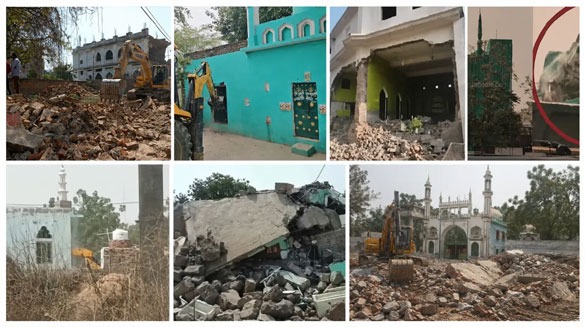
In recent days, local authorities in Rajasthan have demolished approximately a dozen mosques and madrasas in Barmer, Jaisalmer, Bikaner, and Phalodi districts. The justification provided for these demolitions by the BJP-led state government hinges on the claim that the structures occupy pasture land belonging to the state and thus pose a national security threat. Notably, many of these religious sites were established prior to India’s independence, when such land categorization did not exist.
The speed and manner of the demolitions have raised serious concerns among local Muslim communities. Notices served to mosque committees demanded proof of legal ownership within an impossibly short timeframe — often just one or two days — heavily favoring a state-sanctioned narrative that targets Muslim places of worship. Meanwhile, Hindu religious structures in similar positions seemingly remained unscathed, raising alarms about bias and discrimination.
Opposition leaders, including Congress party members, have heavily criticized the demolitions as a politically charged campaign aimed at polarizing communities ahead of upcoming elections. They argue that these actions detract from genuine issues such as communal harmony and social equity.
Legal and Civil Rights Concerns
The Association for the Protection of Civil Rights (APCR) has condemned the demolitions as “complete hooliganism,” emphasizing that due legal processes have not been followed. The APCR intends to challenge these state actions in court, underscoring a potential violation of constitutional protections related to religious freedom and property rights.
Furthermore, the ongoing demolitions appear to be part of a broader trend reflecting the BJP government’s increasing assertiveness regarding minority communities. Critics liken this campaign to practices seen in West Bengal following the implementation of a contentious “detect, delete, and deport” (3D) policy targeting alleged illegal immigrants among the Muslim population.
A delegation from Jamiat Ulama-i-Hind visited Rajasthan to assess the situation and support local Muslims facing eviction. They emphasized the historical significance of these structures and rejected the government’s sudden claims about their supposed illegitimacy.
Historical Context and Local Impact
Rajasthan’s border districts, historically home to substantial Muslim populations, are now the focal point of rising tensions. The centuries-old mosques and sacred sites not only serve as places of worship but also symbolize the cultural and social fabric of the region. Many local leaders and historians argue that the government’s actions represent a severe breach of long-established rights and threaten communal harmony.
Among the significant structures targeted is the nearly 250-year-old dargah of Hazrat Mahmood Shah Jilani in Jaisalmer. This site has long embodied a spirit of coexistence among diverse communities. With the government calling for documentation and legal proof of ownership from local Muslim communities within mere days, many fear that the demolition campaign aims to erase the cultural history associated with Islam in the region.
Local politicians have spoken out against this discriminatory action, advocating for dialogue and reconciliation rather than division. Their calls for inclusive governance highlight the need for a comprehensive approach to communal issues, emphasizing social harmony over political gain.
Why It Matters
The ongoing events unfolding in Rajasthan are emblematic of a larger trend concerning the rights of minority communities, particularly Muslims, in India. The targeted demolition of mosques raises serious questions about religious freedom and property rights in the context of national security discourse. Regional tensions may escalate, impacting social cohesion more broadly. Moreover, this situation challenges reputations on both domestic and global fronts regarding India’s commitment to multi-religious coexistence.
For developers and users in the AI industry, the data surrounding these events may serve as key insights into societal dynamics and the implications of religious and communal identities. As AI applications grow in context-aware capabilities, understanding the consequences of systemic discrimination will be crucial for developing technologies that aim to foster social equity and inclusion.
Frequently Asked Questions
What is the reason behind the mosque demolitions in Rajasthan?
The Rajasthan government claims that the demolitions are necessary for national security, alleging that the mosques were built on state-owned pasture land, posing a threat to border security.
How has the local Muslim community responded to the demolitions?
Local Muslim organizations and leaders have condemned the demolitions as targeted discrimination and are planning legal challenges against the state’s actions, highlighting a lack of due process and potential violations of constitutional rights.
What does the Jamiat Ulama-i-Hind organization plan to do regarding the demolitions?
Jamiat Ulama-i-Hind has deployed a delegation to assess the situation and support affected communities while challenging the demolitions in court to protect religious freedoms.
What historical significance do the targeted mosques and dargahs have?
The mosques and dargahs date back several centuries, serving as key symbols of cultural heritage and communal harmony in Rajasthan. Their demolition raises concerns about erasing historical legacies tied to the Muslim community.