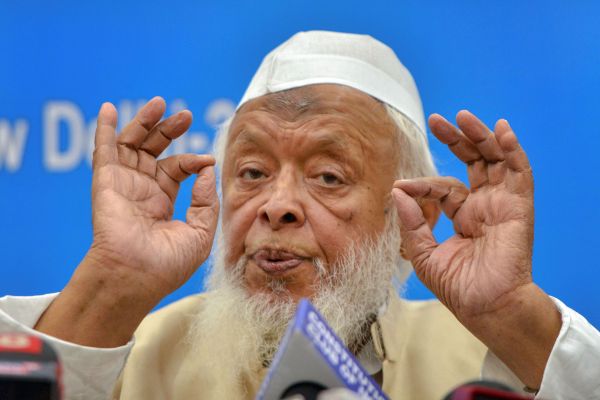
During a recent convention, Maulana Syed Arshad Madani, President of Jamiat Ulema-e-Hind, condemned the targeted demolitions of madrasas and mosques in India as manifestations of discrimination, fueled by hatred from governing authorities. His remarks highlight concerns over the treatment of Muslim communities under the current political regime, emphasizing justice and communal harmony over division.
Condemnation of Government Actions
Madani strongly criticized what he termed “bulldozer actions” against religious institutions, arguing that these operations unfairly target the Muslim community. Speaking at the Jamiat Ulema Uttarakhand’s state executive convention in Piran Kaliyar Sharif, he remarked that these violent measures were not only unjust but also run counter to the principles of democracy and justice. “No nation can be governed through fear and animosity,” he stated, reinforcing the idea that governance based on hate is unsustainable.
Madani’s emphasis on the need for love and compassion as foundational elements for a country resonates deeply within India’s historical context, where communal and religious divisions have often led to strife. In his address, he underscored the argument that temporary governments should not impose long-lasting damage upon communities through discrimination.
The Legacy of Ulema in India’s Freedom Movement
In an emotionally charged narrative, Madani drew attention to the significant contributions made by Muslim scholars and ulema during India’s fight for independence. He reminded attendees that figures such as Sheikhul Hind Maulana Mahmoodul Hasan bravely opposed British colonial rule, facing imprisonment and even execution without seeking clemency. His rhetoric invoked a sense of pride in the historical role of the Muslim community in shaping India’s democratic fabric.
He lamented that the very institutions that nurtured the spirit of freedom are now under threat. “The madrasas from where the spark of freedom emerged are today being brought down by bulldozers. Is this the reward for the sacrifices of our elders?” he challenged, pointing to a perceived betrayal of historical sacrifices made in the name of liberty and justice.
Call for Communal Harmony
Madani extended a powerful appeal for unity between Hindus and Muslims, stressing the importance of maintaining mutual respect and love. He isolated political parties as separate entities, suggesting that their actions should not fluctuate the collective peace between communities. “Hatred must not be answered with hatred; it must be answered with love,” he urged, promoting dialogue over discord.
This call for harmony comes at a time of escalating tensions in various states, particularly where government actions have disproportionately affected religious minorities. Madani’s stance reflects a broader concern that continued division could lead to a volatile socio-political environment in India, affecting the collective well-being of all its citizens.
Why It Matters
The unfolding situation represents critical implications for the social fabric of India and the dynamics of religious tolerance and coexistence. The actions taken by governing authorities against religious institutions may not only serve as a precedent for future discriminative policies but could also contribute to long-lasting social fractures. For developers and businesses, understanding these dynamics is essential, especially those focused on community-building tech platforms or initiatives aimed at fostering social cohesion. The erosion of trust among communities may spotlight the need for innovative solutions that address bias and promote dialogue in divisive contexts.
Frequently Asked Questions
What are “bulldozer actions”?
Bulldozer actions refer to the demolitions of buildings, particularly mosques and madrasas, under the pretext of illegal construction, often perceived as targeting specific communities, particularly Muslims in India.
Who is Maulana Syed Arshad Madani?
Maulana Syed Arshad Madani is the President of Jamiat Ulema-e-Hind, a prominent organization advocating for the rights of Muslims in India, and a notable figure in the religious and social discourse within the community.
What role did Muslim leaders play in India’s independence?
Muslim leaders and ulema played a crucial role in India’s independence movement, actively participating in protests, facing imprisonment, and risking their lives to oppose British colonial rule.
Why is communal harmony important in India?
Communal harmony is vital in India due to its diverse religious landscape. It fosters social cohesion, reduces conflict, and ensures a peaceful coexistence, which is essential for national stability and growth.