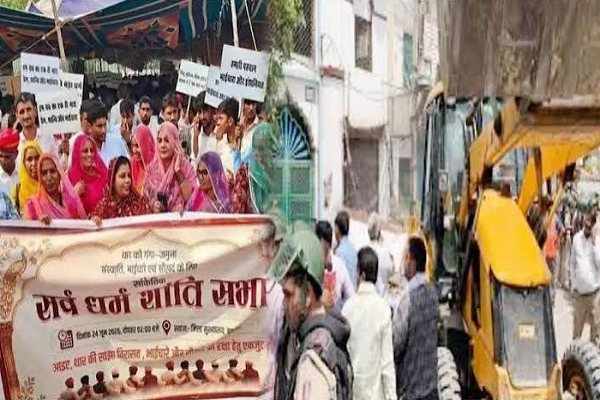

Protesters from Hindu and Muslim communities in Rajasthan unite against mosque demolitions as concerns grow over government actions perceived to selectively target minorities, raising alarms about communal harmony and civil rights.
Joint Community Action in Rajasthan
In an unprecedented show of interfaith solidarity, members of both Hindu and Muslim communities protested jointly in Barmer, Rajasthan, against the recent demolition campaign spearheaded by the Bharatiya Janata Party (BJP) government. They gathered outside the Barmer District Magistrate’s office for a “Sarv Dharm Shanti Sabha” or interfaith peace assembly. This gathering saw participation from religious leaders, social activists, and local residents advocating for an immediate cessation of mosque demolitions deemed to threaten communal harmony in the region.
Escalation of the Demolition Campaign
The ongoing demolitions are part of a larger operation dubbed “Operation Sweep,” initiated by the Rajasthan administration along the India-Pakistan border. Activists report that this campaign has already led to the demolition of four mosques in Barmer district alone. Furthermore, warnings have been issued to nearly 350 mosques across districts with significant Muslim populations, such as Jaisalmer, Bikaner, and Sri Ganganagar, as per statements from local civil rights organizations.
While government officials claim that the operation aims to eliminate illegal encroachments and bolster security measures in the sensitive border area, there are allegations of discriminatory practices. Critics argue that the rules are unevenly enforced, predominantly targeting Muslim places of worship while sparing others.
Voices of Concern and Calls for Action
Azad Singh Rathore, an organizer of the protest, raised significant objections regarding land ownership transparency in Rajasthan. He pointed out that many land records in border regions remain unresolved, making it unjust to specifically target religious structures affiliated with one community. Rathore advocated for the regularization of legal properties instead of the ongoing demolitions. He highlighted that the crisis affects not just mosques but residential homes as well, threatening to leave families without shelter.
Participants at the peaceful demonstration underscored Barmer’s historical reputation for communal coexistence and called for upholding constitutional rights. They expressed their hope that authorities would prioritize dialogue and mediation over coercion and destruction, thereby reinforcing social trust in a region strained by socioeconomic challenges.
Why It Matters
The situation in Rajasthan highlights ongoing issues of discrimination and social exclusion faced by Muslim communities in India. As communal violence and mistrust persist, actions like the demolition campaign can exacerbate societal divides, hindering peace and stability. In a democratic society, protecting the rights of all groups, regardless of religion, is essential for maintaining social harmony and trust in public institutions. The implications extend beyond regional politics, affecting national sentiment regarding equality and justice, as well as the international view of India’s commitment to pluralism.
Frequently Asked Questions
What is “Operation Sweep”?
“Operation Sweep” is a large anti-encroachment initiative launched by the Rajasthan administration, purportedly aimed at eliminating illegal structures along the India-Pakistan border as part of enhancing security and infrastructure.
What are the concerns raised by community leaders regarding the demolitions?
Community leaders argue that the demolitions are selectively targeting Muslim religious sites while ignoring similar structures owned by other communities, raising concerns about discrimination and violation of civil rights.
How many mosques have received demolition notices?
Reports indicate that approximately 350 mosques have received demolition notices across several districts along the India-Pakistan border, significantly affecting communities with large Muslim populations.
What is the broader impact of this protest on communal relations?
The joint protest by Hindus and Muslims reflects a desire to preserve communal harmony in the face of government actions that threaten to fracture society, emphasizing the importance of interfaith dialogue in resolving disputes and bolstering social cohesion.