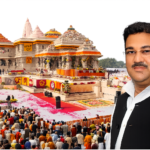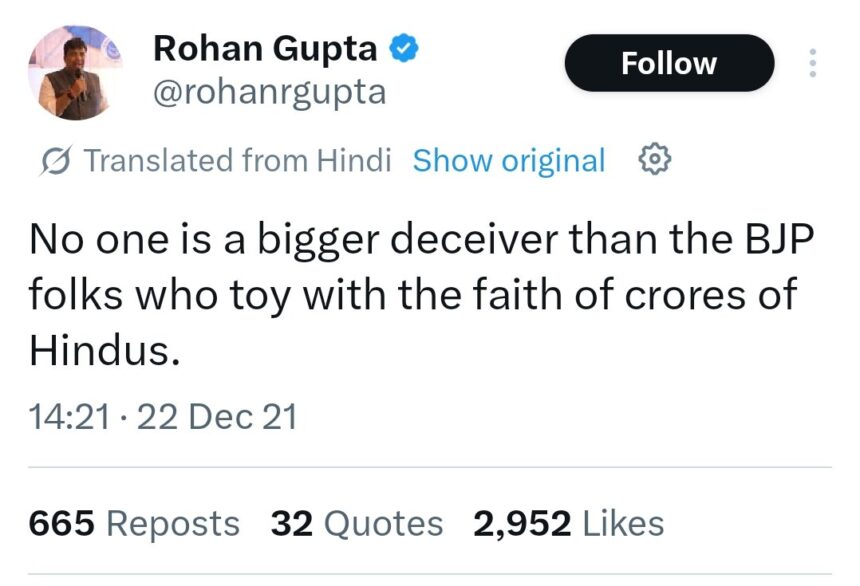

Rohan Gupta, a political commentator, has sharply criticized the Congress party and the Samajwadi Party for their stances on Hindu sentiments, particularly concerning the Ram Temple. He accuses these parties of engaging in hypocritical politics while ignoring their past actions that have been detrimental to the Hindu faith.
Context of the Criticism
Rohan Gupta’s comments arise amid a politically charged climate in India, particularly surrounding the ongoing discourse regarding the Ram Temple in Ayodhya. The Ram Temple has been a significant site in Hindu religious and political debate, especially since the Supreme Court’s verdict in 2019 that cleared the way for its construction. Gupta highlights the seeming inconsistency in the stances of opposition parties, particularly the Congress and the Samajwadi Party, regarding Hindu religious sentiments. His remarks indicate a broader narrative within BJP circles, criticizing opposition parties for what they perceive as a lack of genuine respect for Hindu beliefs.
Historical Context of Hindu Politics
The Ram Temple movement has been historically significant in Indian politics, especially in the late 20th century. The rise of the Bharatiya Janata Party (BJP) was closely linked to its advocacy for the construction of the Ram Temple, seen as a symbol of Hindu identity. Gupta’s comments resonate with a long-standing grievance among some Hindus against political parties that they feel undermine their beliefs and cultural heritage. This sentiment is intensified by incidents like the controversy over the Sabarimala temple or the imposition of taxes on temples, which are often portrayed as attacks on Hindu traditions.
Gupta’s Call for Accountability
In his statement, Gupta calls for accountability from opposition leaders. He suggests that those who have previously neglected Hindu sentiments should reflect on their actions and seek redemption. According to him, the realpolitik surrounding religious issues often stirs up public sentiment, which these parties leverage. His assertion that any wrongdoing in donation practices linked to temples should be thoroughly investigated signals a demand for transparency in religious matters. This highlights an ongoing concern among many about ethical governance in the realm of religious donations and temple management.
Why This Matters
Gupta’s critique is significant as it underscores the polarization in Indian politics surrounding religious identity. The Ram Temple discourse remains a powerful tool in electoral strategies, particularly for the BJP, which seeks to galvanize Hindu voters. Gupta’s remarks illustrate the ongoing tension between cultural identity and political maneuvering, reflecting a deeper ideological battle in India’s socio-political landscape. For many Indian citizens, these discussions frame their understanding of governance, identity, and religious rights, shaping future electoral outcomes and party alignments.
Frequently Asked Questions
What is the Ram Temple movement?
The Ram Temple movement refers to a political and religious campaign in India advocating for the construction of a temple dedicated to Lord Ram at the disputed site in Ayodhya, where the Babri Masjid was demolished in 1992. This movement significantly influenced the rise of the BJP as a major political force in India.
Why is the Ram Temple significant to Hindu voters?
The Ram Temple symbolizes Hindu identity and cultural pride. For many Hindu voters, it represents the reclamation of religious heritage and an acknowledgment of their faith’s significance in India’s history.
What actions have Congress and the Samajwadi Party taken regarding Hindu sentiments?
Critics like Rohan Gupta argue that both Congress and the Samajwadi Party have, at times, failed to support Hindu religious sentiments and have taken stances that are seen as antagonistic to Hindu beliefs, such as opposing the Ram Temple’s construction and involving themselves in issues that are perceived to undermine Hindu traditions.
What does Gupta mean by ‘giddh rajneeti’ (vulture politics)?
‘Giddh rajneeti’ refers to opportunistic politics where parties exploit situations for their benefit without genuine concern for the issues at hand. Gupta uses this term to describe what he sees as the hypocritical nature of opposition parties when questioning the ruling government on matters of religious significance.