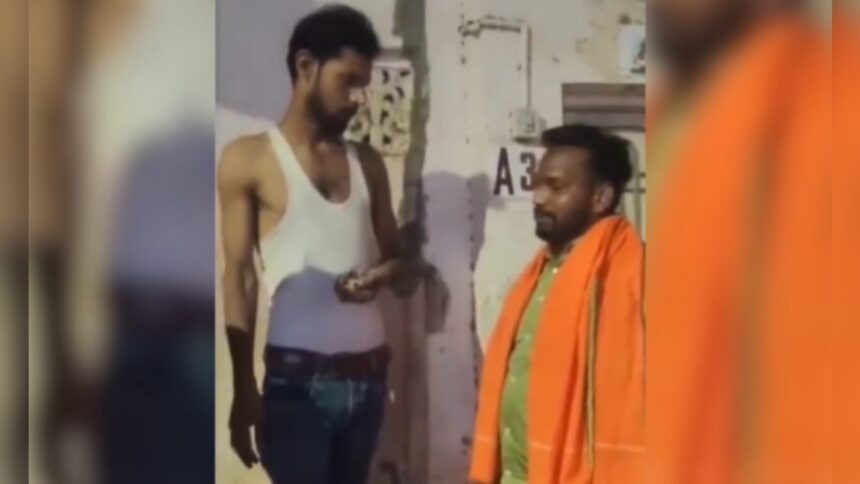

A recent incident in Ahmedabad, Gujarat, has exacerbated concerns over communal tensions, showcasing the ongoing discrimination faced by Muslims in the region. Ganesh Vanzara, a member of the Bajrang Dal, confronted a Muslim migrant worker, pressuring him to leave his rented home, underlining the precarious position of Muslim communities in predominantly Hindu neighborhoods.
Escalating Communal Tensions in Gujarat
The confrontation occurred in the Naroda area, where the migrant worker, originally from Etawah in Uttar Pradesh, was targeted after moving to a neighborhood with a majority Hindu population. Videos of this encounter reveal Vanzara and his group questioning the man’s identity and demanding proof of his background. Upon discovering that he was Muslim, Vanzara referred to him derogatorily as “Ali Khamenei’s nephew” and insisted he should vacate the area and return home.
Vanzara invoked a narrative commonly used by right-wing groups, expressing fears that the presence of Muslims posed a threat to local Hindu women. He echoed the controversial concept of “love jihad,” implying that Muslim men were a danger to Hindu women in their communities. His comments included a chilling reference to the murder of Shraddha Walkar in Delhi, where her partner has been accused of grievous crimes. Vanzara claimed, “Our sisters and daughters will end up being found inside a freezer,” as his associates cheered, highlighting the alarming rhetoric used to justify communal animosities.
Economic Disparities and Social Exclusion
The economic dimensions of discrimination were also evident in Vanzara’s statements, where he suggested that Muslim tenants were paying lower rents than their Hindu counterparts, contributing to resentment in the community. This claimed economic differential serves as a pretext for further marginalizing Muslims, who often face economic disadvantages. The tensions feed into broader societal issues, reinforcing segregation and preventing social cohesion.
The 2002 Gujarat riots, alongside earlier violent events from 1985 and 1992, have deeply rooted these divisions. Such historical communal violence has resulted in the emergence of segregated neighborhoods that not only lack basic amenities and infrastructure but also perpetuate exclusionary practices that deny equal opportunities and resources to Muslim residents.
The Role of Hindutva Groups in Shaping Dynamics
The increasing boldness of bodies like the Bajrang Dal reflects a larger trend influenced by Hindutva ideology, which emphasizes Hindu nationalism and often vilifies Muslim communities. Incidents like the confrontation in Naroda contribute to a narrative that enables economic boycotts against Muslims, discouraging interactions and engagements that could foster social harmony.
Authorities have not issued an official response to this latest incident, which is part of a worrying trend of escalating violence and exclusion against Muslims in the state. The failure to address such violations leaves affected communities in a precarious position, further perpetuating cycles of fear and marginalization.
Why It Matters
This unfolding situation in Gujarat sheds light on the broader issue of communal relations in India and highlights the challenges faced by minority communities under the current socio-political landscape. It raises questions about the implications for social justice, equity, and national unity in a diverse society. For the tech industry and developers, understanding these dynamics is crucial as it informs the development of tools and platforms that could help document and address social discrimination, ensuring that diverse voices are heard and protected.
Frequently Asked Questions
What happened in the incident involving the Bajrang Dal worker in Ahmedabad?
A Bajrang Dal worker confronted a Muslim migrant worker in Naroda, Ahmedabad, pressuring him to leave his rented home and using derogatory remarks about his religious background.
What is the ‘love jihad’ narrative mentioned in the incident?
‘Love jihad’ is a controversial theory espoused by some right-wing groups in India, suggesting that Muslim men are using romantic relationships to convert Hindu women to Islam, often under the guise of love.
How does this incident reflect larger communal tensions in India?
This confrontation exemplifies the ongoing social exclusion and discrimination against Muslims, highlighting the historical and socio-economic factors that contribute to communal violence in regions like Gujarat.
What historical events contribute to the current situation in Gujarat?
The communal violence in Gujarat, particularly the riots of 2002, along with earlier riots in 1985 and 1992, has significantly shaped the socio-political landscape, fostering deep-seated divisions between religious communities.