
Indian Muslims continue to face systemic discrimination and social exclusion, as highlighted by the decades-long Sachar Committee Report. Recent engagements between Muslim community leaders and high-ranking officials like National Security Adviser Ajit Doval reveal a shift towards dialogue, but challenges remain significant.
The Sachar Committee Report: A Historical Milestone
Nearly two decades after the publication of the Sachar Committee Report, the circumstances for Indian Muslims remain a point of concern. Submitted to then-Prime Minister Manmohan Singh in November 2006, the report detailed alarming disparities. It revealed that the Muslim community lagged behind Scheduled Castes and Scheduled Tribes in key development metrics. The report indicated that Muslims accounted for only 4.9% of government jobs, and their literacy rates fell short of the national average.
Despite subsequent inquiries, like the Ranganath Misra Commission’s recommendations in 2007, the implementation of proposals has been lackluster, with reports collecting dust rather than leading to actionable change. This ongoing neglect is termed the ‘development deficit’ affecting Indian Muslims.
Recent Engagements with Government Officials
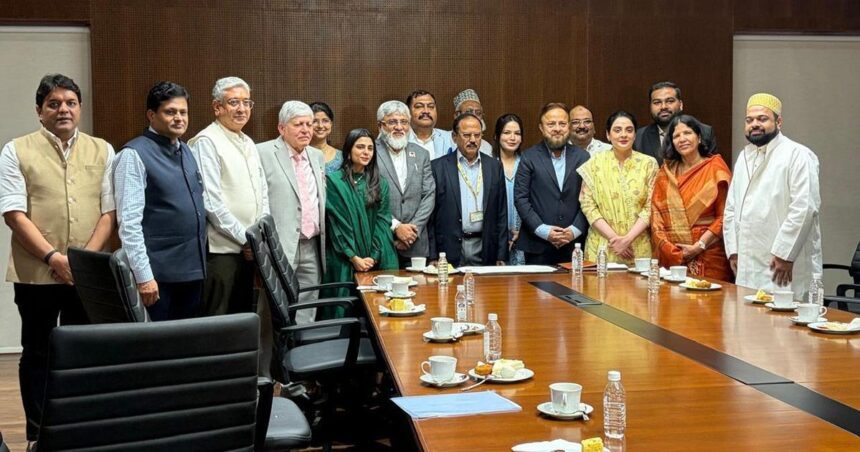
In early 2023, a delegation of 16 prominent Muslim figures—including industrialists, academics, and social activists—decided to take an unprecedented approach. Instead of traditional protests or statements, they sought a direct dialogue with National Security Adviser Ajit Doval at the Seva Teerth.
During their two-hour meeting, the group emphasized their discontent with tokenistic solutions like reservations. They advocated for equal opportunities and an end to institutional discrimination. Interestingly, Doval acknowledged the importance of collective advancement, stating, “Either we sink together or we sail together.”
He noted a noticeable uptick in Muslim recruitment in the armed forces since removing personalized interviews from the selection process, allowing for a more merit-based evaluation. This discussion signifies a willingness to engage openly on contentious issues that have historically been sidelined.
Challenges Remain: Societal Perceptions and Economic Opportunities
While meaningful dialogues are emerging, societal perceptions about Indian Muslims remain fraught with tension. Terms such as ‘love jihad’ and ‘corporate jihad’ amplify sentiments of marginalization within the community. Despite these societal obstacles, individuals like Dr. Faruk Patel—who has built a successful business under BJP rule—demonstrate that opportunities do exist for Muslims in India. However, as Zafar Sareshwala points out, Muslim youth face the burden of striving for exceptionalism to overcome systemic biases.
Recent figures indicate that only about 1% of Muslims were appearing for the UPSC examination a decade ago, but recent efforts have seen that number nearly double, showcasing potential for increased participation in public services. The ongoing struggle illustrates that opportunities do exist; however, they often require exceptional efforts to access them.
Why It Matters
The current climate surrounding Indian Muslims is a critical case study in understanding the broader implications of social inclusion policies and community engagement. The active participation of Muslim leaders in dialogue with government officials may set a precedent for future collaborations aimed at dismantling institutional barriers. The findings from both the Sachar and Ranganath reports reflect economic and social disparities that require comprehensive strategies rather than superficial remedies.
As India continues to evolve, addressing these disparities will not only benefit the Muslim community but enhance the overall socio-economic fabric of the nation. This ongoing dialogue can inform policymakers and social leaders about the real issues faced by marginalized communities, a crucial aspect for nation-building efforts.
Frequently Asked Questions
What are the key findings of the Sachar Committee Report?
The Sachar Committee Report revealed significant disadvantages faced by Muslims in India, including low representation in government jobs, poor literacy rates, and limited access to bank credit.
What was the main agenda of the meeting with Ajit Doval?
The key agenda was to advocate for equal opportunities and an end to institutional discrimination, while expressing that reservation policies were unlikely to yield effective results.
How are economic opportunities evolving for Indian Muslims?
Recent initiatives have seen an increase in Muslim participation in competitive examinations like the UPSC. Programs aimed at providing education and entrepreneurship training are facilitating these changes.
What roles do societal perceptions play in the challenges faced by Muslims in India?
Societal perceptions, often influenced by communal rhetoric like ‘love jihad,’ contribute to a climate of suspicion and discrimination that hampers the community’s progress in various sectors.