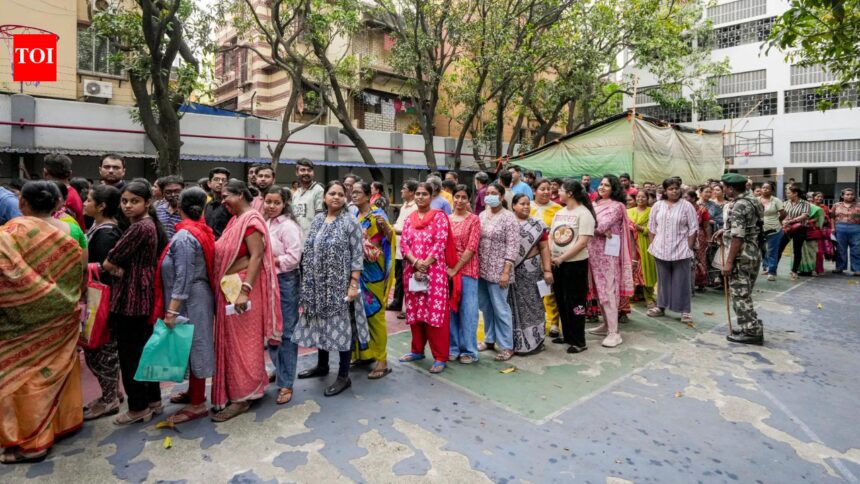

NEW DELHI: As voting concludes in Assam, Kerala, Tamil Nadu, West Bengal, and the Union Territory of Puducherry, attention is turning to the anticipated exit polls. These polls, typically released approximately half an hour after the polls close, provide an early indication of voter sentiment.
While exit polls frequently establish an initial narrative regarding potential winners, their accuracy can vary. Historical data shows that while some elections’ trends were correctly predicted, others strayed considerably from the final outcomes.
The elections in these five states serve as a relevant benchmark. In the previous assembly elections, exit polls yielded mixed results across various states.
Kerala
In Kerala, exit polls correctly forecast a victory for the Left Democratic Front (LDF), but underestimated its success. Polls estimated the LDF would secure around 82 seats and the United Democratic Front (UDF) approximately 56. Ultimately, the LDF captured 99 seats—17 above projections—while the UDF won only 41, falling short by 15 seats.
Tamil Nadu
Exit polls in Tamil Nadu were generally accurate in predicting a win for the DMK-led alliance, although they slightly overestimated the extent of the victory. Projections indicated the DMK+ would achieve around 166 seats, but the actual count was 159. Conversely, the AIADMK+ was projected to secure 63 seats yet performed better with 75 seats—12 more than expected—underscoring the resilience of the AIADMK-led coalition.
Assam
Assam’s election was noted for its accuracy in predictions. Exit polls anticipated a BJP-led NDA victory with roughly 71 seats, while the Congress-led alliance was expected to win about 54. The actual results reflected these estimates closely, with the NDA obtaining 75 seats and the opposition garnering 50.
Puducherry
In Puducherry, exit polls accurately indicated an NDA victory but overestimated its seat count. Projections suggested the NDA would win around 21 seats, while it ultimately achieved only 16. The UPA’s results mirrored predictions more closely by winning 9 seats as expected, although independent candidates’ performance diverged significantly from estimations.
West Bengal
West Bengal proved to be the most notable deviation, as exit polls failed to predict both the scale and clarity of the electoral outcome. Poll averages indicated a competitive race, forecasting approximately 155 seats for the Trinamool Congress (TMC) and 126 for the BJP-led NDA. In actuality, the TMC triumphed with 216 seats—61 more than suggested—while the NDA secured only 77 seats, falling short by 49. Meanwhile, the Congress-led alliance, expected to win around 12 seats, ended with just one.
Collectively, these five states depict a varied landscape of exit poll accuracy. While Assam and Tamil Nadu demonstrated reasonably precise forecasts regarding the overall direction, Kerala and Puducherry reflected discrepancies in estimating margins and seat counts. West Bengal highlighted a significant overestimation of competitiveness in the electoral mandate.