
The recent two-week truce between the United States and Iran, along with the intention to reopen the Strait of Hormuz, has provided some relief. However, oil and gas supplies are unlikely to return to pre-war levels in the near future. In India, the focus has primarily been on household struggles with cooking gas affordability, yet there has been less attention on the industrial sector, particularly micro, small, and medium enterprises (MSMEs), which have been compelled to reduce production by 50% or more.
India’s long-term commitment to clean energy has been emphasized by the West Asia conflict, which has highlighted the need for interim solutions. Experts, think tanks, and industry stakeholders are actively exploring alternatives like electric heat pumps and other emerging technologies targeted at MSME clusters.
Heat pumps utilize established technology but have experienced limited adoption in industrial settings due to higher costs relative to oil or gas. This dynamic is beginning to shift due to growing concerns about fuel availability and price volatility, making heat pumps more appealing, especially when scaled within industrial clusters.
The industrial heat needs vary significantly based on the product and process, indicating that a one-size-fits-all solution may not be viable. Nonetheless, experts from industry groups, venture capital firms, and philanthropic organizations have indicated that heat pumps could be particularly effective in clusters that produce similar goods—such as glass manufacturing in Firozabad or leather production in Chennai—where low to medium temperature heat is sufficient.
While heat pumps can operate on grid electricity, their environmental benefits depend on the power source. Should the grid remain reliant on fossil fuels, these benefits are diminished. To mitigate this issue, experts advocate for large-scale rooftop solar installations within industrial clusters, potentially supplemented by concentrated solar power. This would generate adequate electricity for heat pumps during daylight hours, with grid power serving as backup.
For industries requiring higher temperatures, thermal storage systems and hybrid options may be necessary, although these innovations will take time and sector-specific development. Currently, the primary focus lies in expanding heat pump adoption.
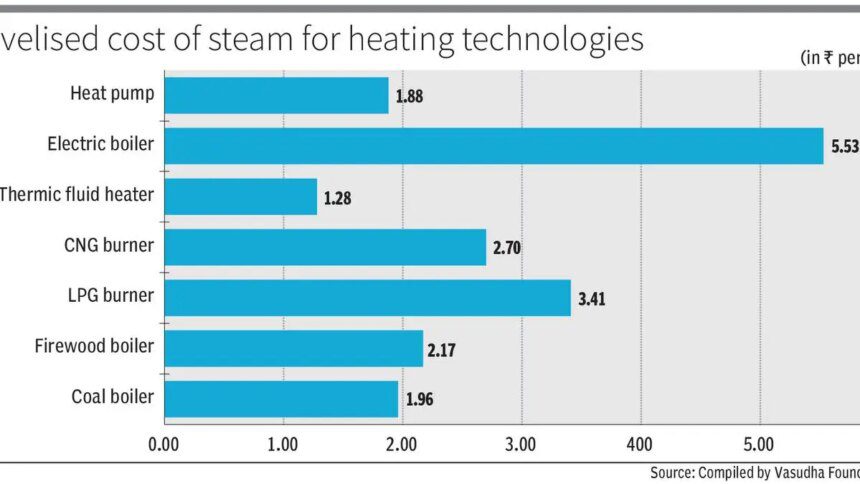
Industry representatives involved in discussions have noted that escalating energy costs are prompting factory owners to consider alternative energy solutions. Heat pumps offer low-cost energy options, as detailed in accompanying data.
Investment in heat pump technology is contingent upon three primary factors: lifecycle cost-competitiveness rather than just initial costs, reliability and compatibility with continuous industrial operations, and demonstrated performance. Pilot projects are essential in this context, as MSME operators emphasize the necessity of minimizing disruptions to ongoing processes.
Three enabling conditions have been identified to enhance the uptake of heat pumps. First is financial support, where capital availability is not viewed as a significant barrier, partly due to philanthropic investments that help mitigate risks. One suggested model is “heat-as-a-service,” where heat is provided under purchase agreements, alleviating the upfront financial burden.
Second, policy support from both central and state governments is required. While there is acknowledgment of the move toward electrification, industry players desire greater clarity and stability in this regard. Key issues such as tariff structures, access to power, and harmonization of incentives between fossil fuels and clean energy are crucial. A white paper addressing these issues is anticipated to be submitted to policymakers.
Third, grid readiness is vital. Though capacity may seem adequate on a broader scale, local plant-level constraints can lead to challenges. This necessitates improved coordination with power system planning.
The immediate opportunity focuses on identifying priority sectors and clusters, facilitating early deployments, and establishing credible pathways for scaling. These initiatives should align with a wider national strategy for clean industrial heat, in accordance with long-term energy transition objectives.
(The writer is India Programme Lead, Earth Journalism Network)
Published on April 13, 2026