Breaking India News Today | In-Depth Reports & Analysis – IndiaNewsWeekBreaking India News Today | In-Depth Reports & Analysis – IndiaNewsWeek
  • Home
  • Nation
  • Politics
  • Economy
  • Sports
  • Entertainment
  • International
  • Technology
  • Auto News
Reading: Oil-Dependent Industry Seeks Revival Through Innovative Heat Pump Solutions
Share
Breaking India News Today | In-Depth Reports & Analysis – IndiaNewsWeekBreaking India News Today | In-Depth Reports & Analysis – IndiaNewsWeek
  • Home
  • Nation
  • Politics
  • Economy
  • Sports
  • Entertainment
  • International
  • Technology
  • Auto News
© 2024 All Rights Reserved | Powered by India News Week
Trending Now: Stay updated with the latest breaking news from India and around the world
Oil-starved industry looks to reignite heat pumps
Breaking India News Today | In-Depth Reports & Analysis – IndiaNewsWeek > Economy > Oil-Dependent Industry Seeks Revival Through Innovative Heat Pump Solutions
Economy

Oil-Dependent Industry Seeks Revival Through Innovative Heat Pump Solutions

Indianewsweek By Indianewsweek April 27, 2026 5 Min Read
Share
SHARE

The recent two-week truce between the United States and Iran, along with the intention to reopen the Strait of Hormuz, has provided some relief. However, oil and gas supplies are unlikely to return to pre-war levels in the near future. In India, the focus has primarily been on household struggles with cooking gas affordability, yet there has been less attention on the industrial sector, particularly micro, small, and medium enterprises (MSMEs), which have been compelled to reduce production by 50% or more.

India’s long-term commitment to clean energy has been emphasized by the West Asia conflict, which has highlighted the need for interim solutions. Experts, think tanks, and industry stakeholders are actively exploring alternatives like electric heat pumps and other emerging technologies targeted at MSME clusters.

Heat pumps utilize established technology but have experienced limited adoption in industrial settings due to higher costs relative to oil or gas. This dynamic is beginning to shift due to growing concerns about fuel availability and price volatility, making heat pumps more appealing, especially when scaled within industrial clusters.

The industrial heat needs vary significantly based on the product and process, indicating that a one-size-fits-all solution may not be viable. Nonetheless, experts from industry groups, venture capital firms, and philanthropic organizations have indicated that heat pumps could be particularly effective in clusters that produce similar goods—such as glass manufacturing in Firozabad or leather production in Chennai—where low to medium temperature heat is sufficient.

While heat pumps can operate on grid electricity, their environmental benefits depend on the power source. Should the grid remain reliant on fossil fuels, these benefits are diminished. To mitigate this issue, experts advocate for large-scale rooftop solar installations within industrial clusters, potentially supplemented by concentrated solar power. This would generate adequate electricity for heat pumps during daylight hours, with grid power serving as backup.

For industries requiring higher temperatures, thermal storage systems and hybrid options may be necessary, although these innovations will take time and sector-specific development. Currently, the primary focus lies in expanding heat pump adoption.

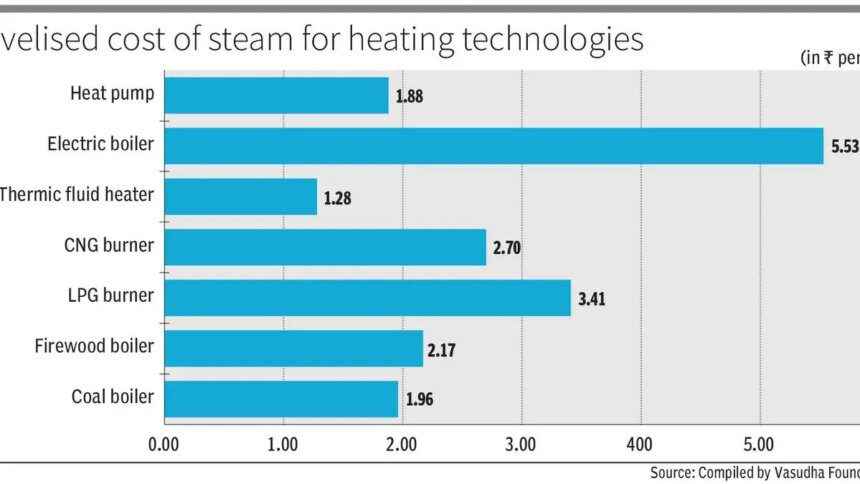
Industry representatives involved in discussions have noted that escalating energy costs are prompting factory owners to consider alternative energy solutions. Heat pumps offer low-cost energy options, as detailed in accompanying data.

Investment in heat pump technology is contingent upon three primary factors: lifecycle cost-competitiveness rather than just initial costs, reliability and compatibility with continuous industrial operations, and demonstrated performance. Pilot projects are essential in this context, as MSME operators emphasize the necessity of minimizing disruptions to ongoing processes.

Three enabling conditions have been identified to enhance the uptake of heat pumps. First is financial support, where capital availability is not viewed as a significant barrier, partly due to philanthropic investments that help mitigate risks. One suggested model is “heat-as-a-service,” where heat is provided under purchase agreements, alleviating the upfront financial burden.

Second, policy support from both central and state governments is required. While there is acknowledgment of the move toward electrification, industry players desire greater clarity and stability in this regard. Key issues such as tariff structures, access to power, and harmonization of incentives between fossil fuels and clean energy are crucial. A white paper addressing these issues is anticipated to be submitted to policymakers.

Third, grid readiness is vital. Though capacity may seem adequate on a broader scale, local plant-level constraints can lead to challenges. This necessitates improved coordination with power system planning.

The immediate opportunity focuses on identifying priority sectors and clusters, facilitating early deployments, and establishing credible pathways for scaling. These initiatives should align with a wider national strategy for clean industrial heat, in accordance with long-term energy transition objectives.

(The writer is India Programme Lead, Earth Journalism Network)

Published on April 13, 2026

TAGGED:Economy NewsNews
Share This Article
Twitter Copy Link
Previous Article Despite PFBR going critical, India is still a long way from thorium utilisation India’s PFBR Reaches Critical Stage, Yet Thorium Utilization Remains Distant Reality
Next Article West Bengal polls: NIA to probe bomb haul in tinderbox Bhangar NIA Investigates Bomb Seizure Amid Tensions in West Bengal’s Bhangar Polls
Leave a comment Leave a comment

Leave a Reply Cancel reply

Your email address will not be published. Required fields are marked *

Latest News

HiLITE Group to launch ₹200 crore Shariah-certified Category II AIF

You are a professional news headline editor. Rewrite the following headline into a unique, engaging, SEO-friendly English news title. Rules: Maximum 16 words. Output ONLY the rewritten headline. No quotes, no explanations, no instructions.Original: HiLITE Group to launch ₹200 crore Shariah-certified Category II AIFRewritten headline:

November 12, 2026
Adani to finance Chile's Kaburkaala copper project for Mundra smelter supply

You are a professional news headline editor. Rewrite the following headline into a unique, engaging, SEO-friendly English news title. Rules: Maximum 16 words. Output ONLY the rewritten headline. No quotes, no explanations, no instructions.Original: Adani to finance Chile’s Kaburkaala copper project for Mundra smelter supplyRewritten headline:

November 12, 2026
Lalithaa Jewellery Q2 net profit climbs 4.5% to ₹253 crore

You are a professional news headline editor. Rewrite the following headline into a unique, engaging, SEO-friendly English news title. Rules: Maximum 16 words. Output ONLY the rewritten headline. No quotes, no explanations, no instructions.Original: Lalithaa Jewellery Q2 net profit climbs 4.5% to ₹253 croreRewritten headline:

November 11, 2026
Argentina, Malaysia overtake Indonesia as top veg oil exporters to India

You are a professional news headline editor. Rewrite the following headline into a unique, engaging, SEO-friendly English news title. Rules: Maximum 16 words. Output ONLY the rewritten headline. No quotes, no explanations, no instructions.Original: Argentina, Malaysia overtake Indonesia as top veg oil exporters to IndiaRewritten headline:

November 11, 2026
Bond yields spike most since tariff meltdown on rate-hike bets

You are a professional news headline editor. Rewrite the following headline into a unique, engaging, SEO-friendly English news title. Rules: Maximum 16 words. Output ONLY the rewritten headline. No quotes, no explanations, no instructions.Original: Bond yields spike most since tariff meltdown on rate-hike betsRewritten headline:

November 11, 2026
Mutual funds' Nifty 50 allocation falls to 21-year low in Sept quarter

You are a professional news headline editor. Rewrite the following headline into a unique, engaging, SEO-friendly English news title. Rules: Maximum 16 words. Output ONLY the rewritten headline. No quotes, no explanations, no instructions.Original: Mutual funds’ Nifty 50 allocation falls to 21-year low in Sept quarterRewritten headline:

November 11, 2026

You Might Also Like

Over 4,000 Muslims booked, 200 arrested: Fact-finding report documents targeted crackdown after “I Love Muhammad” campaign
Nation

Targeted Crackdown: Over 4,000 Muslims Booked, 200 Arrested After ‘I Love Muhammad’ Campaign

5 Min Read
“Bulldozer justice” in Madhya Pradesh: House of man jailed for alleged forcible conversions demolished
Nation

Demolition of House Linked to Alleged Forcible Conversions in Madhya Pradesh

4 Min Read
Telangana urges removal of borrowing conditionalities at pre-Budget meet
Nation

Telangana Advocates for Eliminating Borrowing Conditions in Pre-Budget Meeting

4 Min Read
Maharashtra’s economy to grow at 7.3% in 2024-25, outpacing national growth rate
Nation

Maharashtra’s 2024-25 Economy Set to Surpass National Growth with 7.3% Surge

3 Min Read

About IndiaNewsWeek

IndiaNewsWeek is your trusted source for breaking news, in-depth analysis, and comprehensive coverage of India and the world. We deliver accurate, timely reporting across politics, economy, sports, entertainment, and technology.

contact@indianewsweek.com

Quick Links

  • Nation
  • Politics
  • Economy
  • International
  • Sports
  • Entertainment

More Sections

  • Technology
  • Auto News
  • Education
  • About Us
  • Contact
  • Privacy Policy

Stay Connected

Follow us on social media for the latest updates and breaking news.

Facebook
X (Twitter)
YouTube
Follow US
© 2026 IndiaNewsWeek. All Rights Reserved.
Welcome Back!

Sign in to your account

Lost your password?