
Summary
The tragic chain of railway accidents in Balasore district, Odisha, which resulted in around 300 deaths and injured around 800 passengers, provoked a wave of misinformation on social media. Some users attempted to connect the accident to communal sentiments, specifically blaming Muslims by misrepresenting the location of nearby structures.
Context of the Incident
The railway mishap, which took place on a Friday, led to a significant loss of life and has brought considerable media attention. Following the accident, social media was rife with speculation, including unfounded allegations that a nearby structure was a mosque and suggested that the incident was planned by Muslims.
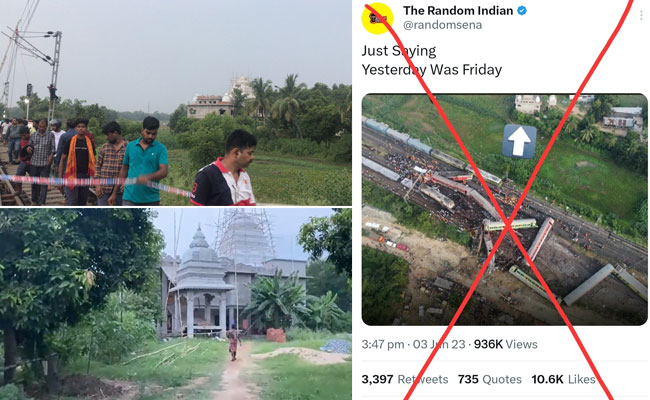
One tweet, shared by a user known as The Random Indian (@randomsena), included an aerial picture of the derailed coaches with a claim that the adjacent white building was a mosque. This tweet quickly gained traction, amassing over 5,200 retweets and about 11,500 likes, helping to spread the notion that the incident was the result of a conspiracy involving Muslims.
Fact-Checking the Claims
Alt News, a fact-checking organization, investigated the claim and corroborated that the structure in question is the Bahanaga ISKCON Temple, not a mosque as insinuated in the viral tweet. They presented additional evidence including site confirmation from journalists and video footage showing the temple entrance labeled with ISKCON signage.
This misinformation reflects a broader issue of how social media can perpetuate communal narratives that can lead to polarization. The mischaracterization of the temple has left many wondering how easily misinformation can spread and influence public perception following tragic events.
Responses to the Misinformation
In response to the tweet’s success, several users have called upon Prime Minister Narendra Modi to take action against mosques located near railway lines, demonstrating how quickly baseless claims can escalate into demands for punitive measures. On the other hand, Prime Minister Modi and Railway Minister Ashwini Vaishnaw have focused efforts on restoration of the affected railway lines, showing a pragmatic approach to addressing the aftermath of the disaster.
Alt News emphasized how absurd it is to link the presence of a place of worship to the cause of the railway accident, reiterating that the structure’s proximity did not correlate with the train mishap in any way. The broader narrative of communal blame needs to be scrutinized to prevent stigmatization of communities based solely on misinformation.
Why This Matters
This incident highlights the dangerous implications of spreading misinformation, especially in a country like India, where communal tensions can easily be inflamed by social media narratives. The events underscore the urgent need for digital literacy and responsible social media use to combat the circulation of falsehoods. It raises serious concerns over the impact such narratives can have on societal divisions, especially in sensitive contexts following a tragedy.
Frequently Asked Questions
What caused the Balasore railway accident?
The exact cause of the accident is still under investigation. However, it involved a chain of mishaps that led to multiple trains derailing, causing a significant number of casualties.
What role did social media play in spreading misinformation about the accident?
Social media played a pivotal role by amplifying a tweet that falsely connected the accident to communal identities, leading to unfounded allegations against a specific community.
What is the Bahanaga ISKCON Temple?
The Bahanaga ISKCON Temple is a religious site affiliated with the International Society for Krishna Consciousness (ISKCON), which conducts various religious and community programs, separate from any mosque.
What actions are government officials taking in response to the accident?
Prime Minister Narendra Modi and Railway Minister Ashwini Vaishnaw are focusing on restoration efforts for the railway lines affected by the accident, instructing immediate actions to restore service.