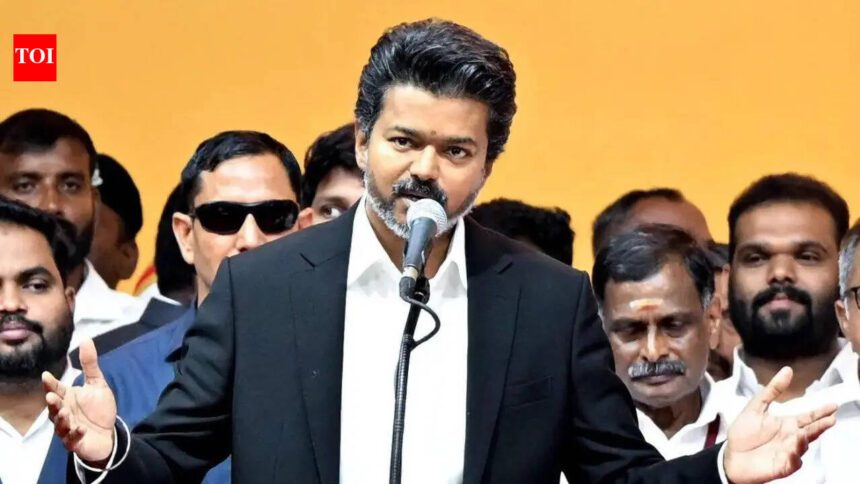

NEW DELHI: Tamil Nadu Chief Minister Joseph Vijay secured a significant victory in the state assembly on Wednesday, successfully proving the majority of his Tamilaga Vettri Kazhagam (TVK)-led coalition during a confidence vote. This vote was mandated by Governor RV Arlekar, who required the newly formed government to establish its majority no later than May 13.
With this win, Vijay, an actor-turned-politician, has marked the establishment of the first coalition government led by a new party in Tamil Nadu’s Dravidian political landscape, ending the long-standing dominance of the Dravida Munnetra Kazhagam (DMK) and the All India Anna Dravida Munnetra Kazhagam (AIADMK). In the recent election, the DMK secured 59 seats, while the AIADMK was reduced to 47. In contrast, TVK emerged as the largest party with 108 seats in the 234-member assembly, marking its inaugural participation in assembly elections just two years after its formation.
Vijay was sworn in as chief minister on May 7 at Chennai’s Jawaharlal Nehru Indoor Stadium, becoming the first chief minister in Tamil Nadu since 1967 not affiliated with either the DMK or AIADMK.
How Vijay Secured the Numbers
During the floor test, support from the Congress, Communist Party of India (CPI), Communist Party of India (Marxist) (CPM), Viduthalai Chiruthaigal Katchi (VCK), Indian Union Muslim League (IUML), and a faction of AIADMK enabled Vijay to achieve a comfortable victory. The voting results were as follows: 144 MLAs supported the TVK-led government, 25 MLAs backed AIADMK rebels, 22 MLAs opposed the motion, and 5 MLAs abstained.
However, TVK’s effective strength was temporarily reduced to 107 seats due to Vijay vacating one of the two constituencies he won after becoming chief minister. This left the party 11 seats short of the 118 needed for a majority. The Congress, having won five seats, was the first party to pledge support to the TVK, marking an end to its longstanding alliance with the DMK. The CPI and CPM, both with two seats each, also declared their support. Following negotiations, the VCK and IUML, which previously hesitated to join the coalition, eventually came on board, bringing the governing coalition’s tally to 121 seats.
AIADMK Dynamics
The political landscape shifted dramatically in the days leading up to the trust vote. Vijay’s visit to AIADMK rebel leader C Ve Shanmugam fueled speculation that a faction within the AIADMK was leaning toward supporting the new government. Approximately 30 AIADMK MLAs, expressing dissatisfaction with party chief Edappadi K Palaniswami’s leadership after the elections, indicated a willingness to back Vijay.
Amid this turmoil, Shanmugam accused Palaniswami of potentially collaborating with the DMK to thwart Vijay’s ascendancy. Shanmugam emphasized the party’s founding principles, stating any proposal to ally with the DMK contradicted its historical position against the party.
Compounding this conflict, a rebel faction led by former ministers SP Velumani and C Ve Shanmugam publicly endorsed Vijay’s government, with Velumani appointed as their legislative party leader. Shanmugam argued that supporting Vijay was essential to reviving the “Amma rule” associated with the late Chief Minister J Jayalalithaa.
Party Whip and Assembly Dynamics
In a bid to quell dissent, AIADMK leadership issued a whip prior to the trust vote, warning that any violation could result in disqualification under anti-defection laws. Party MP IS Inbadurai stressed the binding nature of the whip issued under Palaniswami’s authority.
The DMK has dismissed reports of any post-election coalition with the AIADMK and confirmed its intention to serve in opposition, with analysts suggesting that the ongoing factionalism within the AIADMK could benefit the DMK in the long term.
In his inaugural address to the assembly, Vijay articulated the importance of respect for all political voices, regardless of party strength, asserting that the assembly should function as both the “heart and the brain” of democracy, encouraging the acceptance of valuable suggestions while dismissing those that are not constructive.