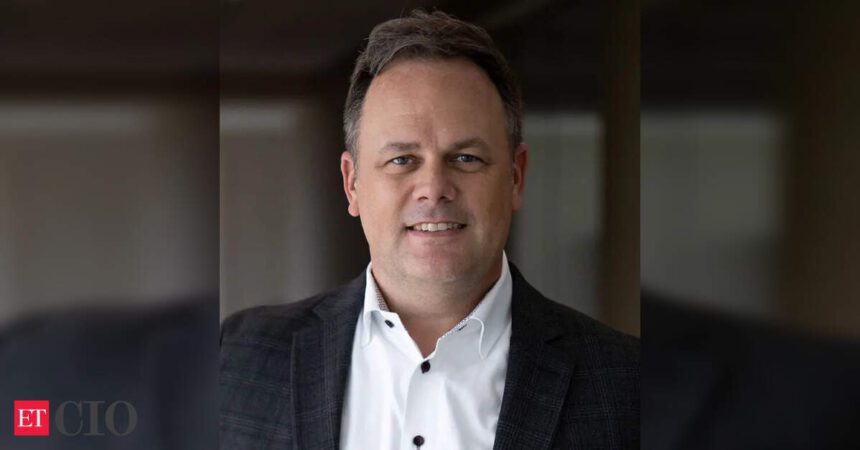

Bryan Harris, EVP and CTO at SAS, addressed the SAS Innovate 2026 conference, which attracted professionals from banking, insurance, life sciences, and the public sector. His key message emphasized the necessity of building trust within organizations before gaining trust in artificial intelligence (AI). This interview followed his keynote speech and has been edited for clarity and publication.
Edited Excerpts:
Harris stated, “Start with trust—and I mean a very specific kind of trust. Before you can build trust in AI, you have to build trust between leadership and the workforce.” He noted that many executives frame AI initiatives as cost-cutting measures, which leads to resistance among employees who may fear automation will threaten their jobs. “That’s not a technology problem. That’s a leadership problem,” he asserted.
He explained that the two main drivers in any business are revenue and profit. While cutting costs by reducing staff is a simpler approach, creating new revenue channels through AI requires vision and courage. “What I’m asking for from the market is leaders who are willing to do the harder thing.”
On the importance of access, Harris remarked, “We want people everywhere to have access to capable AI models—just as we wanted global access to broadband.” He pointed out that on-premises and hybrid deployments lower reliance on costly cloud-based solutions, making AI feasible for organizations with different economic contexts, particularly in markets like India. He expressed optimism about Indian users in Pune, who approach AI with fresh perspectives and are achieving impactful results.
Harris affirmed that SAS’s deterministic large language model (LLM) offers a competitive edge. He differentiated SAS from many startups, emphasizing their extensive experience in regulated sectors. “The sectors we serve are looking for precision, accuracy, and defensibility,” he stated, contrasting that with the demo-driven focus of many newer companies. SAS’s Viya platform is designed to provide reliable outputs grounded in proven analytics.
Regarding the relevance of quantum computing to AI, Harris described quantum technology as being at a stage similar to classical computers in the late 1970s. He remarked on the existing challenges in quantum computing, particularly around stability and reliable outputs. He posited that, if quantum capabilities mature, they could significantly enhance model training efficiency.
SAS has generated between 11 and 15 million lines of code each month through AI, ultimately targeting over 100 million lines by the end of 2026. Harris emphasized the need for frameworks for verification and validation in business domains, which he believes should involve collaboration among standards bodies, vendors, and customers.
When discussing the ethical considerations around AI, he highlighted that enterprises often sacrifice consistency under pressure to deliver results quickly. “The result isn’t just occasional errors; it’s a system that behaves unpredictably, which ultimately erodes trust,” he said.
The Pune R&D center is integrated within SAS’s global model, allowing for real-time collaboration and innovation. Harris noted that the Pune team operates with a fresh mindset, crucial for navigating evolving analytics challenges.
He cautioned enterprise leaders to be discerning in their application of AI, particularly in high-stakes environments. “If you are making a fraud decision in 30 milliseconds, you should not be putting a large language model in that flow,” he stated. Harris advocated for a complementary use of AI to enhance traditional models without compromising speed and accuracy.
In closing, he remarked on the effects of AI on creativity, arguing that while AI can generate outputs, it cannot replace the human intention behind creative work. “As soon as the public sees that your creativity was cheapened by AI, you have cheapened your product,” he concluded.
Harris’s insights reflect the critical role of leadership and ethics in advancing AI in sectors where precision and accountability are paramount.