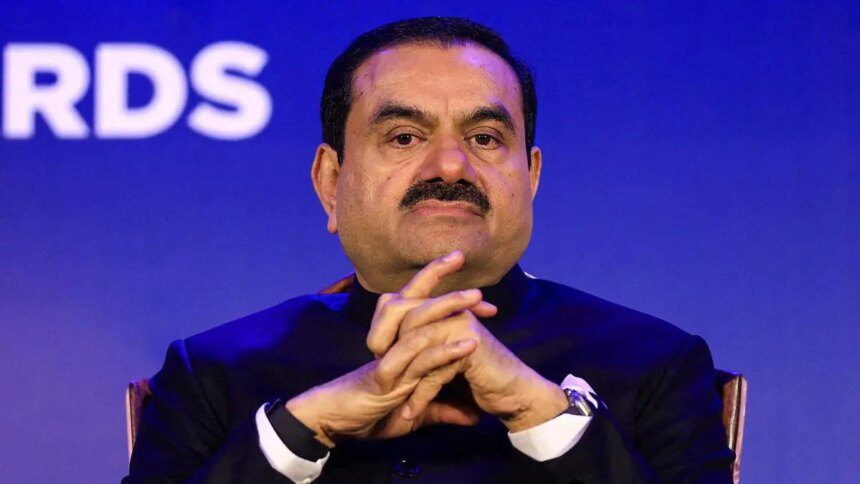

The U.S. Department of Justice has permanently withdrawn all criminal charges against Indian billionaire Gautam Adani and his nephew Sagar Adani, concluding a high-profile securities and wire fraud case in New York after prosecutors determined they could not uphold the allegations.
This decision coincided with the closure of multiple regulatory investigations involving the Adani Group in recent days.
Last week, the U.S. Securities and Exchange Commission (SEC) settled civil allegations against both men related to disclosures made to investors regarding solar energy projects in India. Court documents indicated that Gautam Adani agreed to pay $6 million while Sagar Adani settled for $12 million, without admitting or denying any wrongdoing.
Following this, the U.S. Treasury Department’s Office of Foreign Assets Control (OFAC) resolved claims that the Adani Group had violated U.S. sanctions on Iran concerning LPG imports. As part of this settlement, the conglomerate agreed to pay $275 million and provided extensive cooperation during the investigation, including making proactive disclosures.
In a court filing, the U.S. Department of Justice requested that the indictment against the Adanis be dismissed with prejudice, meaning the case cannot be reopened. “The Department of Justice has reviewed this case and has decided, in its prosecutorial discretion, not to devote further resources to these criminal charges against individual defendants,” the department stated. Subsequently, the court ordered the indictment to be dismissed with prejudice.
The case’s closure marks a significant turnaround for the Adani Group, which faced threats to its global expansion plans due to the SEC and DOJ allegations. Filed in late 2024, these allegations claimed that the Adanis orchestrated a $265 million bribery scheme involving Indian officials to secure solar power contracts while misleading U.S. investors and lenders.
Such dismissals with prejudice are rare in U.S. criminal proceedings, often reflecting a conclusion that pursuing the case is unwarranted after thorough review. Prosecutors found no definitive U.S. linkages or substantial evidence to support the allegations.
The anticipated dismissal follows months of intense negotiations between U.S. prosecutors and a strong legal team representing the Adanis. The defense comprised five legal advisors from law firms including Sullivan & Cromwell and Nixon Peabody, who presented core arguments to U.S. authorities during the review, ultimately leading to the dismissal of charges.
In submissions publicly disclosed on April 7, 2026, the Adani legal team forcefully contested the SEC’s jurisdiction over the case. They labeled the SEC’s fraud-related proceedings as an “impermissibly extraterritorial application” of U.S. securities laws, arguing that the case involved Indian defendants, an Indian issuer, and securities not traded on U.S. exchanges, with all alleged acts occurring solely in India.
The defense asserted that the SEC lacked necessary jurisdiction and failed to establish actionable misstatements or to connect the defendants to the bond offering. They contended that the SEC had reinterpreted unviable anti-bribery allegations into securities fraud claims, highlighting that there had been no investor losses and that Gautam Adani was not responsible for authorizing the bonds.
The case had drawn criticism from legal experts regarding whether authorities had overstepped securities laws to address conduct predominantly occurring overseas. Gautam Adani, Sagar Adani, and Vneet Jaain faced charges solely under securities and wire fraud statutes, while other defendants faced more serious charges under the Foreign Corrupt Practices Act, further complicating the prosecution’s position.
The Adani Group has consistently dismissed the allegations as unfounded, defending its governance and compliance standards and pledging to pursue legal avenues to contest the claims. This distinction, coupled with the lack of U.S. linkages, has increasingly shaped scrutiny of the government’s legal strategy, with former SEC commissioner Laura Unger suggesting that authorities had attempted to base a securities fraud case on bribery allegations that had not been formally pursued or adjudicated in India.
Published on May 18, 2026.