Summary
The recent demolition of the Arabia Zia-ul-Uloom Madrasa in Siddharthnagar, Uttar Pradesh, has sparked considerable controversy, highlighting issues of land rights and the treatment of religious institutions within the Indian legal framework. Following a court ruling that classified the madrasa as an encroachment on government land, authorities swiftly executed the demolition, leading to public outcry regarding the treatment of minority communities under BJP-led governance.
Background of the Demolition
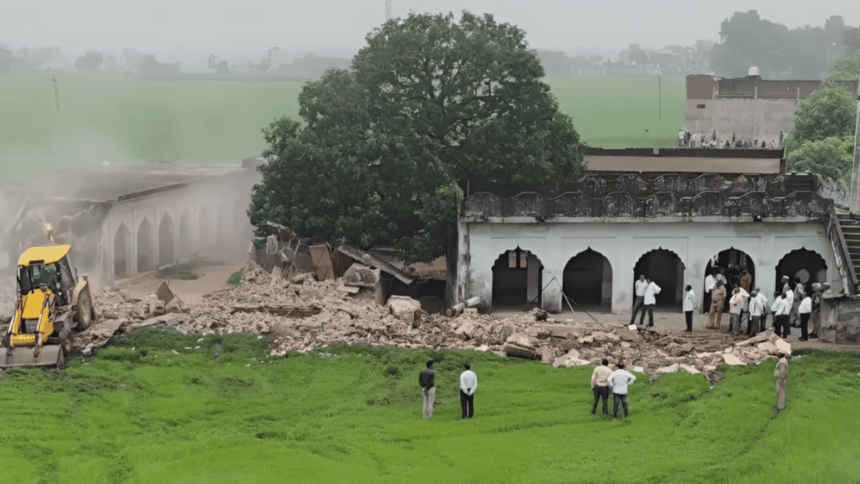
On August 14, 2023, the District Magistrate’s Court upheld a previous ruling from the Domariyaganj Tehsildar’s Court that initiated the process for the demolition of the madrasa. The court’s decision arose from claims made by five local villagers who argued that the institution encroached upon approximately 9,000 square feet of government-designated land, previously recorded as a playground. The Arabia Zia-ul-Uloom Madrasa, which has been an educational institution for the local Muslim community since its establishment in 1938 and subsequent relocation in 1967, provided education to around 400 children.
Local authorities, led by Domariyaganj Sub-Divisional Magistrate (SDM) Vivekanand Mishra, commenced the demolition at 7 a.m., utilizing bulldozers and a police presence of nearly 100 personnel. Within two hours, critical structures of the madrasa, including classrooms and a shop, were dismantled. Officials indicated that although the madrasa began on private land, it had expanded over the years onto government property, triggering legal action.
Public Response and Political Ramifications
The demolition incited significant backlash from political leaders, particularly within the Samajwadi Party. MLA Saiyeda Khatoon, along with local party members, protested at the site, arguing that the demolition was “unjustified.” Tensions escalated when police intervened, resulting in clashes and barricades being erected to maintain order.
The Aam Aadmi Party (AAP) condemned the demolition as “unconstitutional,” framing it as a violation of religious freedom and equality. Congress leader Javed Ashraf Khan labeled it as part of an “open hate agenda against Muslims.” Activist Abdur Raqueeb Khan criticized the selective application of the law regarding religious structures, emphasizing that equitable enforcement is necessary across all communities.
This incident is part of a broader context where religious minorities, particularly Muslims, have faced increased scrutiny under the current government. The rapid execution of legal decisions against minority institutions raises concerns over systemic biases that may favor certain groups over others, fostering a climate of exclusion and marginalization.
The Bigger Picture: Systemic Discrimination
The demolition of the madrasa serves as a pivotal case study in understanding how policies and legal frameworks can disproportionately impact religious minorities in India. Over the years, reports have emerged detailing various instances of social exclusion, economic boycotts, and marginalization faced by the Muslim community. These events often occur parallel to rising Hindutva nationalism, which advocates for policies that can sideline minority rights.
As political rhetoric increasingly emphasizes majoritarian policies, lesser attention is allocated to ensuring equitable treatment of diverse communities. The demolition of the Arabia Zia-ul-Uloom Madrasa not only highlights individual grievances but also signifies a systemic issue that calls into question the commitment to secularism in Indian governance.
Why It Matters
The demolition of religious institutions like the Arabia Zia-ul-Uloom Madrasa can have far-reaching implications beyond the immediate community. It reflects broader societal patterns where governance appears to increasingly favor majority populations, challenging the framework of secularism and pluralism in India. For developers and users in the tech industry, understanding these socio-political dynamics is crucial; applications and platforms cannot ignore these realities as they may affect user engagement and trust.
The significance of this event resonates within the AI industry as well. Algorithms and models trained on biased data run the risk of perpetuating discrimination, making it vital for tech developers to ensure fairness and inclusivity in their designs. The interconnectedness of technology and societal issues underlines the need for ethical considerations in both product development and corporate policies.
Frequently Asked Questions
What led to the demolition of the Arabia Zia-ul-Uloom Madrasa?
The demolition was initiated following a court ruling that upheld claims of encroachment on government land. Villagers claimed the madrasa extended into a previously designated government playground.
How did the local community respond to the demolition?
The demolition sparked protests led by local politicians, including members of the Samajwadi Party, who labeled the action as unjustified and representative of broader issues of discrimination against Muslims.
What are the implications of this event for religious minorities in India?
This case reflects a concerning trend of increasing marginalization and discrimination against religious minorities in India, calling into question the commitment to secularism and equal rights under the law.
How does this situation tie into the broader political landscape in India?
The demolition underscores the tension between majoritarian governance and minority rights, raising alarms about the ongoing systemic challenges faced by minority communities within a changing socio-political climate.