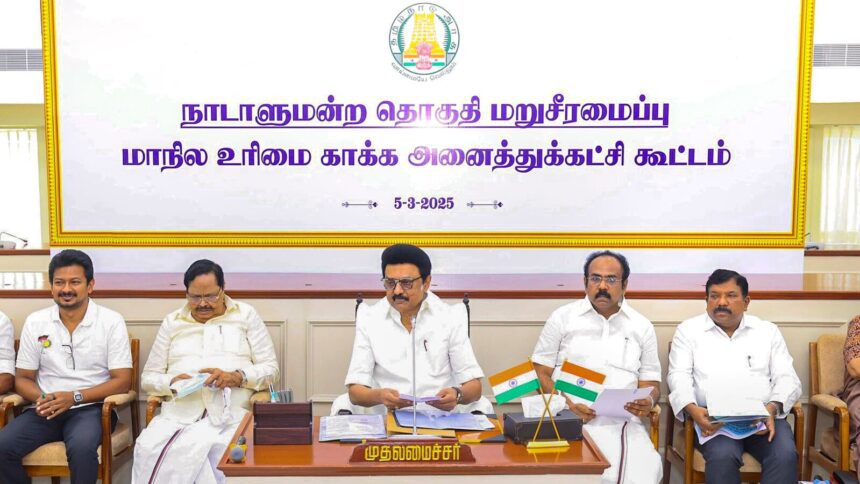

On March 5, a majority of political factions across Tamil Nadu convened for an all-party assembly called by Chief Minister MK Stalin to resist the delimitation of Parliamentary constituencies scheduled for 2026. The state assembly elections are also set to occur in Tamil Nadu in 2026.
In this meeting, the parties urged the Centre to prolong the 1971 Census-based delimitation for an additional 30 years past 2026, citing the need for “fair representation” for states that have effectively managed their population growth.
Last week, Union Home Minister Amit Shah assured that southern states would not lose “even a single seat” after the upcoming delimitation of constituencies. However, Karnataka expressed skepticism, stating that Shah’s claims regarding the contentious issue were “not credible.”
Siddaramaiah accused the Bharatiya Janata Party (BJP) of leveraging delimitation as a means to “marginalize” southern states. The anticipated delimitation has sparked disputes between certain southern states and the central government.
What exactly is delimitation? According to the law, ‘delimitation’ refers to the process of altering the boundaries of constituencies. This is conducted based on the updated population statistics from the latest census. Delimitation is a constitutional obligation aimed at ensuring a just and representative electoral system and the equitable representation of citizens in governance.
What does the Constitution stipulate about delimitation?
The number of seats in Parliament and state assemblies is determined by population figures. The intention is to ensure that the number of constituents represented by a Member of Parliament (MP) or a Member of the Legislative Assembly (MLA) remains consistent. This aligns with the principle of ‘one citizen, one vote, one value’ established under Article 81 of the Constitution of India.
The Constitution mandates that the number of seats in both houses (Parliament and state assemblies) be realigned after each census. “Following each census, the allocation of seats in the House of the People to the States and the division of each State into territorial constituencies shall be readjusted by such authority and in such manner as Parliament may by law determine,” states the text of
Moreover, Article 170(3) of the Constitution declares: “Upon the completion of each census, the total number of seats in the Legislative Assembly of each state and the division of each State into territorial constituencies shall be readjusted by such authority and in such manner as Parliament may by law determine.”
When has delimitation occurred previously?
A census was conducted in India in 1951, which led to the establishment of the first delimitation commission under the Delimitation Commission Act of 1952. Its objective was to delineate the boundaries of Lok Sabha and state assembly constituencies. Since then, these boundaries have been revised on three occasions—in 1962, 1972, and 2002—by the delimitation commission formed under the
In the most recent exercise, some constituency boundaries were updated using data from the 2001 Census. However, the number of Lok Sabha seats, the allocation of these seats among different states, and the number of seats in state assemblies have remained unchanged since the delimitation carried out in 1972.
After the 1951 census, the number of Lok Sabha seats was fixed at 494, which later increased to 522 following the 1961 census. However, since 1971, the count of Lok Sabha seats has been capped at 543. This translates to roughly 1 million constituents represented by each member of Parliament.
What roles did Indira Gandhi and Atal Bihari Vajpayee play?
During the Emergency period (June 25, 1975 – March 21, 1977), the Congress government led by Indira Gandhi enacted the 42nd amendment, formally known as The Constitution (Forty-second Amendment) Act, 1976. This amendment established that the 1971 census would serve as the reference point until the first census conducted after 2000, effectively freezing the number of Lok Sabha seats until that time.
In 2002, the government led by Prime Minister Atal Bihari Vajpayee extended this freeze for an additional 25 years, delaying any revisions until at least 2026. This is the freeze that Chief Minister MK Stalin is advocating be continued for another 30 years with respect to the number of Lok Sabha seats.
“It is wholly unjust to diminish the parliamentary representation of Tamil Nadu and the southern states simply because they have efficiently implemented measures for population control. In this context, to incentivize all states to adopt population control strategies, the then-Prime Minister assured in the year 2000 that parliamentary constituencies would remain determined based on 1971 population figures. In line with this assurance, the Honorable Prime Minister must now reaffirm in Parliament that this delimitation framework will be extended for another 30 years,” stated one of the six resolutions passed at Stalin’s all-party meeting on March 6.
What is the procedure for delimitation?
Initially, the President appoints a Delimitation Commission, which is led by a retired judge of the Supreme Court. The panel also includes the Chief Election Commissioner or a representative, as well as the State Election Commissioners.
Furthermore, associate members are designated for each state or Union Territory where delimitation is necessary. These members typically consist of members of Parliament (MPs) appointed by the Council of Ministers and members of the legislative assemblies appointed by the Speaker of each Legislative Assembly.
The Commission operates independently, and the revised boundaries established by it cannot be contested in court.
Upon completing its work, the Delimitation Commission publishes its recommendations and seeks feedback from the general public, political entities, and other interested parties. Once announced in the official Gazette, the Commission’s directives become applicable in the ensuing election.
What are the concerns of the southern states?
The delimitation process is to be finalized based on the upcoming 2021 Census, which was postponed due to the COVID-19 pandemic, and is anticipated to commence this year. The census will likely be followed by the delimitation of constituencies.
The apprehension among southern states stems from the observation that, owing to better economic conditions, population growth has been lower in these regions compared to the north. Consequently, if delimitation is conducted based on population data, northern states are likely to gain more parliamentary seats relative to the South. This would reduce the political weight of southern states.
Regional parties in the South are concerned that delimitation based on population figures may tilt elections in favor of parties like the BJP, which already holds a significant base in the North.
It is entirely unfair to lessen the parliamentary representation of Tamil Nadu and southern states just because they have effectively implemented population control strategies.
The BJP has maintained dominance in northern states for an extended period. Of the 99 parliamentary seats, the Congress party enjoys a stronger presence in the South compared to the North, commanding 53 seats across Karnataka, Maharashtra, Kerala, Telangana, and Tamil Nadu.
“Considering the relatively faster rate of population growth in Northern India, seat allocations based on current population figures would result in states like Tamil Nadu, Andhra Pradesh, and Kerala losing Lok Sabha seats while states like Uttar Pradesh, Bihar, Rajasthan, and Madhya Pradesh could gain seats,” noted a Chennai-based data analyst in a recent conversation with LiveMint.
Stay updated with all the latest Business News, Politics updates, Breaking News Events, and more on Live Mint. Download TheMint News App for Daily Market Updates.