
Summary
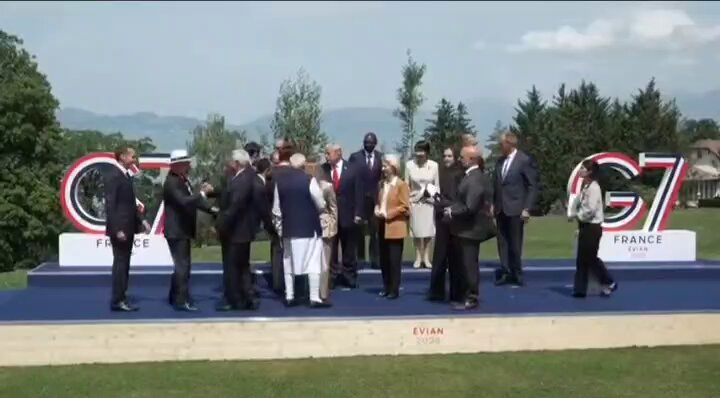
During the G7 summit, former U.S. President Donald Trump greeted Indian Prime Minister Narendra Modi in a surprising manner, standing up from his seat to shake hands. This gesture has drawn considerable attention as it contrasts with Trump’s previous behavior towards Modi, where he appeared to ignore him.
Context: The G7 Summit and Global Interactions
The G7 summit, an assembly of the world’s major advanced economies, serves as a platform for discussing global issues ranging from economic stability to climate change. It is an event where leaders gather to reinforce international ties and address pressing challenges. The interaction between Trump and Modi at such a high-profile event highlights the complexities of geopolitical relationships.
Typically, body language and gestures at these summits can send strong messages about the rapport between leaders. Trump’s decision to stand up and greet Modi may indicate a thawing in relations or an acknowledgment of India’s growing significance on the world stage.
Trump and Modi: A Complicated Relationship
The relationship between Donald Trump and Narendra Modi has gone through various phases. While both leaders have expressed admiration for each other in the past, there have also been moments of tension. Trump’s earlier dismissal of Modi, where he seemed to ignore him, contrasted sharply with his latest display of respect. This change is noteworthy as it may suggest a strategic recalibration in Trump’s view of India’s global role.
The dynamics between the two leaders are influenced by a range of factors, including regional security issues, economic partnerships, and the global balance of power. As India continues to emerge as a major player internationally, such gestures from world leaders like Trump may reflect a recognition of that status.
Public and Political Reactions
The media coverage around Trump’s gesture has been significant, with various outlets highlighting its implications. Indian news platform Aaj Tak reported on the incident, emphasizing the unexpected nature of Trump’s handshake and its potential impact on public perception. Social media has also played a role in disseminating this information rapidly.
Political analysts are discussing what this means for the future of Indo-U.S. relations. The handshake could be interpreted as an olive branch or as a strategic move by Trump to reinforce alliances in a changing geopolitical landscape.
Why This Matters
For Indian readers, the interaction between Trump and Modi represents more than just a momentary greeting. It underscores the larger narrative of India’s rising influence on the global stage. As the world’s largest democracy, India’s role in international affairs is increasingly pivotal, particularly in trade, security, and climate change initiatives.
The relationship with the United States is crucial for India, both economically and strategically. A positive rapport between leaders is likely to enhance bilateral ties, impacting areas such as defense collaborations and trade agreements. Therefore, observations during such summits are not merely ceremonial; they shape the future trajectory of India’s international engagements.
Frequently Asked Questions
What was the significance of Trump standing up to greet Modi?
Trump standing up to greet Modi at the G7 summit signifies a potential warming of relations between the two leaders, suggesting recognition of India’s importance on the global stage.
How has the relationship between Trump and Modi evolved?
Trump and Modi’s relationship has experienced fluctuations, marked by moments of camaraderie as well as instances of tension. This recent gesture indicates an effort to enhance rapport.
What impact does this interaction have on India-U.S. relations?
The handshake at the G7 summit could strengthen bilateral ties, influencing areas such as trade, defense, and global cooperation on issues like climate change.
Why is the G7 summit important for India?
The G7 summit provides India with an opportunity to engage with major world leaders, reinforcing its position as a key player in international discussions on global challenges.