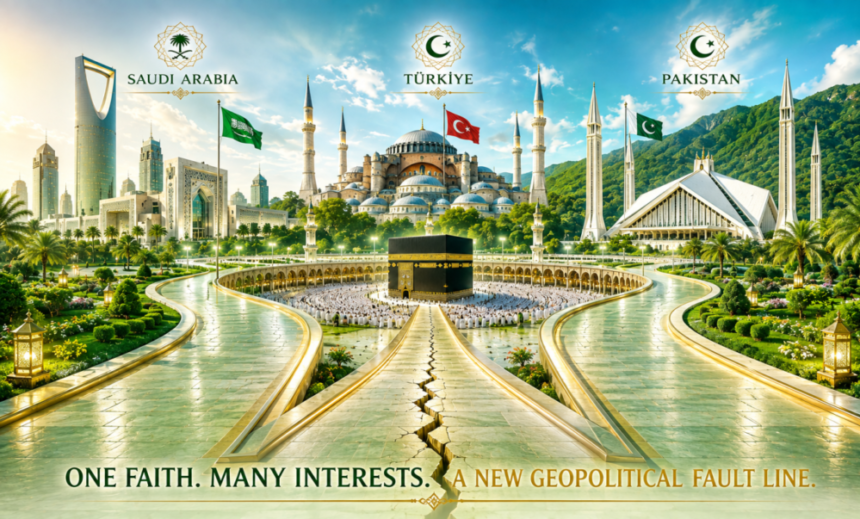

The recent signing of the Mecca Joint Defence Agreement between Saudi Arabia, Türkiye, and Pakistan marks a significant geopolitical shift in the Muslim world, emphasizing national interests over collective solidarity. This pact illustrates a growing trend where individual countries prioritize their security concerns, potentially redefining the dynamics of Muslim unity and regional geopolitics.
Background of the Mecca Pact
On August 7, 2023, the three nations committed to a defensive framework that regards any aggression against one member as aggression against all. This agreement emerges from the backdrop of heightened tensions in the region, particularly in light of U.S.-Iran conflicts and Iranian activities in the Gulf. Notably, the pact’s defensive language masks significant implications for the strategic landscape of the Middle East and South Asia.
Saudi Arabia brings substantial financial and energy resources to the table, while Türkiye contributes a robust conventional military and a burgeoning defense industry. Pakistan, the sole nuclear-armed nation among them, reinforces this alliance by supplying military personnel and experience. The interoperability among these nations underscores a strategic necessity: their specific vulnerabilities collectively shape a mutual defense pact.
Geopolitical Implications of the Pact
This agreement acts as a new security architecture, effectively connecting the Gulf, Anatolia, and South Asia into a cohesive defensive bloc. By linking diverse strategic theaters, the Mecca pact introduces a regional layer to the previously compartmentalized security concerns related to American influence, Iran’s nuclear ambitions, and Israel’s role in the region.
While the alliance does not explicitly target Iran, its strategic implications could compel Tehran to reassess its posture in the wider region. With the possibility that hostility toward one member can evoke response from the others, Iran may need to navigate its regional strategies with greater caution, altering its established role as a champion of resistance.
Shifts in Muslim Identity and Unity
The Mecca pact signals a potential fracture in the notion of a unified Muslim community. The Organization of Islamic Cooperation (OIC) represents 57 diverse member states with varying interests, and the new alliance emphasizes how nations may prioritize national security over a shared Islamic identity. Countries like Saudi Arabia, Türkiye, and Pakistan now pursue their individual agendas informed by local threats and opportunities, raising questions about the very foundation of Muslim solidarity.
This evolution could lead to a reality where the Muslim world might evolve into several distinct power centers, each defining its own strategic approach. Whether this trend solidifies a new form of Sunni strategic alignment remains to be seen, but it undeniably complicates the narrative of a singular Muslim geopolitical community.
Why It Matters
The implications of the Mecca agreement extend beyond military collaboration, influencing diplomatic, economic, and social contexts within the geopolitical chessboard of the Middle East and South Asia. For developers and analysts in the AI industry, a shift toward nation-centric interests could prompt a re-evaluation of how technologies, cybersecurity, and information dissemination are approached in a rapidly evolving landscape marked by growing nationalism and reduced multilateral cooperation.
As these nations recalibrate their defense strategies, the development of AI-driven military technologies may receive increased investment and focus, impacting international collaborations and the sharing of critical defense technologies. The shifting priorities may also create opportunities and challenges for AI developers who work across borders in multiple regulatory environments.
Frequently Asked Questions
What is the Mecca Joint Defence Agreement?
The Mecca Joint Defence Agreement is a defense pact signed by Saudi Arabia, Türkiye, and Pakistan on August 7, 2023, establishing a mutual defense commitment against external aggression.
What are the implications for Iran following this pact?
While not explicitly aimed at Iran, the pact creates a new strategic calculus for Tehran, which may have to reconsider its regional approach to avoid triggering responses from the pact’s members.
How does this affect the interpretation of Muslim unity?
The agreement poses significant questions regarding traditional notions of Muslim unity, as it emphasizes individual states’ security interests potentially at the expense of a collective political identity.
What might this mean for the United States and its role in the region?
This new arrangement does not signify the end of American influence in the region but rather could lead to a diversification of security partnerships, allowing the U.S. to focus on strategic priorities that only it can effectively manage.