
Summary
The recent demolition of Masjid-e-Maulana in Telangana’s Sangareddy district has raised significant concerns regarding legal rights, religious sensitivity, and social justice. The actions taken by the revenue officials, coinciding with Ramadan, have ignited accusations of discrimination against the Muslim community and prompted calls for accountability from various political and human rights organizations.
The Demolition Incident
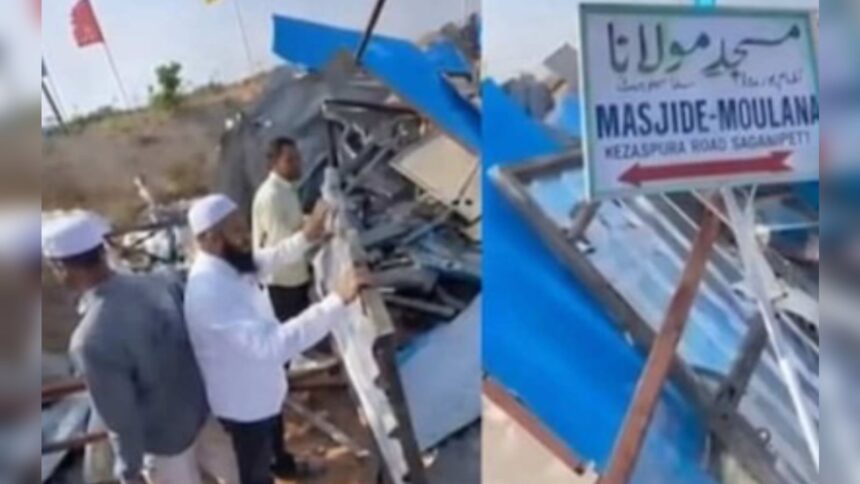
On the eve of Ramadan, authorities demolished the newly constructed Masjid-e-Maulana in Sadasivpet, contending that it was illegally built on government-classified “Inam land.” This swift action followed the mosque’s completion and the commencement of prayers, prompting criticisms regarding the timing and insensitivity shown towards the Muslim community during a significant religious period.
Local reports indicate that the mosque had opened just days prior to its demolition, heightening feelings of distress within the community. Revenue officials maintained that structures erected on “Inam land” are against regulations, thereby justifying their actions. Residents lamented the absence of prior notice about the demolition, with one expressing, “If there was a legal issue, authorities should have issued warnings and allowed court proceedings.”
Community and Political Reactions
Community members have voiced their grievances, particularly targeting the alleged mishandling of the legalities surrounding the mosque. Land claimant Mohammed Kaleem, who purchased the property two years ago, argued that authorities had not contested the presence of the mosque prior, highlighting the community’s persistence to seek a peaceful space for prayer.
Political leaders, including AIMIM president Asaduddin Owaisi, condemned the demolition, questioning the timing of the enforcement and the delay in addressing the issue for two years following construction. Owaisi has instructed local party leaders to engage with relevant officials to seek clarity on the matter. The AIMIM and Majlis Bachao Tehreek (MBT) have called for accountability, including the suspension of key officials involved and criminal charges against those responsible for the demolition.
Broader Context of Minority Rights
This incident is not isolated; it follows a troubling pattern of actions impacting minority communities in India. A recent vandalism incident at a mosque in Yadadri Bhuvanagiri, where defacement and desecration occurred, further underscores heightened tensions. Human rights organizations have expressed concern over these actions, calling for transparency and fairness in governmental approaches toward religious minorities.
The ongoing struggles faced by Muslims regarding their rights, property, and religious freedoms reflect a broader context of exclusion and marginalization. Activists assert that such abrupt actions, particularly without dialogue, contribute to socio-political strife and mistrust among communities. This raises critical questions about the legislative frameworks governing minority rights in India, especially under the current regimes.
Why It Matters
Understanding the implications of these incidents is crucial for the global community, particularly as they relate to issues of religious freedom and social justice. Demolitions of places of worship can result in long-lasting psychological impacts on affected communities, exacerbating social divisions and fear. Political instability can surface in localized protests, engaging international human rights observers. Global developers and practitioners concerned with inclusive governance should note that the trajectory of minority rights in India could influence regional stability and socio-economic development.
Frequently Asked Questions
What is Inam land?
Inam land refers to land granted by the government under specific conditions for certain designated purposes, often protected from private ownership or unauthorized usage.
Why was the mosque demolished during Ramadan?
The demolition took place shortly after prayers commenced in the newly constructed mosque, coinciding with the start of Ramadan. This timing has drawn significant criticism for being culturally insensitive.
What are the legal claims surrounding the land?
The land claimant, Mohammed Kaleem, asserts that he legally purchased the plot two years ago and that authorities had previously allowed the mosque’s construction without objections.
What actions have political leaders called for following the demolition?
Political leaders from AIMIM and MBT have demanded accountability, including the suspension of officials involved, potential criminal charges against them, and reconstruction of the mosque on the same site.





![Community members raise their arms during a gratitude poem at a supper in Westbrook, Maine, in July 2025 [Courtesy of Community Plate]](https://www.indianewsweek.com/wp-content/uploads/2026/09/Potluck-Parties-Surge-in-Popularity-Across-America-A-Culinary-Revival-300x203.jpeg)