
NEW DELHI: The stage is set for a significant electoral battle as West Bengal and Tamil Nadu prepare for assembly elections on Thursday, April 23. Tamil Nadu will conduct voting in a single phase across all 234 seats, while West Bengal will see voting for 152 seats in this initial phase, with a second phase scheduled for April 29.
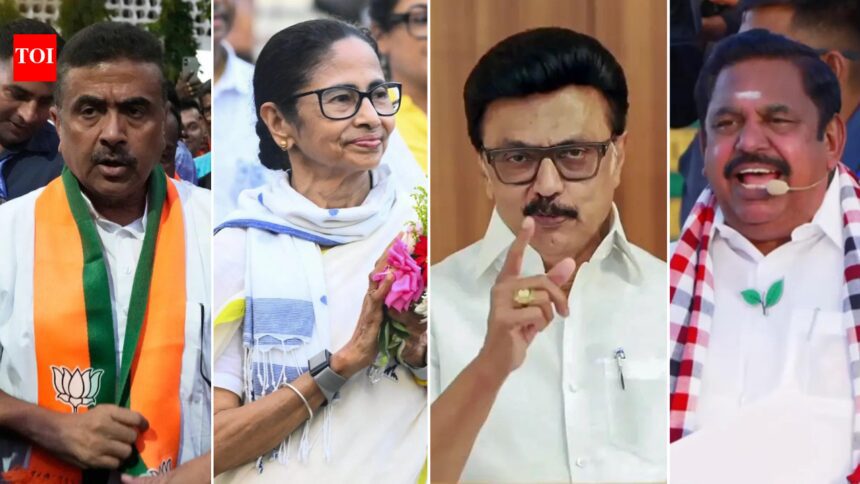
Both states have been characterized by intense and high-profile campaigning led by major political figures. The Bharatiya Janata Party (BJP), represented by Prime Minister Narendra Modi and Home Minister Amit Shah, is making a concerted effort to challenge incumbents Mamata Banerjee and MK Stalin. Rahul Gandhi and other leaders have also contributed to the campaign activities.
Amit Shah adopted a combative stance, asserting, “In Tamil Nadu and Puducherry, Congress will not even cross double digits.” The Election Commission has increased its vigilance in light of heightened political tensions. Since February 26, authorities have seized cash, liquor, drugs, and other inducements valued at over ₹1,000 crore, with total recoveries now at ₹1,072.13 crore.
In Tamil Nadu, the movement of Electronic Voting Machines and polling materials has been heavily secured, while West Bengal has seen significant deployment of central forces, drawing criticism from Mamata Banerjee, who questioned if this was intended to intimidate voters. She raised concerns regarding the use of CRPF armoured vehicles during polling and alleged that the BJP-led Centre was manipulating state machinery to influence the election results.
West Bengal
Key constituencies in the first phase of the West Bengal assembly election include Nandigram, represented by Suvendu Adhikari, who previously defeated Chief Minister Mamata Banerjee. Banerjee has since relocated to contest from Bhabanipur, while Adhikari has also filed nomination papers for that seat. Other significant constituencies in this phase include Darjeeling, Siliguri, and Jalpaiguri, with campaigning concluding on April 21.
North Bengal is a focal point in Phase 1, featuring 54 assembly seats. In Nandigram, Adhikari faces Trinamool Congress candidate Pabitra Kar and others, making it one of the most closely watched contests. The political rivalry remains fierce as Banerjee aims to retain power and consolidate support, while the BJP seeks to capitalize on its momentum from 2021. Modi and Shah have promoted the slogan “sonar bangla” in response to Banerjee’s “Bohiragata” narrative, sharpening their attack on issues such as law and order by citing specific incidents.
Amid sustained struggles, the Congress Party and Left Front continue to vie for relevance in the state, with the Congress potentially influencing outcomes in Kolkata and regions beyond. The Trinamool Congress has found itself under scrutiny from its allies within the INDIA bloc, as it aims to preserve its dominance in West Bengal’s political landscape.
Tamil Nadu
In Tamil Nadu, more than 5.73 crore voters are preparing to cast their votes to choose from 4,023 candidates during this high-stakes assembly election. Security measures are stringent, accompanied by an extensive crackdown on electoral inducements by the Election Commission.
The primary contest is expected to unfold between the DMK-led alliance and the AIADMK-led front, with Chief Minister MK Stalin seeking a second term while Edappadi K Palaniswami aims to reclaim power after five years. The political scene in Tamil Nadu has been traditionally dominated by Dravidian parties, and this election reflects that prevailing trend. Recent years have shown the DMK to be electorally robust, whereas the AIADMK has struggled post the death of former Chief Minister J Jayalalithaa, with its last assembly election victory occurring in 2016.
The national parties, BJP and Congress, play a minor role, with the BJP allied with the AIADMK and the Congress aligning with the DMK.
An additional factor in this election is the involvement of Tamil superstar Vijay and his party, Tamilaga Vettri Kazhagam, who has attracted substantial crowds. However, his recent rally in Karur led to a tragic stampede, raising safety concerns.
While Vijay’s entry introduces a new dynamic, his party is contesting independently of the traditional DMK and AIADMK alliances. Unlike the BJP and Congress, TVK is not perceived as an outsider in Tamil Nadu politics. Nevertheless, the question remains whether this public support can translate into actual votes, a challenge that has historically confronted celebrity-led political efforts in the state.
The assembly election results for West Bengal, Tamil Nadu, Assam, Kerala, and Puducherry will be announced on May 4.