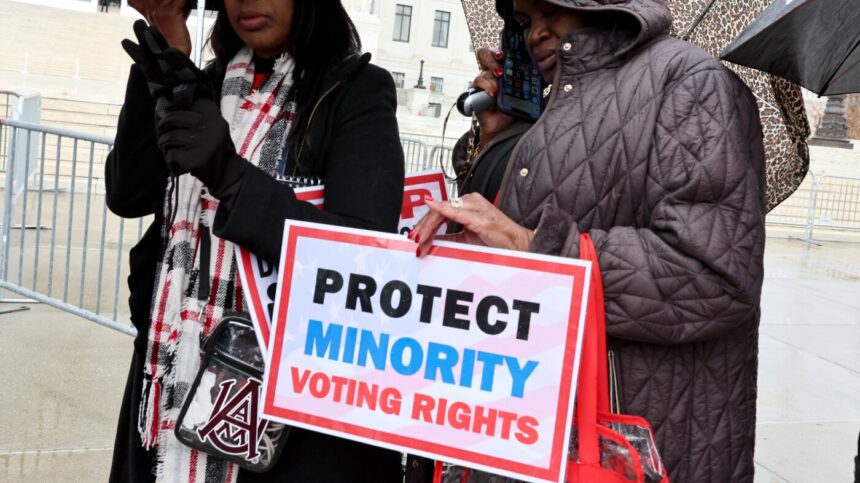

In a recent move, the U.S. Supreme Court declined to review a lower court ruling that undermines critical protections for minority voters under the Voting Rights Act. This decision has sparked renewed discussions about voting rights, especially the implications for private individuals seeking to enforce their rights in the democratic process.
Supreme Court’s Decision on Voting Rights
The Supreme Court’s refusal to take up an appeal from Arkansas United, an immigrant advocacy group, leaves intact a controversial ruling from the 8th U.S. Circuit Court of Appeals. This ruling limits private groups’ ability to bring lawsuits under Section 208 of the Voting Rights Act, which allows voters needing assistance—especially those with disabilities or language barriers—to seek help from someone they trust during elections.
The court’s decision effectively ends the long-standing practice of allowing private individuals to challenge voting rights infringements in several Midwestern states, including Arkansas, Minnesota, and North Dakota. The implications of this decision could lead to decreased avenues for individuals to advocate for their voting rights.
Impact on Minority Voters
In the wake of this ruling, many fear that protections for minority voters could be significantly weakened. The 8th Circuit had explicitly ruled that private groups, such as Arkansas United, do not have the right to sue to enforce voting assistance provisions under the Voting Rights Act. This stance threatens the ability of many low-income and language-impaired voters to navigate the electoral process effectively.
This ruling is particularly concerning to advocates, as it diminishes the roles civil society organizations play in assisting vulnerable voters, who may otherwise face numerous barriers when trying to exercise their democratic rights. According to Thomas Saenz, president of the Mexican American Legal Defense and Educational Fund (MALDEF), this situation presents a significant anomaly, as historically, courts have upheld private rights to sue under various provisions of the Voting Rights Act.
The Broader Context of Voting Rights in the U.S.
This Supreme Court decision is part of a broader trend of diminishing protections under the Voting Rights Act. Just months prior, a conservative majority on the court issued another ruling that weakened protections against racial discrimination in redistricting. This pattern has led to growing concerns about the future of voting rights across the United States, where states might impose even more restrictive measures on voting.
As officials from various states rally behind this restrictive interpretation, there is increasing trepidation that the current legal landscape could lead to further disenfranchisement of minority communities in future elections.
Why This Is Trending
The topic of voting rights is generating significant interest in India and globally due to its implications for democracy. As countries work towards ensuring fair electoral processes, many citizens are concerned about rising disenfranchisement and the pushback against existing voting rights protections, particularly for marginalized communities. In India, where electoral integrity and inclusivity are paramount, developments around voting rights abroad often resonate, prompting discussions on similar issues at home.
Frequently Asked Questions
What did the Supreme Court decide regarding the Voting Rights Act?
The Supreme Court declined to review a ruling from the 8th U.S. Circuit Court of Appeals that limits the ability of private individuals and groups to sue for voting assistance under Section 208 of the Voting Rights Act.
How does this ruling affect minority voters?
This ruling makes it more difficult for minority voters, particularly those needing language assistance or help because of disabilities, to seek remedies against voting rights violations, thereby weakening protections that were previously in place.
What is Section 208 of the Voting Rights Act?
Section 208 allows voters who require assistance—such as those with disabilities or limited English proficiency—to receive help from a person of their choice when casting their ballots.
Why is the Missouri case significant?
The Missouri case, led by advocates for disabled voters, challenges state laws that limit assistance at polling places and will seek to establish a private right of action, potentially setting the stage for higher court challenges to existing interpretations of the Voting Rights Act.