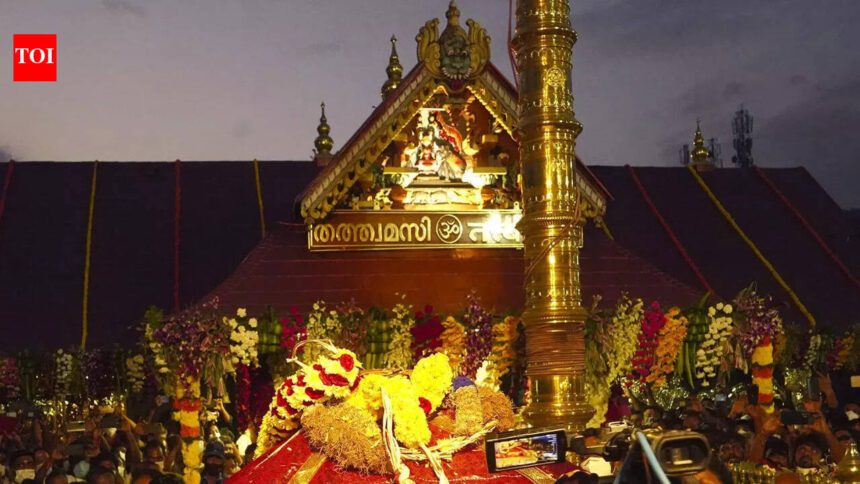

NEW DELHI: In a notable development that appears to contradict a previous ruling that annulled the Sabarimala Ayyappa temple’s practice of prohibiting the entry of women aged 10 to 50, the Supreme Court on Thursday tentatively agreed that the rights of devotees to determine their manner of worship are non-justiciable. This statement emerged during the proceedings following an argument presented by senior advocate J Muth Raj, who highlighted that in Hinduism, every village has its ‘gram devta,’ every family has a ‘kul devta,’ and each individual has their ‘ishta devta,’ all of whom are revered in different ways. He contended that it would be impractical for the court to assess the essentiality of such practices within the broader context of the religion.
The bench deliberating on the Sabarimala case included Chief Justice Surya Kant and Justices B V Nagarathna, M M Sundresh, Ahsanuddin Amanulla, Aravind Kumar, A G Masih, P B Varale, R Mahadevan, and J Bagchi. During the discussions, Chief Justice Kant and Justices Nagarathna, Sundresh, Kumar, and Mahadevan expressed their reluctance to apply judicial scrutiny to the mode and manner of worship chosen by devotees. Raj queried the baseline for judicial review in absence of specific religious texts that prescribe such worship. The Justices responded by asserting that conscience and faith are personal matters for individuals.
Justice Sundresh noted, “Article 25 rights protect a believer from a non-believer. It gives importance to the conscience of a person to practise, profess, and propagate religion. The manner of worship is part of conscience and a space private to the devotee and God. This cannot be given a restrictive meaning.” Justice Mahadevan added, “Faith is faith. Its validity can’t be tested.”
Representatives of all major religious communities, including senior advocates N K Kaul, K Radhakrishnan, Krishnan Venugopal, Guru Krishna Kumar, Shyam Divan, and Arvind Datar, collectively contended that long-standing customs, like those observed at the Sabarimala temple, are rooted in faith and are thus non-justiciable.