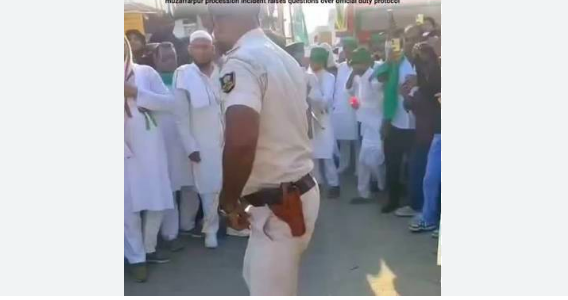

A Muslim police officer in Bihar, India, is facing disciplinary action for participating in a Muharram procession while in uniform. This incident has sparked a renewed conversation about the perceived selective enforcement of police conduct rules in India, particularly in light of contrasting treatment of Hindu officers participating in religious events.
Incident Details
Sub-Inspector Mustakim Khan, stationed at Kanti police station in Muzaffarpur district, became the center of controversy after a video of him participating in a Muharram procession circulated on social media. Following this, Muzaffarpur Senior Superintendent of Police Kantesh Kumar Mishra confirmed that Khan had been issued a show-cause notice and would be temporarily transferred to the police lines as a part of the administrative process typical during ongoing departmental inquiries. This action has been interpreted by many as a reflection of systemic discrimination in the application of police conduct regulations.
Previous Similar Cases
The disciplinary measures against Mustakim Khan have drawn attention largely due to the contrasting treatment of Hindu officers. For instance, in January 2025, Circle Officer Anuj Chaudhary was filmed participating in a Hindu religious procession while in uniform, an act that similarly raised questions about adherence to police conduct rules. Despite calls for disciplinary action from critics, including former Indian Police Service officer Amitabh Thakur, no punitive measures were documented against Chaudhary. This disparity has prompted concerns about that actions taken by police authorities may be influenced by communal affiliations.
Perceptions of Bias in Enforcement
The disparity in enforcement of police conduct rules has provoked significant debate about institutional bias. Observers have pointed out that this situation highlights an inconsistency in how religious affiliation may play a role in determining the severity of consequences for similar actions. Such perceived bias can undermine public trust and raises questions about fairness and equality before the law, particularly for minority communities like Muslims in India. The issue extends beyond individual cases, pointing to broader societal trends that affect religious and ethnic minorities in the country.
Why It Matters
This incident illustrates critical questions surrounding the equitable enforcement of laws and rules within public institutions. The ongoing selective enforcement can lead to feelings of alienation and marginalization within communities, which may undermine the broader societal fabric. For international observers and analysts, the situation serves as a case study of how law enforcement’s actions can reflect larger political and social dynamics within a nation, particularly concerning religious identities. Consequently, the implications for social cohesion, the rule of law, and the treatment of minorities in pluralistic societies could be significant.
Frequently Asked Questions
What are the police conduct rules being referenced in this case?
The police conduct rules typically stipulate that officers should maintain neutrality and refrain from displaying personal affiliations with any religious or political events while in uniform, ensuring that they carry out their duties without bias.
What was the response from authorities regarding this case?
Authorities issued a show-cause notice to Sub-Inspector Mustakim Khan and ordered a formal inquiry into the incident. His transfer to police lines was seen as a preliminary step while the investigation is underway.
How do these incidents affect the perception of police neutrality in India?
Such incidents can lead to public skepticism regarding the neutrality of law enforcement. If similar infractions result in different consequences based on the religious identity of the officer, it could erode trust among the communities they serve.
What are the broader implications of these disparities for minority communities in India?
The perceived bias in enforcing conduct rules can exacerbate feelings of marginalization and exclusion among minority communities, potentially influencing their engagement with law enforcement and reinforcing divides in an already polarized societal landscape.