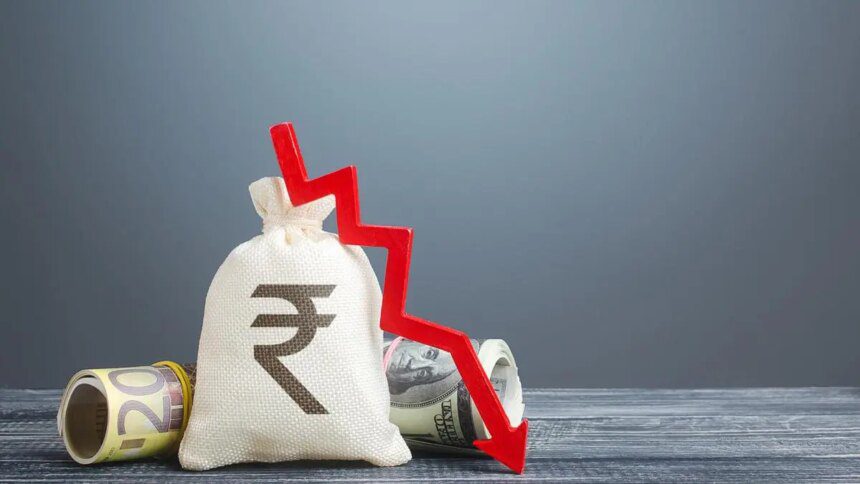

The Indian rupee on Friday crossed the 96 mark against the US dollar for the first time, primarily influenced by US President Donald Trump’s recent social media statement regarding the continuation of conflicts in West Asia, which contributed to rising crude oil prices. The ongoing sell-off by foreign portfolio investors (FPIs) in domestic equity markets further pressured the rupee.
Nevertheless, the Indian currency managed to close just below the 96 mark due to intervention by the Reserve Bank of India (RBI), which facilitated dollar sales through State-owned banks. On an intraday basis, the rupee recorded a low of 96.14 and 95.9650, reflecting a decrease of about 20 paise from the previous close of 95.7625. Throughout the week, the rupee experienced all-time closing lows in every trading session, ending about 1.57 percent weaker, or down roughly 149 paise compared to last Friday’s close of 94.48.
Analysis of the Decline
The surge in crude oil prices, with Brent crude trading around $108 per barrel, significantly affects the rupee. India imports nearly 90 percent of its crude oil, and any spike in prices leads to increased dollar outflows, thereby depreciating the rupee.
As US assets gain appeal as a safe haven amid the turmoil in West Asia, FPIs are liquidating their holdings in emerging markets, including India. This trend has escalated the demand for dollars, applying additional pressure on local currencies.
Abhishek Goenka, Founder of IFA Global, remarked, “It’s a one-sided market. Exporters are hesitant to hedge. Market participants appear to be divided into two camps: those who are long on dollar/rupee and those who are anticipating RBI measures or a sudden market reversal and are remaining on the sidelines. Timing such a reversal is challenging, and few are considering shorting dollar/rupee at this moment.”
Goenka added, “This sentiment is evident in the price action. There is persistent pressure on the rupee, and the only factor supporting it is RBI supply. If they withdraw, the dollar/rupee rate is likely to soar.”
According to a note from Ambit Capital, the current depreciation of the rupee, which stands at 12 percent year-on-year, diminishes the yield differential of 255 basis points between India’s 10-year government security yield and the US 10-year Treasury yield. This situation makes fixed income arbitrage opportunities less attractive between India and developed markets when factoring in currency risk.
Published on May 15, 2026.