
Protests Erupt Over Waqf Board Composition in Manipur
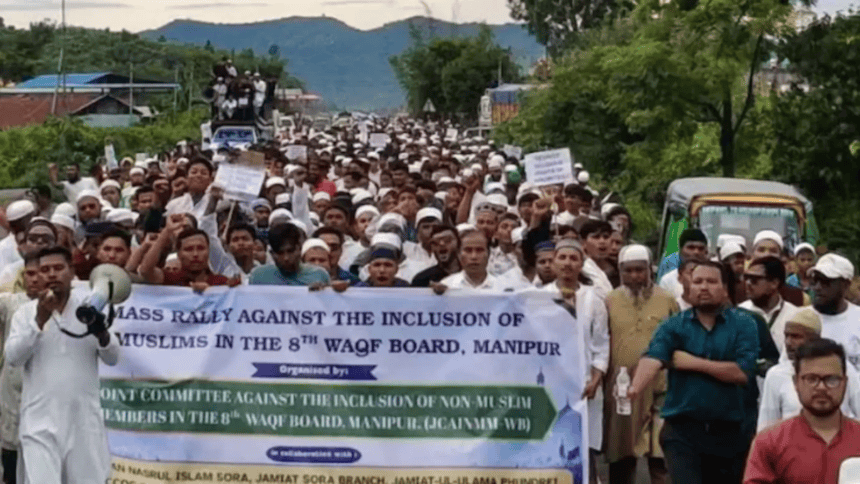
In recent days, protests have surged across Manipur in response to the controversial inclusion of two non-Muslim members in the newly constituted 8th Manipur Waqf Board Committee. Rallies have taken place in Sora, Lilong, and Kshetrigao, with community leaders demanding the revocation of this decision amidst growing concerns about the representation of the Muslim community in religious affairs.
Community Mobilization and Government Response
The protests, spearheaded by the Joint Committee Against the Inclusion of Non-Muslim Members in the 8th Waqf Board (JCAINMM-WB), have gathered strong support from various Muslim organizations, local clubs, and civil society groups. The largest demonstrations were held in Sora on August 20 and continued across the state. Enthusiastic crowds raised slogans and carried placards, clearly expressing their discontent over the Waqf Board’s new membership structure.
In a response to the unrest, Chief Minister Yumnam Khemchand Singh convened a meeting with representatives from the Meitei Pangal community, assuring them that their concerns would be handled as a priority. The Waqf Board, which manages properties designated for the Muslim community, has emerged as a focal point for discussions about representation and community rights.
The Underlying Tensions and Future Implications
At the forefront of the protests, leaders like Jamiat-ul-Ulama Sora Branch president ML Zulfiqar Alam Sheikh have articulated the significance of the Waqf Board as an institution essential for the welfare and rights of the Muslim community. Sheikh warned of intensified agitation should the government disregard their demands. MV Ataur Rahman, the Joint Committee’s president, further emphasized that the traditional administration of the Waqf system by Muslims must be maintained to protect community interests.
As protests spread to other areas like Lilong and Kshetrigao, they highlighted the discontent over the Waqf Amendment Act, 2025. Lilong United Club (LUC) condemned this legislation as being contrary to secularism, indicating broad dissatisfaction with policies perceived as exclusionary.
Why It Matters
The events in Manipur are indicative of a broader trend of increasing communal tensions and challenges to minority rights in India. The situation exemplifies how legal and institutional frameworks can significantly impact social cohesion, governance, and justice within communities. Musicians, artists, and ordinary citizens are voicing concerns about discrimination through protests, reminding governments and institutions that representation matters. The ongoing agitation reflects a yearning for inclusivity and equitable treatment in governance, aspects that must resonate within a democracy. The handling of the situation by the state government could very well affect not only local dynamics but also influence national discourse on minority rights and communal harmony.
Frequently Asked Questions
What is the Waqf Board, and why is it important for the Muslim community?
The Waqf Board is an institutional framework that manages properties donated by Muslims for religious, educational, and charitable purposes, including mosques and madrasas. Its importance lies in overseeing the welfare and representation of the Muslim community in matters concerning these properties.
What are the primary concerns raised by the protests in Manipur?
The protests are mainly centered around the inclusion of two non-Muslim members in the Waqf Board, which community leaders argue undermines Muslim representation in an institution critical to their interests.
What are the implications of the ongoing protests?
The protests could lead to increased tensions between communities and signal a rising dissatisfaction with how minority rights are treated in India. If unresolved, it may also set a precedent for similar conflicts in other regions.
What actions has the Chief Minister taken in response to the protests?
Chief Minister Yumnam Khemchand Singh has engaged with representatives of the Meitei Pangal community to address their grievances, promising to prioritize their concerns over the Waqf Board’s composition.