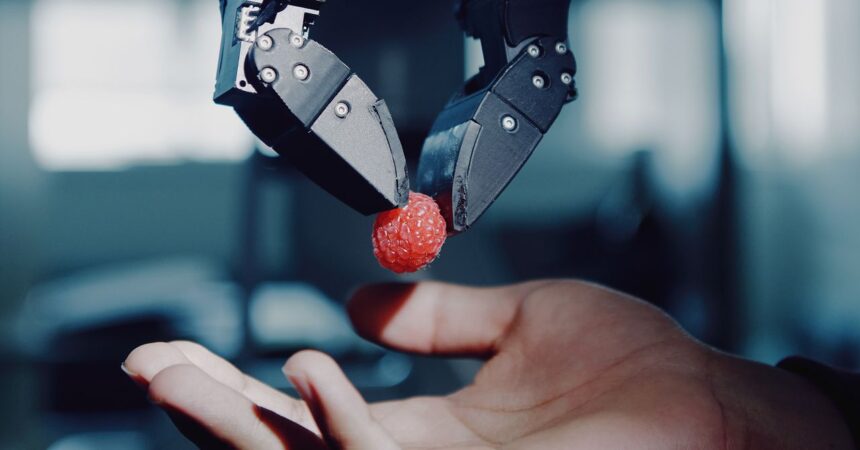

Food handling remains a heavily human-centric area of work, particularly in the processing of fruits, vegetables, meats, and other food items. These tasks require swift yet gentle handling, and the variability among individual food items presents a challenge for automation.
Eka, a robotics company, appears to be on the verge of significant advancements in this field. Observations suggest that their robots exhibit early signs of what could be described as physical intelligence, reminiscent of the initial iterations of OpenAI’s large language model, GPT-1. While GPT-1 often produced incoherent text, it nonetheless demonstrated fundamental linguistic capabilities.
In a demonstration, one of Eka’s robots was filmed reaching for a set of keys in slow motion. The robot exhibited a human-like behavior by first touching its grippers to the table and sliding them along the surface before grasping the keys. Eka’s algorithms appear to enable the robots to instinctively recover from errors, a trait that is particularly difficult for most robots to acquire without extensive human-guided training that incorporates a range of potential mistakes.
Notably, there seems to be an understanding in these robots of the physical attributes they interact with. The sensors appear capable of detecting the weight of their arms, the inertia when moving towards objects, and the weight of items once grasped. This level of sensory awareness presents a potential pathway for achieving human-like dexterity in robotics.
Agrawal, a representative from Eka, indicated that the current methodology could be applied to tasks requiring finer manipulation, such as assembling an iPhone. This could be accomplished by developing specialized actuators and sensors and simulating the tasks.
After a visit to Eka, the author spent time observing food preparation at a nearby restaurant. Although the capabilities of Eka’s machines might reach a level comparable to human workers, the enjoyment of interacting with people in such environments may lead some, including the author, to prefer the presence of human staff, despite advancements in automation.
In conclusion, while experts hold differing opinions on the optimal methodologies for developing robotic dexterity, it is evident that achieving human-like tactile intelligence will be crucial for future advancements in the field.