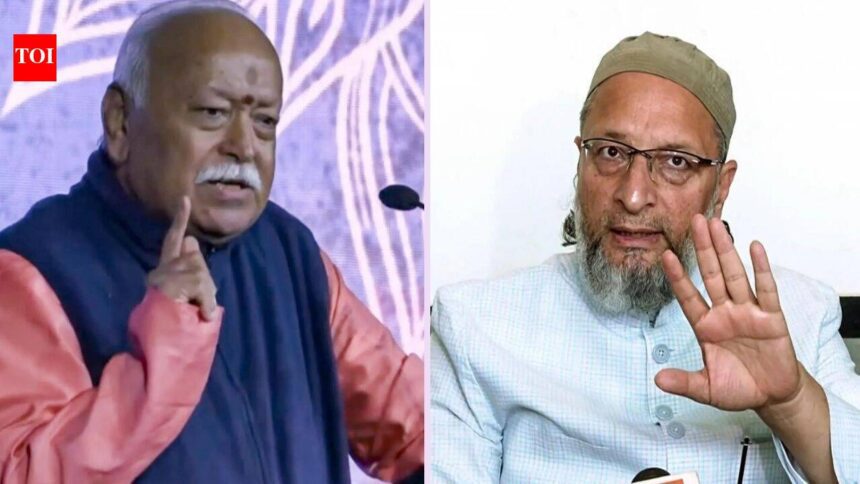

AIMIM president Asaduddin Owaisi has sharply criticized RSS chief Mohan Bhagwat for his remarks on Hindu-Muslim unity, suggesting a disconnect between the RSS’s public statements and its historical writings. Owaisi’s comments highlight ongoing concerns about the treatment and perception of minorities in India, particularly Muslims and Christians, amid rising social tensions and political rhetoric.
Contradictory Narratives from the RSS
During a recent event in New York, Mohan Bhagwat claimed that any Hindu who believes that Muslims should not live in India “will not remain a Hindu.” This statement, however, was met with skepticism by Owaisi, who argued that the RSS often presents a facade of inclusivity while its foundational writings reflect a different stance. According to Owaisi, the RSS has never formally rejected the views of its key thinkers, who have historically expressed exclusionary sentiments.
Historical Context of Exclusion
Owaisi referred to a biography of RSS founder K B Hedgewar, which reveals Hedgewar’s opposition to the Congress party’s focus on Hindu-Muslim unity. Owaisi cited that Hedgewar did not support Gandhi’s efforts towards communal harmony, indicating a long-standing ideological rift. Furthermore, former RSS chief M S Golwalkar’s book “Bunch of Thoughts” contains chapters that describe Muslims and Christians in India as “internal threats,” reinforcing a narrative of marginalization.
Owaisi further argued that the RSS’s participation (or lack thereof) in India’s freedom struggle was indicative of its stance on communal identity, suggesting Hedgewar’s exit from the Congress was rooted in his opposition to a multi-religious anti-colonial struggle.
Present-Day Implications for Minorities
Owaisi’s critique extends to contemporary issues facing Indian Muslims and Christians, such as the enactment of laws perceived as discriminatory. He highlights the Uniform Civil Code, which he claims disproportionately affects Muslims, and contentious anti-conversion laws targeting Christians. Owaisi invoked the 2002 Gujarat riots as a reminder of the violence faced by Muslims under RSS influence, insisting that past aggressions continue to shape present realities for these communities.
The average Muslim and Christian in India today may face social exclusion and economic hardships as a direct consequence of rising sectarian rhetoric, fueled by significant political narratives from the BJP and RSS leadership. This situation raises critical questions about the future of India’s pluralistic society.
Why It Matters
The dynamics between the RSS, BJP, and minority communities are indicative of broader trends in governance and social policy in India. As this relationship evolves, the implications extend beyond mere politics; they could reshape societal fabric and economic opportunities for millions. In international discourse, such issues affect how India is perceived, potentially impacting foreign relations, investment, and tourism. Ethical governance, minority rights, and communal harmony are increasingly becoming focal points in global discussions surrounding democracy.
Frequently Asked Questions
What are the key concerns regarding Muslims and Christians in India today?
Concerns include social discrimination, legal marginalization through laws perceived as anti-minority, and historical violence against these communities, particularly stemming from the political rhetoric of organizations like the RSS and BJP.
How does the RSS view communal harmony?
Despite public claims promoting unity, the RSS’s historical documents suggest a focus on Hindu identity, often at the expense of inclusivity towards Muslims and Christians, revealing a contradictory stance on communal harmony.
What events have historically influenced the relationship between Hindus and Muslims in India?
Events such as the partition of India, communal riots, and the 2002 Gujarat riots have significantly impacted Hindu-Muslim relations, fueling societal divides and shaping modern political narratives.
What is the impact of the BJP’s governance on minority rights?
The BJP’s policies and statements have been associated with increased marginalization of minorities, leading to heightened social tensions and allegations of discrimination in legal practices, further complicating the relationship between communities in India.