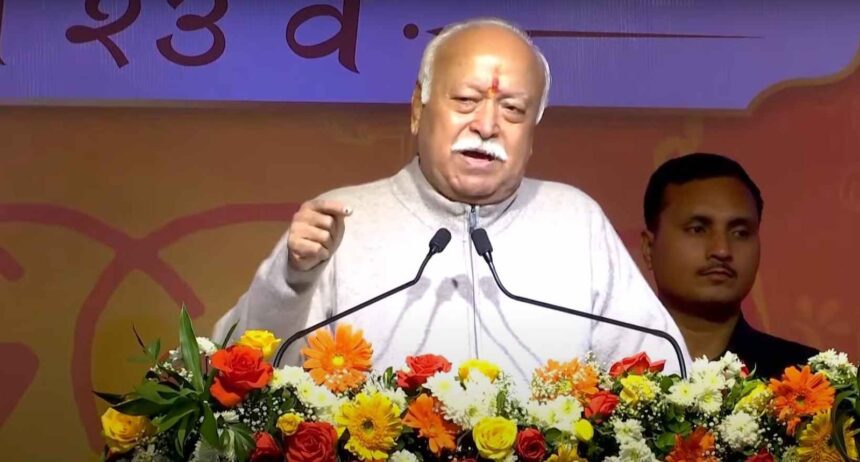

The Opposition in India has sharply criticized RSS chief Mohan Bhagwat for his remarks on religious diversity made during his visit to the United States. Leaders from various parties have challenged Bhagwat to demonstrate the same inclusive posture at home, accusing the RSS and BJP of fostering communal tensions in India.
Bhagwat’s Remarks Generate Controversy
Mohan Bhagwat, head of the Rashtriya Swayamsevak Sangh (RSS), recently stated in the United States that India’s religious diversity is a core part of its identity. He asserted that a Hindu who believes there should not be any Muslims in India does not truly understand Hinduism. This statement was made amidst broader discussions on how India embraces different faiths, and it received praise from the Bharatiya Janata Party (BJP) for exemplifying inclusive Hindu values.
However, these remarks have drawn ire from various Opposition leaders back in India, who argue that Bhagwat’s statements reflect a contradictory approach when compared to the policies and rhetoric prevalent among BJP leaders and organizations domestically. Congress leader Kapil Sibal emphasized the discrepancy, questioning why such tolerance isn’t openly expressed within India, where communal tensions have reportedly escalated.
Opposition Leaders Demand Consistency
Leaders across the political spectrum have called out Bhagwat, urging him to apply his rhetoric of acceptance in the context of Indian politics. Congress spokesperson Shama Mohamed expressed skepticism about Bhagwat’s intentions, asking why he is reluctant to convey this message locally. Owaisi, from the AIMIM, went a step further, highlighting a historical narrative that the RSS has employed, suggesting that the words spoken internationally are often different from the core ideology followed at home.
There is a growing criticism aimed at the RSS’s historical figures—especially M.S. Golwalkar, V.D. Savarkar, and K.B. Hedgewar—for containing ideologies that pertain to social exclusion and discrimination against certain communities, particularly Muslims and Christians. Owaisi has called for Bhagwat to openly condemn the writings of these ideologues, which he claims promulgate a dangerous definition of nationalism as excluding, rather than embracing diversity.
The Response from the BJP
In stark contrast, the BJP staunchly defended Bhagwat’s statements, with Maharashtra Chief Minister Devendra Fadnavis asserting that tolerance is deeply embedded in Hinduism and foundational to Hindutva. Others within the BJP reiterated that India’s rich diversity is a source of strength and unity rather than division. Smriti Irani, a former Union minister, underscored the concept that diversity enriches India, enhancing a sense of oneness among its people.
Bhagwat delivered these remarks to members of the Indian-American community and interfaith leaders in New York, where he emphasized India’s historical role as a sanctuary for individuals of various faiths. However, the dichotomy between his international statements and the perception of the RSS’s actions in India has led to significant political controversy.
Why It Matters
The ongoing discourse surrounding Bhagwat’s remarks signifies broader implications for societal dynamics in India, especially concerning communal relations. The tension between inclusive rhetoric and the realities faced by minority communities, especially Muslims, raises questions about the effectiveness of such statements in bridging divides. Analyzing the interplay between political narratives and grassroots reality is vital for understanding the evolving social fabric of India, making it critical for both local and global audiences to assess the underlying issues of discrimination and marginalization.
Frequently Asked Questions
What are the main criticisms of the RSS regarding Muslim communities?
Critics argue that the RSS has historically promoted a vision of India that marginalizes Muslims, often depicting them as “internal threats” through the writings of its prominent leaders.
How did Opposition leaders respond to Bhagwat’s remarks?
Opposition leaders called for Bhagwat to apply his inclusive rhetoric within India, questioning the apparent inconsistency between his statements abroad and the communal tensions exacerbated by BJP policies.
What significance do Bhagwat’s remarks have for Hindu-Muslim relations in India?
Bhagwat’s remarks could imply a potential shift in discourse towards greater acceptance; however, Opposition skepticism raises concerns about the translation of such rhetoric into actionable policies that support minority communities.
How does the BJP defend Bhagwat’s statements?
The BJP maintains that Bhagwat’s comments reflect a long-standing tradition of tolerance and inclusivity within Hinduism, emphasizing that such values are crucial to India’s identity.