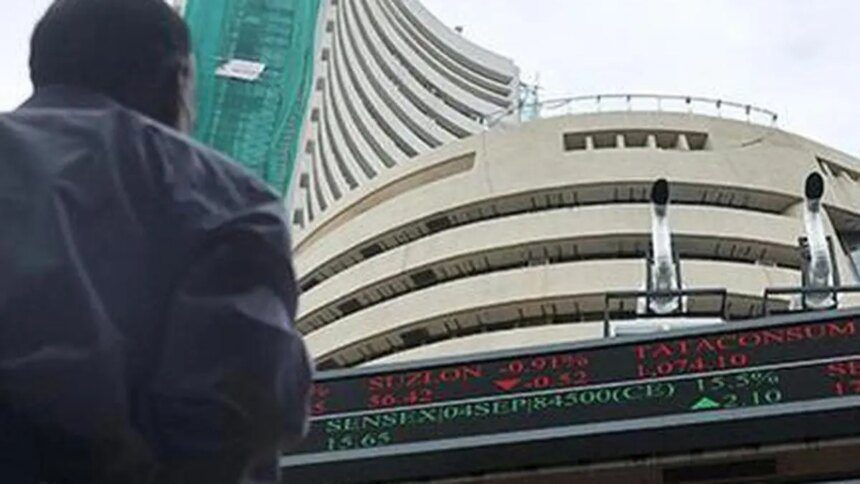

Markets concluded the week on a negative note on Friday, as renewed military tensions between U.S. and Iranian forces in the Strait of Hormuz unsettled investor confidence, largely undermining the optimism built over the week regarding a potential peace agreement.
“The decline was predominantly attributed to a fresh surge in crude oil prices, with Brent crude bouncing back above the $100-mark amid renewed hostilities between the U.S. and Iran, which quelled hopes for a near-term peace deal,” stated Ajit Mishra, Senior Vice President of Research at Religare Broking. He advised participants to adopt a stock-specific strategy, focusing on sectors such as pharma, energy, auto, and select metal counters.
The Nifty 50 index closed at 24,176.15, down 0.62 percent, having traded within a narrow range of 24,127–24,254 throughout the session. The Sensex finished at 77,328.19, declining by 0.66 percent. Iran’s allegation of a U.S. ceasefire violation initially exacerbated the sell-off, although Donald Trump’s subsequent statements affirming the ceasefire and Iran’s indication of a return to normalcy mitigated further declines.
Brent crude, which had temporarily surged above $100 a barrel amidst the escalation, retreated to trade below $95, while domestic crude futures fell below ₹9,000, reversing gains from the previous session. The rupee depreciated to around 94.47 against the dollar, dropping approximately 0.23 percent as demand for dollars increased due to geopolitical uncertainty. Meanwhile, gold prices rose by ₹500 to ₹1,52,800, with traders closely monitoring U.S. non-farm payrolls data later in the day for insights into dollar direction and Federal Reserve policy.
Sector performance varied, with banking and financial stocks severely impacted, as Nifty PSU Bank and Nifty Financial Services ranked among the top losers. Realty and Oil & Gas sectors also ended lower. In contrast, IT and Fast-Moving Consumer Goods (FMCG) sectors saw modest gains, with Nifty IT emerging as the top sectoral performer. Notable gainers included Titan and Apollo Hospitals, while State Bank of India and Coal India closed lower. SBI reported a Q4 FY26 net profit of ₹19,683.7 crore, up 5.6 percent year-on-year and slightly above estimates, but market reactions were muted due to softer-than-expected core income growth and margin challenges.
In a divergence within broader markets, the Nifty Midcap index reached a new all-time high, closing at 61,911, down just 0.15 percent, while the Smallcap index extended its gains for a fourth consecutive session, also reaching a new high—both benchmarks significantly outperforming the main indexes. However, market breadth remained negative, with 286 of the Nifty 500 stocks closing lower.
Weekly performance saw the Nifty gaining 0.74 percent, while the Sensex added 410 points, led by sectoral gains in Capital Markets, Auto, and Defence. Shrikant Chouhan, Head of Equity Research at Kotak Securities, noted that midcap and smallcap indices drew attention this week, attributing the shift to easing geopolitical tensions earlier in the week prompting a rotation into high-beta stocks.
Foreign institutional investor (FII) outflows moderated during the session, with domestic institutional buying providing some resistance against steeper declines.
Looking ahead, market dynamics will heavily depend on the Gulf situation. The response from Iran to the U.S. peace proposal and developments in the Strait of Hormuz will likely set the tone for markets next week. Dr. Joseph Thomas of Emkay Wealth Management commented, “…a resolution may be reached soon, and the markets could gradually pick up strength,” while cautioning that geopolitical volatility could persist. Key technical levels to monitor include Nifty support at 24,000–24,100 and resistance at 24,400–24,500, with the Sensex levels at 76,500 on the downside and 77,800–78,000 on the upside.
Published on May 8, 2026.